The custom of asking for and giving good words is a cultural practice surrounding people’s beliefs and philosophy, as well as their aspiration for the good. It is also evidence of Vietnamese people’s studious tradition and their high esteem of knowledge.
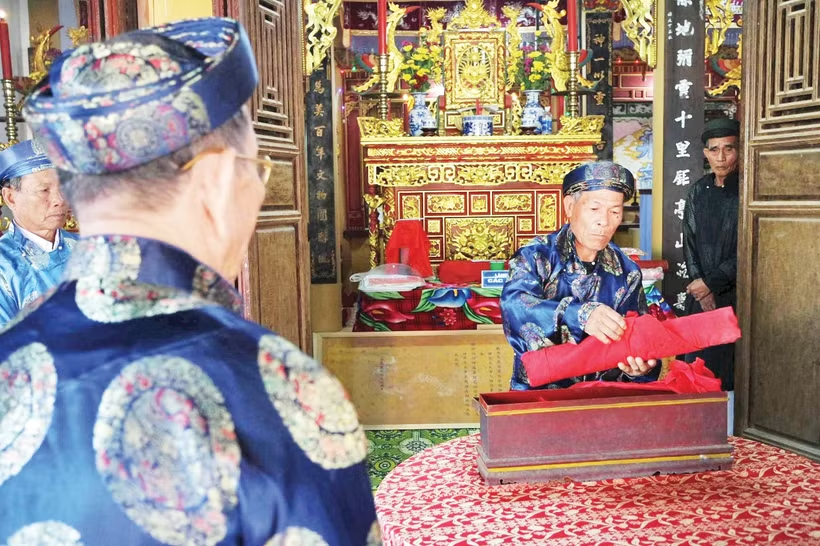
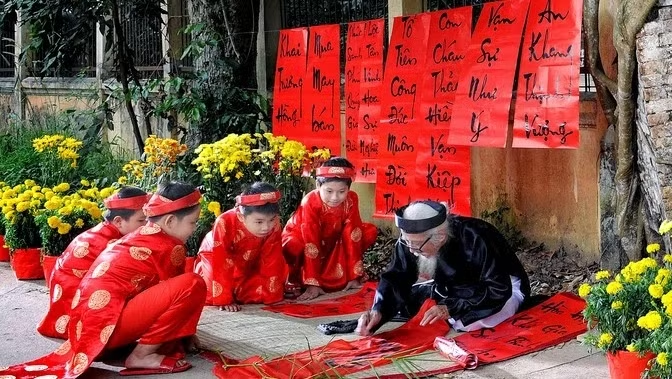
A word or a parallel sentence is a spiritual present from a Confucian scholar and conveys New Year wishes to recipients.
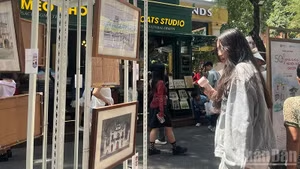
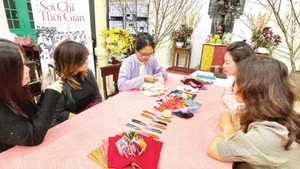
For quite a while, Vietnamese calligraphy fell into oblivion. Since being revived, the art and the custom of asking for words have seen some changes. Penmanship is now not only done with brushes, crimson-red paper and Chinese ink but also other materials such as wood, stone, bamboo and silk. Confucian scholars now include not only old men in traditional long dress and headgear but also youngsters and women.
After writing the letter 福 (happiness) for two youngsters, calligrapher Nguyen Manh Hung from Huong Nam Calligraphy Club revealed that each word written in calligraphy has a profound meaning. Calligraphers acquire the beauty and meaning of each word with a sophisticated understanding.
Calligrapher Nam Phong Vu Ngoc Ky was writing the word 安, which means ‘peace’. He carefully explained the character’s etymology: a woman (女) under a roof (宀), which suggests that if there is a woman in the house, it will be safe and sound. His explanation helped the recipient understand the etymology and philosophy.
The recipients’ ask for words often based on their age and social background. The old tend to like 德 (virtue or integrity) and 心 (heart) while young people prefer 愛 (love) and 達 (achieve). Parents often ask for the words 智 (wisdom) or 明 (bright) for their children while 壽 (longevity) is a popular character presented to parents.
In the old days, calligraphers used to write Chinese script, but today they also write in Vietnamese script, which is more familiar and legible for the recipients.
However, not all good penmen can be calligraphers. The calligraphers must thoroughly understand the words they write as well as the receivers who ask for them. The words are advice and teachings for receivers to improve themselves rather than to run behind materialistic things.
No matter if you ask for ‘happiness’, ‘wisdom’ or ‘prestige’, they will be useless if you whole-heartedly exert every effort to achieve the goals.