Preserving the soul of ancient communal houses
Da Le Thuong communal house, located in Thanh Thuy ward, is hidden behind rows of ancient trees, with moss covering its tiled roof, creating a tranquil space seemingly detached from the bustling streets outside. In the main hall, Nguyen Van Dieu, a caretaker and guardian of the communal house, is carefully wiping each item as to preserve the communal house is to preserve the village’s memory of who it is.”
During the time he was assigned to look after the communal house, Mr Dieu has never left his post for long. During the flood season, he is always the first to arrive to inspect the building and raise valuable objects to higher ground. “Sometimes the water rises quickly, and I have to stay awake all night. My own house may be damaged, but the communal house must not be,” he shared.
According to Nguyen Viet Tri, head of the Da Le Thuong village council, the role of the caretaker is not merely that of a guardian, but also a “keeper of collective memory”. “Mr Dieu, together with the village elders -members of the clan council -are those who tell stories to younger generations about the founding ancestors, the succeeding generations, and the formation of the community during village rituals. The memory of the village is preserved in royal decrees, in each page of clan genealogies and within the communal house itself. Genealogies are not only for recording names, but also help descendants understand where they come from and what they have gone through,” said Tri.
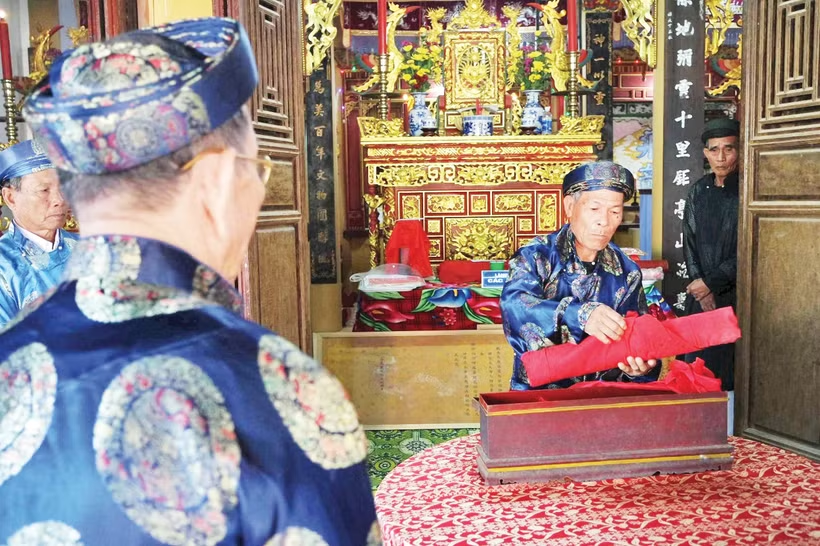
Leaving Da Le, we travelled to Phu Bai village, known for its tradition of learning and long-standing family lineages, established around 1558 during the Trinh–Nguyen division period. The village currently preserves seven royal decrees from various dynasties and more than 20,000 pages of valuable documents (already digitised), including land registers and population records from the Tay Son and Gia Long periods, along with numerous customs, practices, beliefs and traditional festivals. The communal house lies by the gentle Phu Bai River, with an open and peaceful space resembling a traditional ink painting.
Ngo Phuoc Toan, the village ritual custodian, guided us through each section of the communal house. He stopped at the place where the royal decrees are kept in glass cases. “We only open them during major ceremonies. It is not merely to preserve them, but to let people know that our village has a long history,” he explained. According to him, preserving communal houses today faces many challenges: harsh weather conditions, material deterioration and the indifference of a portion of the younger generation. Nevertheless, he also noted positive changes, with many restoration programmes and government support helping improve preservation efforts.
Modern life is gradually changing how people connect with communal houses. Traditional community activities are becoming less frequent. Many young people grow up, leave the village for study or work, and have fewer opportunities to return. Toan confided: “Young people today are very busy. Sometimes we do not see them at the communal house for an entire year. It is not that they are unaware of it, but the connection has weakened. However, when they hear stories about history and royal decrees granted by kings, their expressions begin to change. Once they understand, they feel differently. And for them to understand, there must be storytellers.”
According to Vo Thi Minh Thao, an official in charge of culture and social affairs in Phu Bai ward, preservation efforts in the area are not only driven by individuals. Local authorities have implemented programmes to restore communal houses, providing funding for repairs and reinforcing deteriorating structures. “We identify communal houses as an important part of cultural life. However, for preservation to be effective, it requires the participation of the community. The greatest challenge today lies not in funding, but in changing awareness,” she said.
Preserving heritage in contemporary life
Hien Luong communal house (Phong Thai ward), home to a traditional blacksmithing craft of more than 500 years, serves both as a place of worship and the spiritual centre of the entire craft village. The rhythmic clanging of hammers from the forges blends with the sound of the communal house bell during festivals. Hoang Dau, the caretaker, said: “Wherever people from Hien Luong go, they remember the communal house, because it is where the craft ancestors and forebears are honoured.” He showed us royal decrees recognising the contributions of the founding ancestors who established the village and passed down the craft. In Hien Luong, the communal house is inseparable from daily life. It lives with the hammer strikes, with sweat, and with the rhythm of the people’s lives. “The craft may change with the times, but the communal house must never be lost,” he affirmed.
Pho Trach village (Phong Dinh ward) is one of the ancient riverside villages along the O Lau River, where the communal house still retains many original features. Meeting us in the courtyard, Le Hua, head of the village council, now over 80 years old, still visits the communal house every day. He does not keep royal decrees or genealogies, but preserves something else: living memory. He shared: “I am not a caretaker, but I treat the communal house as my own home. When I was young, I listened to my grandfather tell stories about the founding of the village. Now I tell them to the younger generation. Documents are not essential, as long as there are people who remember. Many young people now prefer their phones. But when we show them royal decrees and tell stories of the past, about the village’s achievements, they begin to feel curious...”
Tran Dai Vinh, a researcher of Hue culture, noted that the system of communal houses in Hue is an important part of the traditional cultural structure, clearly reflecting the formation of villages, beliefs and community organisation. “Communal houses are not merely architectural works, but comprehensive cultural spaces, where memory, rituals and identity are preserved,” he said.
Hue is not only a former imperial capital with famous royal monuments, but also a place that preserves hundreds of ancient villages with communal houses, shrines and genealogies - “cells” that form the cultural identity of Viet Nam.
According to Doan Quyet Thang, Head of the Culture and Social Affairs Division of Phong Dinh ward, in recent years many communal houses have been inventoried, documented and gradually restored, while the digitisation of royal decrees and ancient documents has also been implemented. Community participation remains the decisive factor. Without the people, heritage would lose its living meaning. Therefore, recognising and honouring individuals such as caretakers and genealogy keepers has become increasingly important. They are regarded as “custodians of preservation”, ensuring that heritage is not broken or lost.