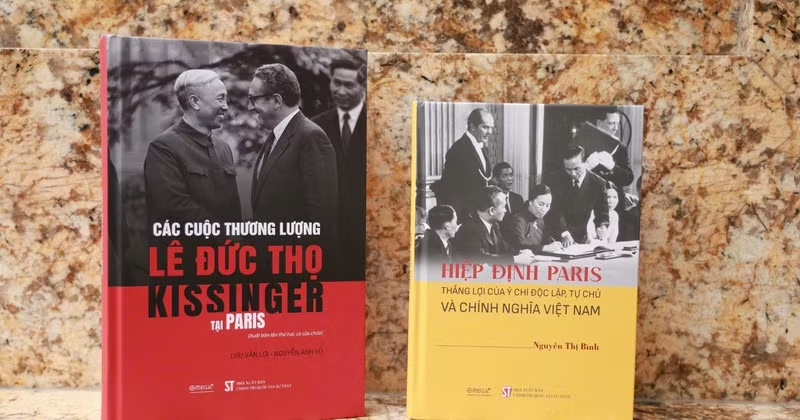
Honouring this legacy, the Su That National Political Publishing House introduced a pair of publications: “The Paris Agreement – A Triumph of Viet Nam’s Independence, Self-Reliance and Justice” by former Vice President Nguyen Thi Binh, and “The Negotiations between Le Duc Tho and Kissinger in Paris” by Luu Van Loi and Nguyen Anh Vu.
The combination of vivid personal recollections and systematically documented sources has fully reconstructed the resilience and fortitude of Viet Nam at the historic negotiating table.
The Paris Peace Accords on ending the war and restoring peace in Viet Nam, signed on January 27, 1973 in France, marked the victorious outcome of a special “front”—a battlefield of intellect and strategy—where intense negotiations reflected the broader dynamics of the resistance war against the US.
The success of the Paris Accords embodied the combined strength of Viet Nam under the leadership of the Communist Party of Viet Nam, demonstrating the close coordination between military, political and diplomatic efforts, while affirming the power of justice on the international stage. Beyond reshaping the course of the war, the agreement opened a strategic turning point, laying a crucial foundation for the path towards peace and national reunification.
In that context, Nguyen Thi Binh, head of the delegation of the National Front for the Liberation of South Viet Nam and then the Provisional Revolutionary Government of the Republic of South Viet Nam, was not only a direct participant but also one of the most prominent figures in Vietnamese diplomacy at the Paris Conference. Her book is therefore not merely a scholarly work, but also a collection of vivid, emotionally rich memoirs that bring readers back to the dynamic and challenging atmosphere of the negotiating table.
From key developments in the negotiation process to everyday details, from the tense atmosphere of formal sessions to informal side meetings, all are vividly reconstructed through the firsthand experiences of an insider.
The image of diplomat Nguyen Thi Binh is portrayed in the book with a calm and confident demeanour, marked by a flexible yet steadfast approach. The impressions she left on the press and international counterparts—from the clarity and precision of her statements to her tactful and skilful engagement in dialogue—not only reflect her personal calibre, but also vividly embody the art of Vietnamese diplomacy.
In addition to reconstructing the course of the Paris Conference, the book vividly portrays leading Vietnamese statesmen and diplomats. From President Ho Chi Minh, who laid the foundation for revolutionary diplomacy, to figures such as Nguyen Duy Trinh, Le Duc Tho, Nguyen Huu Tho and Xuan Thuy, each is depicted with distinct qualities in thought, style and character.
These accounts go beyond personal memoir, helping to illuminate the key factors behind the success of Vietnamese diplomacy in Paris. They highlight the convergence of strategic vision, political resolve and collective intellect which were considered the decisive elements at pivotal moments in history.
Notably, the book highlights the spirit of “fighting while negotiating”—a consistent strategy throughout the resistance. The Paris negotiating table was not separate from the battlefield; rather, it was closely intertwined with developments on the ground, shaping both the position and strength of Viet Nam during the negotiations.
The Paris Conference took place from May 13, 1968 to January 27, 1973, comprising 202 public sessions, 45 high-level private meetings between Special Adviser Le Duc Tho and US National Security Adviser Henry Kissinger, 500 press conferences and around 1,000 interviews.
The private meetings between Le Duc Tho and Kissinger were particularly distinctive and of crucial importance. These behind-the-scenes exchanges are recounted in detail by veteran diplomats Luu Van Loi and Nguyen Anh Vu in the revised second edition of “The Negotiations between Le Duc Tho and Kissinger in Paris.”
Through detailed records, rich documentation and compelling firsthand accounts, a vivid and comprehensive picture of the Paris Conference is brought to life. With his forthright and resolute character, Le Duc Tho earned the respect of even Kissinger, who acknowledged that although he had not been formally trained in diplomacy, he was a seasoned negotiator, unwavering and persistent in pursuing his objectives.
The prolonged and intense negotiations—marked by a battle of wits—between Special Adviser Le Duc Tho and US National Security Adviser Henry Kissinger are recounted in chronological order throughout the Paris Conference. This narrative highlights the strategies and intentions of the US, while clearly elucidating Viet Nam’s views, strategies, flexibility and steadfastness in negotiation.
More than half a century has passed, yet the significance and diplomatic lessons of the Paris Conference remain as relevant as ever. They enable today’s readers to gain a deeper understanding of the past, while serving as a source of inspiration that nurtures national pride and strengthens the resolve of present generations on the path of integration and development.