The interview was granted on the occasion of the 81st anniversary of the founding of the Viet Nam People’s Army (December 22, 1944 – 2025)
Q: The Resolution of the 13th National Party Congress set out the requirement and task of “building the People’s Army to be revolutionary, regular, elite, and gradually modern, with some services, arms, and forces advancing straight to modernity. By 2025, basically building a lean, streamlined, and strong army, creating a solid foundation to strive to build a revolutionary, regular, elite, and modern People’s Army by 2030.” To date, how have we implemented this requirement, and what outstanding results have been achieved?
A: In the past term, the implementation of the requirement and task of building a revolutionary, regular, elite, and gradually modern People’s Army, with some services, arms, and forces advancing straight to modernity, has achieved many results of great significance. These outcomes have created a solid foundation for the Central Military Commission to set the goal of building a “revolutionary, regular, elite, and modern” army one term earlier than stipulated in the Resolution of the 13th National Party Congress and the Resolution of the 11th Military Party Congress.
The People’s Army has always been an absolutely loyal and reliable political force of the Party, the State, and the people; it has remained steadfast in the Party’s goals and ideals, preserved and strengthened its working-class nature and profound people’s and national character; and has placed absolute trust in the Party’s leadership, especially in the strategic and breakthrough decisions of the Party and the State.
The Army has excellently fulfilled the core objective of building a “lean, streamlined, strong” force in line with Resolution No. 05-NQ/TW (dated January 17, 2022) of the 13th Politburo on the organisation of the Viet Nam People’s Army for the 2021–2030 period and subsequent years. This has met task requirements in the new situation, been aligned with the two-tier local government system, and been consistent with the Party’s viewpoints and line on all-people national defence and people’s war. By September 2025, the entire Army had reorganised and adjusted the structure and staffing of more than 4,000 organisations, ensuring synchronisation and rationality among components and forces, avoiding overlap in functions and tasks, and reducing intermediate levels and service units.
Training, education, and training activities have undergone significant renewal, including new training contents on techniques and tactics closely aligned with practical tasks, operational targets, and the development of new forms of warfare. Emphasis has been placed on training to master new and modern weapons and equipment, while closely combining military training with political education and the strengthening of combat spirit, willpower, and adaptability in modern warfare and in task performance under all conditions. The Army has focused on enabling some services, arms, and forces to advance straight to modernity, while accelerating research and development of the defence industry towards autonomy, self-reliance, self-strengthening, dual-use, and modernisation, producing products of a breakthrough nature.
The quality of building a regular People’s Army has seen comprehensive, even, and solid improvements in all aspects, with close integration between regularity in personnel and the standard military style of a revolutionary army and the noble qualities of “Uncle Ho’s Soldiers”, and regularity in infrastructure and equipment with a unified, orderly, bright, green, clean, and beautiful barracks system associated with building a healthy military cultural environment.
Q: What significance do the results from building an elite army during the 11th Military Party Congress term hold for enhancing the overall quality, level, strength, and combat readiness of the Army, thereby ensuring the successful fulfilment of tasks in all situations?
A: The notable results include the fact that our Army has consistently demonstrated political acuity and sensitivity, proactively grasping, forecasting, and accurately assessing situations, maintaining strategic initiative and avoiding passivity or surprise. It possesses strong technical and tactical proficiency, masters and effectively utilises new and modern weapons and equipment, and has streamlined its organisational structure while progressively modernising equipment, enhancing mobility, and aligning with budgetary capacity and the roadmap for army modernisation.
We have promptly studied wars and military conflicts around the world with the aim to supplement and develop military art and command methods, closely combining tradition with modernity, and proactively responding effectively to both traditional and non-traditional security challenges in the new situation.
Q: Advancing to modernity is an inevitable trend and an urgent requirement for the Viet Nam People’s Army. Looking back at this process to date, what outstanding results have been achieved?
A: Building a modern People’s Army has been a major policy identified early on by the Party, the State, and the Army, dating back to the early years of the resistance war against the US for national salvation. Especially in the context of the strong development of the Fourth Industrial Revolution, particularly in the military field, army modernisation is not only an inevitable trend but also an urgent requirement.
The Central Military Commission and the Ministry of National Defence have focused on leading and directing strong renewal of scientific and technological mechanisms and environments, linking research with the application of research outcomes to create breakthrough products; gradually mastering advanced and modern technologies; concentrating resources on key projects to build and modernise manufacturing lines and technologies for the production, repair and upgrading of weapons and technical equipment; creating breakthroughs in military science and technology with high dual-use value; researching and producing improved land warfare weapons; and prioritising the modernisation of the navy, air defence–air force, communications, electronic warfare, armour, technical reconnaissance, and coast guard forces.
Following the timely issuance of a set of criteria for building a modern People’s Army in the new situation, the Army has concentrated on investing in and improving the quality of training, education and training closely aligned with reality, building smart military schools towards standardisation, modernisation, and interconnectivity, thereby contributing to the training and development of human resources and officers and soldiers with strong qualifications, knowledge, and capabilities.
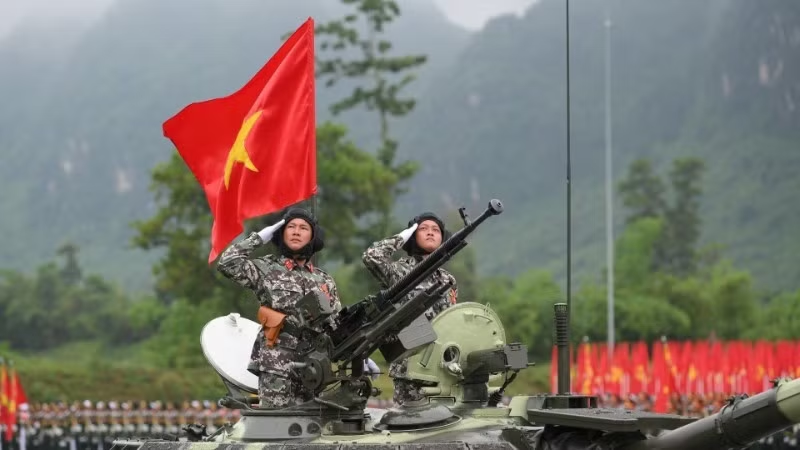
To date, modern forces equipped with advanced weapons and equipment have been built. Notably, the navy and coast guard have been equipped with classes of submarines, missile frigates, fast attack missile craft, gunboats, patrol vessels, advanced rescue vessels, coastal missile systems, and modern patrol, reconnaissance and combat aircraft. The air defence–air force has procured, researched, developed, and modernised multi-role combat aircraft, surface-to-air missile systems, and new-generation radar systems, while enhancing national airspace management capacity. Communications and electronic warfare forces have been built and equipped with modern, high-technology equipment capable of reconnaissance and suppression across frequency bands of adversary weapons and equipment and have established systems serving operational command to meet task requirements in all situations. The infantry has also been gradually modernised with advanced infantry weapons, modern tanks, armoured vehicles, and self-propelled artillery, initially meeting combat requirements under conditions where the enemy employs high-technology weapons.
Q: Could you please provide further information on the solutions for carrying out the task of building a revolutionary, regular, elite, and modern People’s Army in the 2025–2030 period?
A: Thoroughly grasping the Party’s line and viewpoints on military affairs, national defence and safeguarding the Fatherland in the new situation; the strategic decisions on national development; and the Party General Secretary’s guidance on “two steadfast principles, two accelerations, and two preventions”; firmly maintaining and strengthening the Party’s absolute and comprehensive leadership and the State’s centralised and unified management and administration over the Army and the defence cause, the Central Military Commission has set out nine key objectives with three breakthroughs: (1) comprehensively improving the military and defence institutional framework; effectively mobilising resources to build a revolutionary, regular, elite, and modern army; (2) focusing on developing high-quality human resources; accelerating the attraction and utilisation of talent; building a contingent of cadres capable of meeting the requirements of a modern army; improving regularity and discipline management; and promoting the cultural values of “Uncle Ho’s Soldiers” in the new era; and (3) accelerating the development of science and technology, innovation and digital transformation; and developing an autonomous, self-reliant, self-strengthening, dual-use and modern defence industry.
Key solutions identified and implemented in a coordinated manner include proactively researching, grasping, assessing, and forecasting situations; advising on strategic responses; handling military and defence situations promptly, flexibly, and effectively; preventing passivity and surprise; firmly safeguarding national independence, sovereignty, unity, and territorial integrity. Efforts will continue to advise on guidelines and strategies, improve institutions, mechanisms and policies on military and defence, and build a revolutionary, regular, elite, and modern army. The Army will continue to play its core role in building an all-people national defence and a strong posture of people’s security. It will remain steadfast in building a politically strong and elite force as the foundation for enhancing the overall quality and combat power of the entire Army. Strongly fostering patriotism, autonomy, confidence, self-reliance, self-strengthening, national pride, and the heroic traditions of the Army will ensure that traditional cultural values become an endogenous resource and driving force for building a revolutionary, regular, elite, and modern army. Leadership will focus on fulfilling combat readiness tasks, organising a lean, streamlined, strong force; improving the quality of education and training; making breakthroughs in regularity building and discipline management; and accelerating defence industry development and military science.
With more than 80 years of tradition in building, fighting, and growing, officers and soldiers across the Army will continue to uphold unity and solidarity, seize opportunities, overcome challenges, and strive to comprehensively fulfil all objectives and tasks of the 2025–2030 term. They will build a revolutionary, regular, elite, and modern Viet Nam People’s Army, resolutely and persistently safeguarding the Socialist Republic of Viet Nam, while always standing ready to accept and excellently accomplish all assigned tasks, together with the entire Party and people, to successfully implementing the Resolution of the 14th National Party Congress in the nation’s new era of development.