The “key” to elevating the Vietnamese brand
From traditional markets to modern supermarkets, each QR code has become a transparent “digital passport”, allowing customers to track the entire journey of a product. As a result, Vietnamese goods are becoming increasingly safe and confident in conquering major markets, opening new opportunities for a transparent and sustainable digital economy.
Laying the foundation for a digital future
The Politburo’s Resolution No. 57-NQ/TW, dated December 22, 2024, affirmed that science, technology, innovation, and digital transformation are key drivers to improve labour productivity and competitiveness and promote sustainable development in the digital era. Accelerating the application of strategic technologies such as AI, blockchain, big data, cloud computing, and smart traceability is not only an inevitable requirement but also a lever to help Viet Nam make breakthroughs and integrate more deeply into the global digital economy.
Traceability has become a mandatory requirement for goods circulating on the market to ensure quality, prevent trade fraud, and protect consumer rights. In Viet Nam, this field has been strongly promoted since the Prime Minister signed Decision No. 100/QD-TTg on January 19, 2019, approving the on project “Implementation, application and management of the traceability system.”
According to Bui Ba Chinh, Director of the National Barcode Centre under the Ministry of Science and Technology, immediately after Decision No. 100/QD-TTg came into effect, the implementation of goods traceability in localities saw many positive changes. So far, all 34 provinces and cities nationwide after the administrative merger have built plans to implement the project on “Implementation, application and management of the traceability system” in their localities. All localities have identified key product groups or OCOP products as the focus for traceability application, with more than 25,000 enterprises adopting traceability systems.
Le Thi Lan (Nghia Do Ward, Ha Noi) expressed her concern when many products on sale still had vague origin information. After installing a traceability application on her phone, she could view full product data, from manufacturers and packaging times to warehouse in-and-out records and distribution agents nationwide. “Thanks to that, I know where the goods come from, which enterprise produces them, and whether they are genuine, I can even track the entire journey of the product,” Lan said.
In many localities, traceability is becoming a “golden key” helping Vietnamese agricultural products conquer demanding markets.
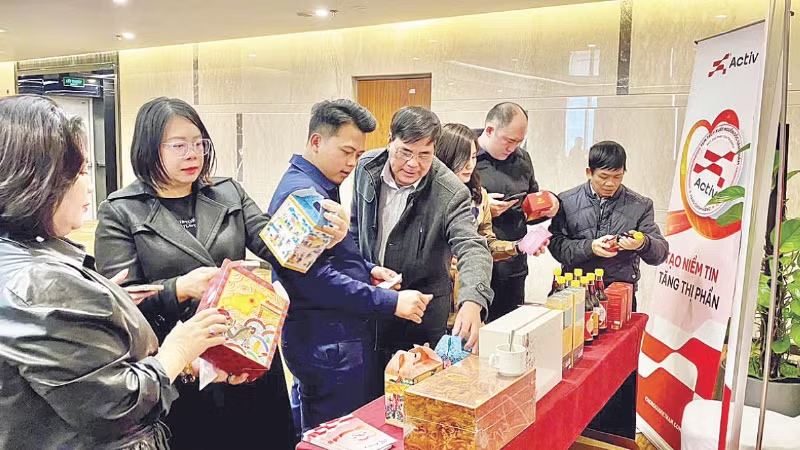
In many localities, traceability is becoming a “golden key” helping Vietnamese agricultural products conquer demanding markets. Recently, 100 ancient shan tuyet tea trees belonging to the raw material area managed by Thuong Son Tea and Herbal Cooperative (Thuong Son Commune, Tuyen Quang Province) have been fitted with RFID electronic chip labels to identify each tree. This is the first step in the journey to digitise tea raw material management, implemented by Viet Nam Anti-Counterfeiting Technology Joint Stock Company (ACTIV) in cooperation with Nui Den Herbal Tea Joint Stock Company through the TrueData solution — a traceability system integrating RFID, AI, and blockchain.
According to Dr. Pham Xuan Phuong, Chairman of the Board of Directors of Nui Den Herbal Tea Joint Stock Company, the project not only helps identify raw materials but also aims to conserve precious shan tuyet tea genetic resources by creating a “digital passport” for each tree, thereby protecting producers’ rights and improving brand value. As a result, Vietnamese tea products gain more opportunities to conquer stringent markets with demanding customers such as Japan, the EU, and the US. In the longer term, this model is expected to become a model for high-tech application in the conservation and development of indigenous resources, contributing to building a sustainable value chain for shan tuyet tea and moving towards the goal of “Digitising heritage – Improving the value of Vietnamese agricultural products.”
To ensure quality and enhance transparency, Phuc Thinh Fish Sauce Production Joint Stock Company (Giao Ninh Commune, Ninh Binh Province) has implemented the attachment of RFID electronic chip labels, issuing a “digital identity” for each bottle of fish sauce. According to Nguyen Anh Tuan, General Director of Phuc Thinh Fish Sauce Production Joint Stock Company, thanks to traceability technology, consumers can view the entire journey of the product from the raw material area to the factory and into the hands of buyers, along with precise time and location data. With this approach, Phuc Thinh Company affirms its commitment to ensuring every drop of fish sauce that reaches consumers is transparent and protected by real data.
Creating momentum for sustainable market management
According to Resolution No. 57-NQ/TW of the Politburo and Decision No. 100/QD-TTg of the government, traceability is identified as one of the important breakthroughs in the national digital transformation process, helping enterprises save quality control costs, prevent trade fraud, and build trust thanks to transparent information.
Senior Colonel Tran Hong Phu, Deputy Head of the Police Department for Administrative Management of Social Order (C06) under the Ministry of Public Security, affirmed that for enterprises, traceability not only helps reduce production costs but also increases openness and transparency, thereby strengthening reputation and product quality. For citizens, it is an important tool to help them choose safer and more effective consumption, ensuring their rights and health in an increasingly diverse and complex market.
For enterprises, traceability not only helps reduce production costs but also increases openness and transparency, thereby strengthening reputation and product quality. For citizens, it is an important tool to help them choose safer and more effective consumption, ensuring their rights and health in an increasingly diverse and complex market.
Senior Colonel Tran Hong Phu
Deputy Head of the Police Department for Administrative Management
of Social Order, Ministry of Public Security.
From the perspective of market management, Kieu Dinh Canh, Deputy Head of the Ha Noi Market Management Sub-Department, said that the application of traceability helps authorities quickly handle food safety incidents when they occur, while effectively preventing violations. For enterprises, this is also an important step in the digital transformation process.
Le Ngoc Dat, Chairman of the Board of Directors and General Director of the Hydrogen Water Purifier Technology Group, shared: “We are preparing to implement traceability to protect our brand while ensuring quality and bringing trustworthy products to consumers. With traceability codes, customers will feel more assured about product origins and the credibility of manufacturers.”
Traceability not only protects domestic consumers but also open opportunities for Vietnamese goods to reach international markets. When each product possesses an “electronic citizen identity”, transparency not only affirms the credibility of Vietnamese brands but also contributes to a sustainable digital future.