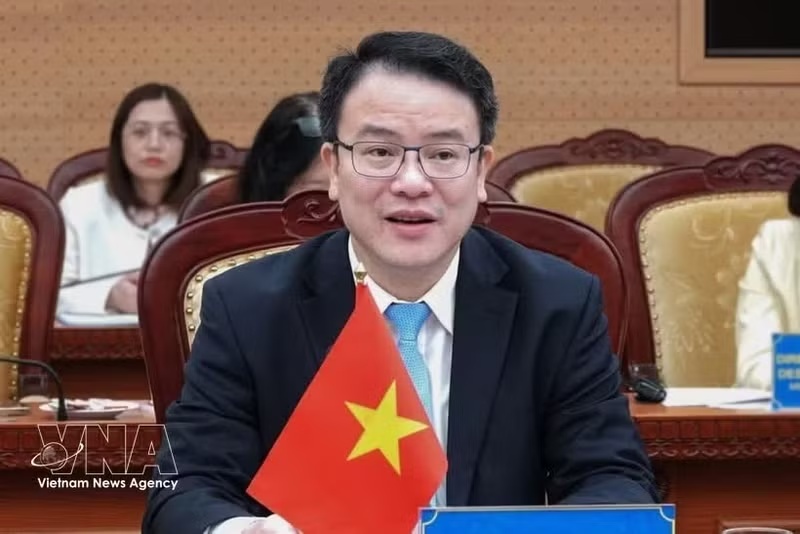
At AFMM 30, ASEAN finance ministers acknowledged progress by working groups on infrastructure finance, insurance cooperation, customs integration, the ASEAN Single Window, cross-sector collaboration, the ASEAN Tax Forum, and the ASEAN Treasury Forum. They praised these achievements as contributing to regional integration and approved the cooperation plan for the next phase.
Viet Nam reaffirmed its development strategy for 2021–2025 and 2026, based on three pillars - institutional reform, infrastructure development, and human resources, with infrastructure as a top priority to drive new growth.
Vietnamese Deputy Minister of Finance Tran Quoc Phuong expressed his support for the working groups’ reports, highlighting efforts to implement the ASEAN Economic Community Blueprint.
To achieve these objectives, Viet Nam is mobilising diverse financial resources. Alongside effective use of the state budget, the country is leveraging domestic capital via financial markets and promoting public–private partnerships (PPP). Diversifying funding not only eases public debt pressures but also enhances the sustainability and efficiency of strategic infrastructure projects.
Viet Nam also highlighted the role of the ASEAN Tax and Customs Forums in improving the business environment. Simplified procedures and the Single Window mechanism reduce costs and processing time for businesses while increasing transparency and competitiveness. The Deputy Minister stressed that removing infrastructure bottlenecks is key to enhancing competitiveness and promoting regional connectivity. Viet Nam pledged continued close coordination with member states to build a strong and prosperous ASEAN financial community.
During discussions with international organisations, ASEAN finance ministers and central bank governors, along with the ASEAN Secretary-General, reviewed the regional macroeconomic outlook with leaders of the Asian Development Bank, World Bank, and IMF. ASEAN growth reached 4.5% in 2025, supported by strong domestic demand, digital investment, export recovery, and FDI exceeding 230 billion USD. Amid geopolitical risks and volatile capital flows, ASEAN leaders emphasised the importance of flexible macroeconomic policies and regional cooperation.
At the AFMGM session, Phuong reaffirmed Viet Nam’s commitment to integrated and sustainable financial markets. Viet Nam is accelerating reforms to adapt to emerging sectors such as digital assets, artificial intelligence, and innovation, while diversifying financial instruments to attract investment.
Viet Nam also plans to harmonise domestic and international resources, using loans from ADB, WB, and other development partners. In 2026, the country will cut compliance costs and administrative procedures by 50%, tighten fiscal discipline, and prioritise investment in development and innovation. The government is committed to collaborating with international organisations and ASEAN countries to ensure energy security, promote green growth, and foster sustainable development.
Within AFMGM 13, ASEAN members approved the 2026–2030 financial sector plan and endorsed the REVIVE restructuring project to enhance operational efficiency from 2027. They also supported priority initiatives proposed by the Philippines, focusing on capital market development, payment connectivity, and financial resilience.
Viet Nam strongly backed sustainable ASEAN capital market development, noting that FTSE Russell’s confirmation of its stock market upgrade path marks a significant milestone in reform and transparency. The official pledged Viet Nam’s continued close coordination with member states to implement joint initiatives effectively.
![[In Pictures] General Secretary and President To Lam and his spouse visit and present books to Royal Library of Belgium](https://en-cdn.nhandan.vn/images/3NY4Z6Du1Md1PrS_s0ZZOrwc5xDfq4rRua69depr-TBkwatGjBcD9lagzrI2BmGDo4nKYA9qjKDjuB3-yYloL_1KbNBr00klMZQFyHQxQ6Jq6GzFfAiY0m5agKw6jNtArN4QnVntX8RQeUmD7pdCq7nwvn3e235v3kufpokBN_s/1-tong-bi-thu-chu-tich-nuoc-va-phu-nhan-tham-tang-sach-cho-thu-vien-hoang-gia-bi.jpg.avif)