Cashew milk – a “new gateway” for Vietnamese cashews into high-value food markets
In recent years, a walk down the “health food” aisles of major US supermarket chains, key influencers of American consumer habits, shows that cashew milk has become a familiar option. Once largely confined to vegan communities or consumers favouring organic products, cashew milk is now competing on equal footing with almond and oat milk.
The growth momentum of this market stems from multiple factors, including declining consumption of cow’s milk, high rates of lactose intolerance, rising demand for healthy diets, and a strong shift towards sustainable and ethical consumption, particularly among younger consumers. What is notable is that behind every carton of cashew milk on US shelves, Viet Nam remains one of the most important links in the raw-material supply chain. For many consecutive years, Vietnam has held a dominant share of the US market for imported raw cashew nuts.
Against this backdrop, the US decision to eliminate import tariffs on cashews from November 14 has been widely seen as a rare “golden window”. Not only does it support an export recovery after a sharp decline in 2024, but it also opens the door for Vietnamese cashews to penetrate deeper into higher-value food segments, where profit margins are far more attractive than those of traditional raw exports.
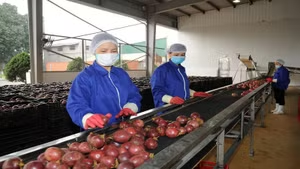
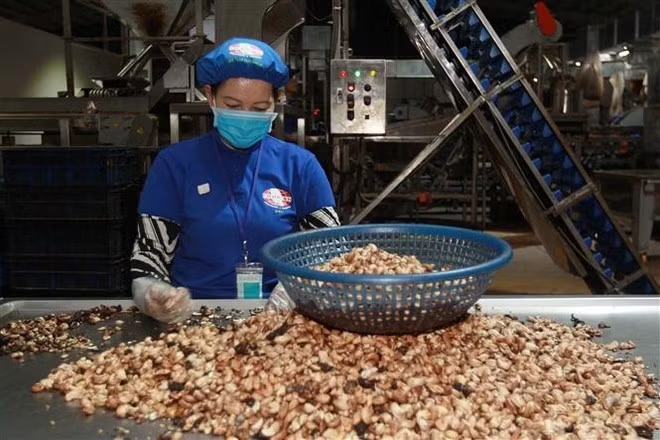
For decades, Viet Nam has been known as a “cashew empire”, commanding an overwhelming global market share. Yet behind this reputation lies a reality in which the raw-export model has reached its limits. Domestic output has gradually declined, while businesses have become heavily dependent on imports from Africa. Volatile prices have further eroded profit margins.
At the same time, the plant-based milk market, particularly cashew milk, has been expanding rapidly and steadily. According to Grand View Research, the global cashew milk segment alone reached over 218 million USD in 2023 and is projected to grow at an annual rate of 7.3 per cent through to 2030. Although still a niche, it is one of the fastest-growing segments, driven by vegetarianism, clean eating and environmentally conscious lifestyles.
With its strong raw-material advantage, Viet Nam has an opportunity not only to regain market share in the US for cashew kernels, but also to integrate more deeply into the global cashew milk production chain. The removal of US tariffs further reinforces this potential, laying the groundwork for the cashew industry to transform from a raw exporter into a strategic supplier for high-value food products.
US market – A tariff shock and a timely inflection point for rewriting growth cycle
Since 2001, the US has consistently been the world’s largest importer of cashews and Viet Nam’s most important market. For many years, Viet Nam maintained more than 75 per cent of market share, at times approaching 90 per cent, an exceptional figure for an agricultural commodity.
However, 2025 began with a shock as the US maintained high tariffs from August 1. Both Vietnamese exporters and US importers faced significant difficulties. In the first ten months of the year, Viet Nam’s cashew exports to the US fell by more than 17 per cent, with market share dropping below 20 per cent, the lowest level in many years.
As a result, President Donald Trump’s decision on November 14 to remove tariffs on more than 200 food products, including cashews, has been viewed as a “rescue signal” not only for the final months of the year but also for the entire 2025 cycle.
Data from the US International Trade Commission (USITC) show that US cashew imports typically surge between July and December, as businesses prepare for peak demand during Thanksgiving, Christmas and the New Year. The timely removal of tariffs provides a strong boost for Vietnamese cashews to recover market share more quickly.
While the US remains a traditional market, China is emerging as a “new star”. In the first ten months of the year, Viet Nam’s cashew exports to China rose by more than 50 per cent, surpassing exports to the US. China is also the strongest consumer of the W180 grade, the highest-end cashew segment. Geographical proximity and lower logistics costs enable Vietnamese businesses to further consolidate this market during the Lunar New Year peak season.
Some international organisations even predict that China could overtake the US to become the world’s largest cashew market in the near future, helping Viet Nam diversify markets and expand its growth potential.
Viet Nam’s cashew industry is facing intensifying competition from Côte d’Ivoire and Brazil, both of which are investing heavily in deep processing to export higher-value products. In this context, the model of “large-volume raw exports” is no longer sufficient to deliver sustainable growth.
The path forward therefore lies in increasing the value of products such as roasted cashews, flavoured cashews, healthy snacks and ready-to-eat items—and, in particular, in deeper participation in the global food value chain through products like cashew milk.
Viet Nam has an opportunity to transform from a “raw-material empire” into a strategic supplier for high-value food industries. Achieving this will require processing, trading and exporting enterprises to invest more heavily in research and development, processing technologies, quality standardisation, traceability and deeper cooperation with international food conglomerates.
While the US tariff removal is only a short-term catalyst, the larger opportunity lies in the global shift towards healthy, green and transparent food consumption. This is precisely where Vietnamese cashews enjoy a natural advantage. If this “golden inflection point” is fully leveraged, Viet Nam’s cashew industry can enter a new growth cycle, moving from raw-material exports to high-value, premium products, and ultimately playing a leading role in shaping global consumption trends.


![[Infographic] Viet Nam's 16 Comprehensive Strategic Partners](https://en-cdn.nhandan.vn/images/nyM650OGFWrOVWc-xajqN-rTZ68Rlmc1fiGJOhBRYHHdkBILL2hAdMw_FHcqH-128bTaQBSOAMd0_NcTypwz7H-j_NBZzuSdgF8ETMmVl1xLtdcCjym8rCUyKZqQgOZtC4ouMEzxlJoQ-MllehtjehDxIkn58uqaoaCRy4fSY54/1792513260540-1528117236743671738-1528117236743671738-9e797c256fe32c7c7b9c1cc03b0ca64e.jpg.avif)