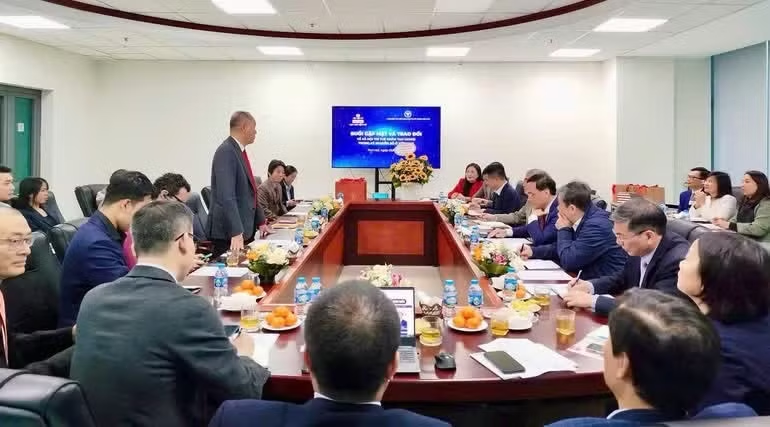
VUSTA has a particular advantage in gathering a wide range of intellectuals from different fields. In the new context, its role needs to shift from a traditional association model to a national knowledge platform.
First, VUSTA should become a bridge between the scientific community and the policy-making process. Today’s development issues are inherently interdisciplinary, from energy transition to the digital economy or AI. Therefore, social critique in a scientific manner must take the lead.
Second, VUSTA should play a role as a hub connecting global Vietnamese knowledge. Many overseas Vietnamese scientists are working at leading research centres in the world. If effective connection mechanisms are established, this resource could make a significant contribution to the country.
Third, it should promote the dissemination of scientific knowledge throughout society. An innovative nation needs a widespread scientific culture, where people understand and trust the value of science. In the AI era, knowledge evolves faster than ever. Therefore, intellectuals must also innovate in their methods of operation, applying digital platforms and data towards more effective connection.
Policy-making as an objective requirement of development
In a modern society, public policy increasingly depends on scientific knowledge. Decisions related to digital, energy transformation, the environment, healthcare, or AI all require a solid scientific foundation. Therefore, incorporating the voice of the scientific community more deeply into the policy-making process is not only the aspiration of intellectuals but also an objective requirement of development.
The first important thing is to change the way of policy consultation is conducted. Scientists should be involved from the stage when policy ideas are formed, rather than only contributing when drafts are nearly finalised. Early participation allows them to identify technological risks, forecast long-term trends, and propose solutions based on scientific evidence.
Second, it is necessary to establish institutionalised mechanisms for scientific advice. In many developed countries, independent scientific councils play a role as regular advisers to parliaments and governments. Viet Nam can fully promote the role of intellectual organisations, particularly VUSTA, as a strategic policy advisory channel.
Another important factor is building a culture of data- and evidence-based policymaking. Effective policy not only rely only on management experience but must be supported by quantitative research, forecasting models, and scientific analysis.
At the same time, the scientific community itself needs to be more proactive. Scientists should not only conduct research in laboratories but also engage in social dialogue and science communication, explaining complex issues in a way that is easily understandable to administrators and the public.
When science becomes a natural part of national decision-making, policy quality will be improved and public trust in knowledge and innovation will be strengthened.
The responsibility of scientists as deputies of the 16th National Assembly
The National Assembly is the highest organ of state power, where long-term strategic policies are decided. In the context where science and technology have become key driving force of development, the participation of scientists in parliamentary activities is becoming increasingly important.
The key difference with National Assembly deputies who are scientists lies primarily in their way of thinking. Science trains individuals to approach issues based on evidence, logical analysis and long-term impact assessment. This is particularly necessary in drafting laws related to new technologies, where policy consequences may last for decades.
Scientists also have the ability to identify global technological trends early. When participating in the National Assembly, they can help ensure that policy stays one step ahead rather than reacting after technology has outpaced the legal framework.
In supervision activities, National Assembly deputies who are scientists can evaluate policy implementation effectiveness based on scientific indicators and empirical data, thereby making appropriate recommendations for adjustment. This helps enhance both the effectiveness and transparency of public policy.
However, to fully realise this role, it is necessary to create favourable working conditions for expert National Assembly deputies, ensure access to in-depth information and establish mechanisms to mobilise networks of experts for support.
More importantly, the presence of scientists in the National Assembly carries symbolic significance: affirming that knowledge and creativity are the foundation of the national development in the new period.
Creating mechanisms to attract and promote high-quality scientific and technological human resources
In the context of global competition for high-tech human resources, Viet Nam needs mechanisms to attract and effectively utilise young scientists, AI experts, and Vietnamese intellectuals abroad.
Competition for scientific and technological human resources is now taking place in global scale. Countries increasingly recognise that scientific talent is a strategic resource deciding their future position. Therefore, attracting and retaining high-quality human resources must be considered a long-term development policy.
First, it is necessary to build a favourable research environment. Scientists need creative spaces, modern facilities, and sufficient autonomy to pursue long-term ideas. What retains scientists is not only income but also opportunities for professional development and recognition of their contributions.
Second, it is essential to reform scientific evaluation mechanisms in line with international standards, based on research quality and impact rather than administrative criteria. When evaluation systems are transparent and fair, talent can flourish.
For overseas Vietnamese intellectuals, it is important to create flexible cooperation models. It's not necessary for everyone to return permanently; they can contribute through joint projects, short-term research programmes, or global expert networks.
In addition, it should focus on training the younger generation from an early stage, especially in fields of AI, data science, and interdisciplinary sciences. Higher education must be closely linked with research and enterprises to form a comprehensive innovation ecosystem.
A country strong in science is not one that has only a few outstanding scientists, but rather one where the system can continuously generate and nurture talent.
Today’s generation of young Vietnamese scientists stands at a very special moment in the country’s development history. For the first time, science and technology are placed at the centre of the national strategy, meaning that both responsibilities and opportunities for the young generation are greater than ever.
The most important thing for young scientists is to nurture long-term aspirations. Science is not a path to quick success but requires perseverance, independence, and belief in the value of knowledge. Major achievements are often built on years of quiet dedication.
Alongside professional expertise, young scientists need a global mindset. Science today has no borders; international cooperation, access to new knowledge and participation in global research networks are essential. However, the deeper the international integration, the greater the need to maintain a sense of contributing to national development.
The young generation should boldly pursue emerging fields such as artificial intelligence, biotechnology, data science, or green energy, which will help shape the future of humanity. Viet Nam can absolutely produce internationally significant scientific achievements if its young generation dares to think big and works persistently.
Science is not only a profession but also a social responsibility. Every research work, no matter how small, contributes to building the knowledge foundation of the nation. When science is linked with the aspiration to serve the country, it becomes the strongest driving force for Viet Nam to enter a new era of development.