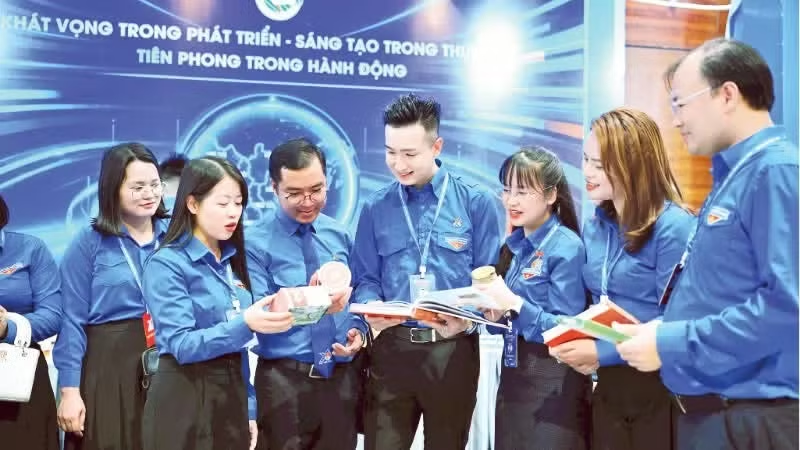
The political report of the 12th-tenure Central Committee of the Ho Chi Minh Communist Youth Union submitted to the congress candidly engaged in self-criticism and confronted difficulties and shortcomings. These include the fact that education in ideals in certain instances remains overly formalistic and has yet to resonate with the thoughts and feelings of young people. In reality, it is not uncommon for training conferences and thematic seminars to be held regularly without any interaction between speakers and audiences, and even with participants merely present to fulfil attendance quotas. This is a consequence of the lack of a reference system and methods for post-activity evaluation.
Similarly, at some grassroots units, although youth union movements and activities draw numerous young people, they sometimes still lack depth. A considerable number of models and tasks remain event-based, failing to create an environment for young people to be creative, lacking continuity or, in other words, the requisite “openness” to connect and form practical, consistent value chains.
The disorientation of Youth Union organisations in some localities is also reflected in efforts to unite and mobilise new groups of young people linked to the current digital context. At the same time, limited capacity among a section of youth union cadres, the “core” of movements, is inducing a “lag” amid the rapid and relentless transformations of the Fourth Industrial Revolution.
At the congress, Party General Secretary and State President To Lam pointed out that education in ideals cannot be merely sterile lectures or resolutions on paper, but must come from close and relatable examples, sincere dialogue, and a smart and humane presence in cyberspace. If it does not “speak to what young people need and speak in a way young people understand”, the youth union will gradually distance itself from the young. That earnest reminder sets out an important task: the youth union’s companionship must increasingly proactively address many issues facing young people in a rapidly evolving world.
The world is undergoing profound transformations with artificial intelligence, the green economy, the circular economy, and a series of new concepts. Within this relentless current, there are always both challenges and opportunities. However, unlike the broad nature of challenges, opportunities often come only to new people who possess fresh mettle and stature.
The key to elevating the quality of activities and amplifying the effectiveness of youth movements lies in placing young people at the centre. The activities of the youth union cannot be sustainable if youth leaders fixate solely on metrics.
Instead, every young person participating in movements needs to learn and develop; they must have space and opportunities to test themselves and be allowed to fail in order to gradually evolve. The training of foreign languages, digital capacity, and innovative start-up skills for young people must be executed equitably and consistently, from bustling urban areas to remote, border, and island areas, in line with the spirit of clear goals, clear responsibilities, clear deadlines, and measurable inputs, results, and impacts.
Each Youth Union member and young person should “think more broadly, learn faster, do better, live more beautifully, act more responsibly, and contribute more”.
Party General Secretary and State President To Lam
From an overall perspective, the aforementioned efforts require a “launchpad” in terms of mechanisms and policies from Party committees and authorities at all levels. The spirit of Resolution No. 25-NQ/TW and Conclusion No. 166-KL/TW on youth work must be substantive resources, quantified through specific projects and tasks instead of remaining only in guiding documents.
Alongside those policy decisions, the youth union needs to boldly change its working style, shape a new direction with a streamlined, capable, and effective apparatus deeply rooted in the lives of young people. At the same time, self-driven effort and the drive to succeed are indispensable. No “launchpad” can be effective if young people themselves lack a sense of self-reliance and self-strengthening in study, work, and training.
Ahead of the congress, Party General Secretary and State President To Lam told each youth union member and young person to “think more broadly, learn faster, do better, live more beautifully, act more responsibly, and contribute more”. Faced with new opportunities, the aspirations of each young person become even more meaningful when they are harmonised with the great rhythm of the country.
Under the flag of the glorious Party, with the companionship of the entire political system and the “special friend” that is the Ho Chi Minh Communist Youth Union, Vietnamese youth can confidently create, master the future, and unite in forging a new era for the nation.