Clear shifts in legislative thinking
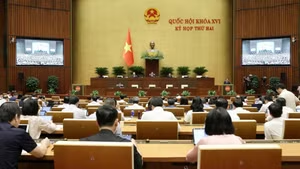
The term of the 15th National Assembly (NA) (2021–2026) has been marked by a strong spirit of reform — most clearly reflected in a shift from a “law-making for management” mindset to “development-enabling legislation”, signalling a fundamental change in both the objectives and methods of law-making.
During the term, many deputies and voters have noted a visible change in the approach to legislation. Whereas laws were previously drafted mainly to serve management needs, the focus has now shifted towards development-oriented legislative thinking — treating the law as a tool to open pathways, guide direction, and unlock new growth drivers.
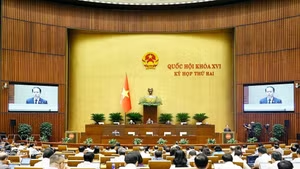
In group and plenary discussions, a number of deputies have pointed out that the most critical stage lies in drafting.
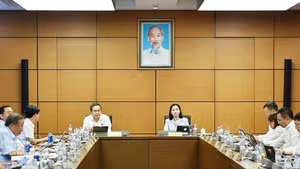
Nguyen Thi Viet Nga (Hai Phong delegation) and other deputies spoke candidly: the root of the matter is renewing thinking from the drafting stage, often by asking a simple question — does this provision truly “open the way” for businesses to grow?
The term of the 15th NA (2021–2026) has been marked by a strong spirit of reform — most clearly reflected in a shift from a “law-making for management” mindset to “development-enabling legislation”, signalling a fundamental change in both the objectives and methods of law-making.
Major progress in legislative thinking has sought to keep pace with the rapid flow of development and respond to new situations as they arise. Instead of waiting for lengthy amendment processes that could delay key projects, the new approach allows for flexible and creative solutions — without violating the Constitution or fundamental legal principles — to unblock resources, promote investment, enhance adaptability, and create momentum for breakthrough development.
Renewing legislative thinking must go hand in hand with reforming procedures. In 2025, the comprehensive revision of the Law on Promulgation of Legal Documents at the 9th extraordinary session underscored an important step, translating into practice the Politburo’s Conclusion No. 119-KL/TW on reforming and improving law-making processes.
Faster timelines, broader democracy
The new process has been redesigned to clarify responsibilities, enhance professionalism and strengthen feasibility. From proposing initiatives and setting the legislative programme to drafting, review and passage, the responsibilities of each actor (the bodies in charge of drafting, reviewing and adopting the legislation) have been spelled out more clearly, helping curb overlap.
In particular, the role of the NA Committee on Laws and Judicial Affairs in reviewing constitutionality, legality and overall consistency within the legal system has been strengthened — not only for bills led by the committee itself, but also for all bills led by other bodies.
Voters and the public have noted and highly valued the NA’s determination to strongly apply information technology and artificial intelligence to accelerate progress and expand democratic participation in sessions, meetings and the public consultation process.
The solicitation of feedback on draft amendments to the 2013 Constitution via the VNeID application — drawing more than 280 million submissions — is a telling example, demonstrating major progress in turning the principles of “the people are the masters” and “the people participate in law-making” into reality.
A firm foundation for breakthrough development
The year 2025 was the year of systemic and comprehensive institutional reform. Law-making work has performed strongly in promptly translating the Party’s major guidelines into law, especially the policy of streamlining the apparatus and improving the effectiveness and efficiency of the political system.
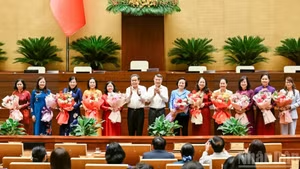
The most notable achievement was the amendment and supplementation of the 2013 Constitution, passed by the NA with 100% agreement (470/470 deputies), providing a constitutional basis for two key models.
Law-making work has performed strongly in promptly translating the Party’s major guidelines into law, especially the policy of streamlining the apparatus and improving the effectiveness and efficiency of the political system.
Firstly, a two-tier local government model (Province/City and Commune/Ward/Special Administrative Unit) replaces the traditional three-tier model (Province, District, Commune). The large-scale reorganisation of administrative units — reducing the number of centrally governed Provinces/Cities from 63 to 34, and cutting nearly 6,700 commune-level units aims to streamline focal points, concentrate resources, expand development space, and improve State management efficiency.
Secondly, a three-tier judicial model (first-instance, appellate, cassation/retrial) for the Courts and Procuracies replaces the previous four-tier model, to ensure adjudication and prosecution are more concentrated, specialised and effective.
Many voters, citizens and the business community have voiced a shared view: good legislation is a necessary condition, but effective implementation is the sufficient condition for the law to enter real life.
Recognising this, in 2025 the NA passed the revised Law on Oversight Activities of the NA and People’s Councils, effective from March 1, 2026. The law lays a foundation for stronger oversight effectiveness and efficiency, ensuring “connectivity” across supervision–recommendations–follow-up–urging implementation. Oversight is no longer limited to identifying shortcomings; more importantly, it is linked to policy recommendations, creating development momentum and strengthening State management.
The achievements in law-making and implementation in 2025 offer valuable lessons, reaffirming that the Party’s centralised and unified leadership is the decisive factor guiding all institutional reforms. Drawing from practice, deputy Pham Trong Nghia (Lang Son delegation) proposed that in the next term, law-making should expand the participation of stakeholders —especially those directly affected — in a substantive and comprehensive manner.
Drafting agencies should publicly respond to feedback to avoid one-way consultation. He also stressed the need to uphold evidence-based policy in law and policy development, and for review bodies to pay close attention to assessing and balancing the relationship between the State, the market and society.
Meanwhile, voters are particularly concerned about laws on land, natural resources and culture, which often generate very specific obstacles when applied in ethnic minority areas, involving local customs, practices and community awareness.
Deputy To Van Tam (Dak Lak delegation) suggested organising direct on-site dialogues with the participation of village elders, hamlet heads and reputable community figures, with full interpretation provided. Legal implementation in such special contexts requires communicators who understand both the law and local customs, so they can explain, persuade and help people comply voluntarily.
Voters and the public place their trust and expectations in the NA continuing its resolute reform drive in the period ahead — focusing on improving the institutional framework for emerging areas such as the digital economy, artificial intelligence and the green transition; further advancing judicial reform; and fostering respect for the law as a cultural norm among every citizen and every business.