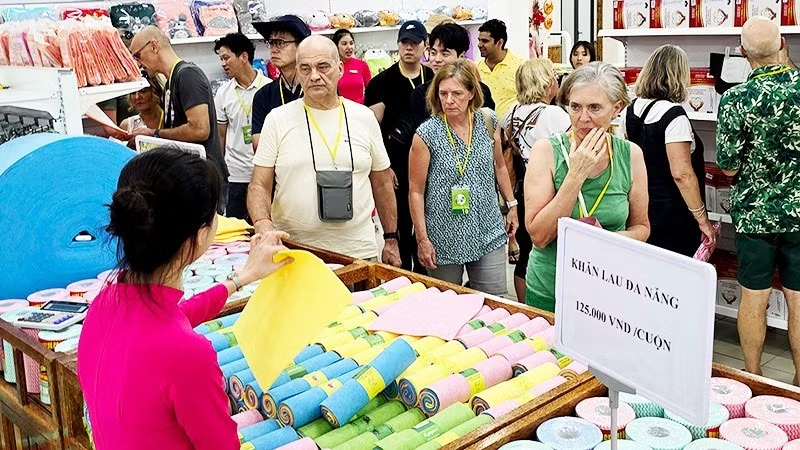
Visiting Ha Noi for the first time, Sarah Miller, a traveller from the UK, was captivated by a pace of life that felt both vibrant and welcoming. Mornings spent by Hoan Kiem Lake, enjoying a hot bowl of pho before strolling around the Old Quarter, left her with lasting, fond impressions.
Viet Nam’s appeal is not limited to first-time visitors; it also exerts a strong pull on those who return. On his fifth trip, Michael Torres, a visitor from the US, said that every time he comes back to Viet Nam, it brings a completely new feeling.
A leap beyond expectations
From wandering the ancient streets of Hoi An, trekking in Sa Pa to soaking up the blue seas of Phu Quoc, Michael found that the more he explored, the more he understood why Viet Nam holds a special place in the hearts of international travellers. A culture rich in identity, friendly people and an unpretentious rhythm of life always leave him wanting to return.
“I thought I’d got to know Viet Nam, but every visit brings something new waiting to be discovered.”
Recently, the UK travel magazine Time Out listed Viet Nam among the world’s 20 best winter destinations for 2025–2026. Specifically, Viet Nam was ranked “Best for food” — an ideal winter destination for travellers who love cuisine. Beyond the variety of traditional dishes, Viet Nam is also exceptionally accessible, from pavement eateries to fine-dining restaurants, at reasonable cost.
Time Out also noted that the period from October to February the following year is the best time to explore Viet Nam, when the weather is pleasant and travel and accommodation costs are particularly “traveller-friendly”, offering better value than many other international destinations. A journey across the country, taking in highlights such as Ha Noi, Hoi An and Ho Chi Minh City, is described as an experience not to be missed.
In Ha Noi, visitors are encouraged to explore small jazz venues, savour the atmosphere of the Old Quarter and enjoy street food. Hoi An impresses with its signature cao lau, tranquil old streets and the shimmering beauty of lanterns each evening. Meanwhile, Ho Chi Minh City appeals with its diverse range of restaurants and cafes, as well as its lively nightlife.
Positive feedback from travellers and international media is helping to elevate Viet Nam’s tourism image — something clearly reflected in the steadily rising number of international visitors across destinations nationwide. Accordingly, in the 11 months of this year, Viet Nam welcomed more than 19.1 million international visitors, up 20.9% year on year, according to the Viet Nam National Authority of Tourism. This is the highest figure on record, officially surpassing the 18 million reached in 2019 — before the COVID-19 pandemic.
With these results, Hoang Nhan Chinh, Head of the Secretariat of the Viet Nam Tourism Advisory Board, said the achievement exceeded expectations, especially at a time when global tourism remains volatile and the Asia–Pacific region has recovered to only about 90% of pre-pandemic levels. Viet Nam’s breakthrough is not a piece of fleeting good fortune; it reflects deeper fundamentals that have been built up and steadily strengthened in recent years.
First is a stable, safe environment — a major advantage for international visitors amid global uncertainty. Next are increasingly open visa policies, with wider visa-waiver coverage and a faster e-visa process, making entry into Viet Nam easier than ever.
In addition, Viet Nam’s competitive edge comes from abundant natural resources, a culture rich in identity stretching from north to south, and a tourism product system that has been continuously refreshed and diversified to match new international tastes — from beach resorts and nature exploration to urban tourism, gastronomy and wellness.
The human factor is also indispensable as Viet Nam is consistently praised by visitors for its friendliness, sincerity and hospitality. In addition, tourism promotion campaigns in recent years have been delivered in a more professional and creative manner, helping Viet Nam’s image appear with increasing frequency across international media.
“Being repeatedly honoured by reputable organisations and magazines also helps to strengthen the appeal, creating a powerful ripple effect and consolidating Viet Nam’s position on the world tourism map.”
Sustaining the momentum
Under Resolution No. 226 dated August 5, 2025, the Government set a target of welcoming at least 25 million international visitors in 2025 — 2–3 million more than the target set at the start of the year. However, at the current pace, the tourism sector has less than a month left to meet this goal.
This is seen as immense pressure, especially as year-end travel demand is fiercely contested among destinations across the region, while infrastructure and service capacity would have to operate almost at full stretch to cope with a sudden surge in arrivals.
Chinh therefore argued that, rather than focusing on numbers, Viet Nam could instead prioritise the high-end segment — including affluent travellers, experts, top talent and billionaires. This group has strong spending power, makes a substantial contribution to the economy, and can deliver optimal returns without the need to expand visa waivers too broadly. It is also a strategy that many countries have adopted successfully, maximising the benefits of visa policy while still maintaining effective control over inbound flows.
In addition, to promote the country and its people more effectively, Viet Nam needs to combine clear destination branding with digital technology, popular culture, major events and the power of its people. “If implemented in a coordinated way with serious investment, Viet Nam can elevate its image — not only attracting visitors but also retaining them over the long term, competing equally with the region’s ‘heavyweights’.”
Meanwhile, businesses — the actors in direct contact with visitors — are also accelerating preparations for the 2026 international season. Nguyen Hoai Thu, Director of Saigontourist Travel (Ha Noi Branch), said the company is focusing on developing specialised product lines to match increasingly sophisticated international tastes. These include long-stay tours linking various destinations; heritage itineraries combined with beach resort breaks; green tourism and responsible tourism products; and experience chains centred on exploring local cuisine.
Alongside product development, Saigontourist is implementing group incentives and signing strategic partnerships with airlines and major tour operators in Europe, to capitalise on opportunities from the expanded visa-waiver policy under Government Resolution No. 82 and decisions under the Law on Entry and Exit (as amended in 2024). The aim is to secure stable, year-round visitor flows.
However, Thu said businesses still need a large-scale national promotion campaign, especially in newly visa-exempt markets. Such efforts would create a wider spillover effect and significantly boost recognition of Viet Nam as a destination. She also emphasised the training of high-quality tourism personnel — particularly guides and tour operators proficient in European languages — as a key factor in raising service standards.
Businesses also proposed speeding up upgrades to tourism infrastructure, improving service quality at destinations, expanding international payment systems and digitising the entire visitor experience to ensure maximum convenience. Another important recommendation is to promote a “three-way” linkage model among businesses, localities and airlines, creating a coherent product chain with sufficient competitiveness against Thailand, Singapore or Malaysia.
“If businesses proactively innovate and support policies are implemented in a coordinated manner, Viet Nam can absolutely maintain strong growth momentum in international arrivals in 2026,” Thu stressed.
In 2024, Viet Nam allocated a budget of around 4 million USD (under 100 billion VND) for international tourism promotion.
![[Video] Viet Nam among Top three Asian destinations for return visitors](https://en-cdn.nhandan.vn/images/nyM650OGFWrOVWc-xajqN-rTZ68Rlmc1fiGJOhBRYHErj-E25MBpvJqrpphXazfrpe9t-fYCGuQU4CN0yXo3Rg/du-lich-vietnam.jpg.avif)











![[In Pictures] Nui Chua Rock Park: A million-year-old outdoor museum of landforms on the Khanh Hoa coast](https://en-cdn.nhandan.vn/images/nyM650OGFWrOVWc-xajqNz57td8idIAL_VG9puyG2UZEKOnmq1DVlT1--ZclbO3z2WBaWZhbt6O3e8kjPZqJMWkfEz7RO9qhcwg8o8LQFK8/ndo-br-cao-nguyen-da-moi.jpg.avif)