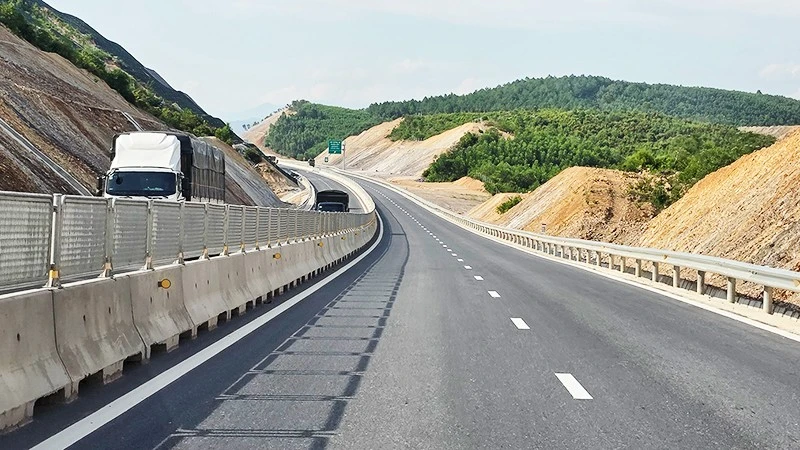
Previously, each truckload of agricultural produce traveling from Cai Lay (former Tien Giang Province) to Ho Chi Minh City took Nguyen Van Sau nearly an entire day. Traffic congestion, poor road conditions, and narrow sections meant deliveries were always made with anxiety. Since the expressway opened, that journey now takes just over three hours.
Redrawing the “cost map”
Beyond ordinary citizens, many businesses have clearly felt the impact of the North–South Expressway coming into operation. Le Minh Tuan, Director of a logistics company in former Binh Duong Province, said that previously, shipments from factories to ports had to be carefully timed to avoid congestion and missed shipping schedules. Now, with expressway sections fully connected, transport time has been shortened, fuel and labour costs reduced, and delivery plans made more predictable. “When roads are open, goods flow smoothly - only then do businesses dare to take on large orders and expand markets,” Tuan said enthusiastically.
These tangible changes underscore the expressway’s effectiveness, reflected in major implementation milestones. December 19 marked a historic moment for Viet Nam’s transport sector, with the official completion and technical opening of 3,188 kilometers of the main North–South Expressway route and 325 kilometres of interchanges, feeder roads, exceeding the five-year target of 3,000 kilometers. In addition, 1,586 kilometres of national highways and 1,701 kilometres of coastal roads have been completed.
According to the Ministry of Construction’s plan, by the end of this year Viet Nam will complete more than 3,800 kilometres of expressways, including 3,345 kilometres of main routes and 458 kilometres of interchanges and access roads, setting a new construction progress record. Once the North–South Expressway is fully connected, nationwide freight and passenger transport will become more convenient, service quality and travel comfort will improve, and logistics costs and product prices will be reduced.
More importantly, the expressway is creating new development momentum for urban areas along the route while opening up east–west connections that allow localities to better exploit spatial potential and growth reserves.
Associate Professor Dr Nguyen Thuong Lang, lecturer at the Institute of Commerce and International Economics, National Economics University, noted that surpassing the 3,000-kilometre target is not merely a construction achievement but reflects a fundamental shift in Viet Nam’s infrastructure development mindset. From being viewed as a supporting sector, transport, especially the North–South Expressway, has been repositioned as a structural lever that determines the organisation of economic space and the distribution of growth drivers.
Notably, the expressway is reshaping the economy’s “cost map.” As travel time and transport expenses decline, geographic distance is no longer the major barrier it once was. Many sections have reduced travel time by 30–50% compared to before, while also helping lower logistics costs, which remain relatively high compared with other countries in the region. This enables investment capital, labour, and technology to move more flexibly across regions, improving efficiency in division of labor and specialisation. “This is a crucial condition for Viet Nam to move away from a growth model heavily reliant on low costs toward one based on efficiency and productivity,” Dr Nguyen Thuong Lang emphasised.
From the perspective of logistics and supply chains, Dr Le Xuan Sang, Deputy Director of the Viet Nam Institute of Economics, said the North–South Expressway helps Viet Nam take a further step toward building a multimodal connectivity system. When expressways are linked with seaports, airports, and logistics centers, transport costs not only decrease but also become more stable and predictable, an especially critical factor for export-oriented businesses. “As global supply chains undergo restructuring, infrastructure advantages will determine Viet Nam’s ability to attract and retain high-quality investment flows,” Dr Le Xuan Sang affirmed.
Completing the national infrastructure system
Under the plan, Viet Nam aims to complete 5,000 kilometres of expressways by 2030, forming a structurally complete national infrastructure network. Experts believe this is an ambitious yet achievable target, provided that the proven approach of recent years is maintained, characterised by strong central direction, flexible mechanisms and resolute implementation.
According to Associate Professor Dr Nguyen Thuong Lang, once the North–South expressway corridor is largely in place, the focus of infrastructure development in the next phase should shift from vertical expansion to strengthening east–west links, ring roads and economic corridors, so that expressways can truly play their spillover role. Only when expressways are seamlessly connected with seaports, airports, border gates and logistics centres can their economic benefits be fully multiplied.
From a policy perspective, continued priority for public investment in key routes remains necessary, but it must be complemented by private-sector participation through appropriate public–private partnership (PPP) models. At the same time, the target of 5,000 kilometres of expressways must be matched by higher requirements for operational quality. As the network expands rapidly, pressures related to maintenance, traffic safety and operations management will intensify, making it essential to accelerate the application of technology in traffic management, toll collection, load control and smart maintenance as an integral part of the expressway development strategy.
In the long term, the 5,000-kilometre expressway network is expected to become one of the key pillars enabling Viet Nam to realise its development goals towards 2045. When embedded in the overall national infrastructure strategy and closely linked with high-speed rail, coastal roads and regional economic corridors, expressways will not merely serve as transport facilities but also as the foundation for a new, more efficient and sustainable growth model.
Meanwhile, the Vice Director of the Viet Nam Institute of Economics cautioned that the North–South expressway does not automatically generate growth without supporting conditions. The greatest challenge in the coming period lies in the effective utilisation and orderly development of spaces along the route. Without synchronised planning for urban areas, industrial zones and services, there is a real risk of spontaneous, fragmented development and even waste of resources.
In addition, issues of maintenance, traffic safety and operational management will become increasingly critical as traffic volumes rise sharply. It is therefore necessary to swiftly perfect financial mechanisms for expressway maintenance and to apply technology in traffic management and load control, ensuring the long-term, sustainable operation of expressway routes.
Looking further ahead, the North–South expressway will only realise its full value when it is incorporated into a comprehensive infrastructure strategy, closely connected with high-speed rail, coastal roads and East–West economic corridors.
“Expressways are not merely roads linking the North and the South; they are becoming a guiding axis for a new development structure, helping Viet Nam enhance its competitiveness and move closer to its long-term development goals,” affirmed Dr Le Xuan Sang.