More than two centuries ago, in “Phu Bien Tap Luc”, Le Quy Don recorded images of the mountainous western region of Quang Tri and the trade routes crossing the Truong Son range into Laos. From the Lao side, beyond Dinh Ai Lao (Lao Bao), the East Sea/South China Sea seemed almost within sight. Today, Lao Bao has become an important gateway on the East–West Economic Corridor, where goods from Thailand and Laos flow towards the sea.
The meeting point of Lao Bao
Lao Bao’s gateway role is reflected not only on regional transport maps but also in the daily rhythm of life in this border town. Nguyen Van Hung, a long-haul container truck driver, said that each week he crosses the border twice, transporting goods from Mukdahan (Thailand) through Savannakhet (Laos) to Lao Bao and then onward to Da Nang for export, before making the return journey.
“When the My Thuy deep-water seaport in southern Quang Tri Province begins operations, drivers like us will be able to deliver cargo there directly for export, significantly reducing logistics costs,” Hung said.
Along the more than 2,000-kilometre Viet Nam–Laos border, eight pairs of international border gates have been established. Owing to the strategic location of National Highway 9 and favourable natural conditions around the Lao Bao International Border Gate in Quang Tri and Densavan in Savannakhet Province (Laos), the Politburos of Viet Nam and Laos agreed to develop the Lao Bao–Densavan Border Gate area into a special economic zone in 1997.
Since then, a series of preferential policies have been introduced, creating momentum for Lao Bao to emerge as an important trading centre on the East–West Economic Corridor.
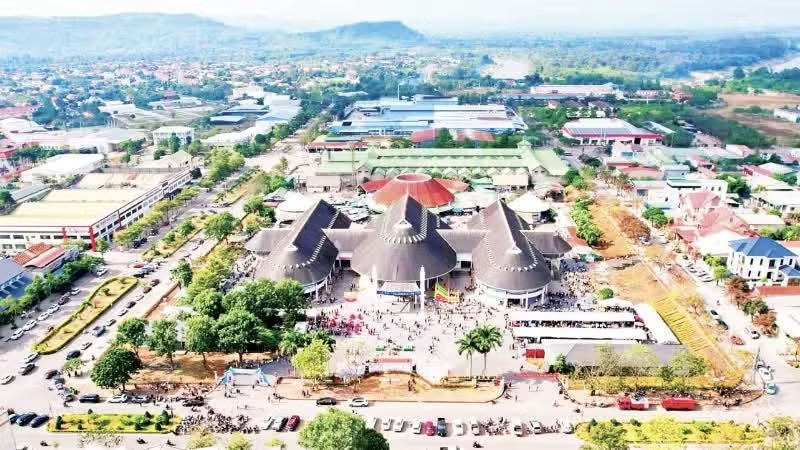
The Lao Bao Special Economic and Trade Zone was also established with a series of preferential mechanisms, helping this once quiet borderland on the eastern bank of the Se Pon River become a destination for investors, businesses, and traders from across the region. Lao Bao Town has been transformed and become more vibrant and full of life.
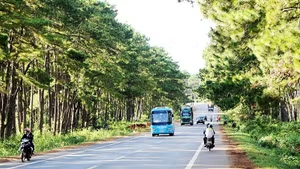
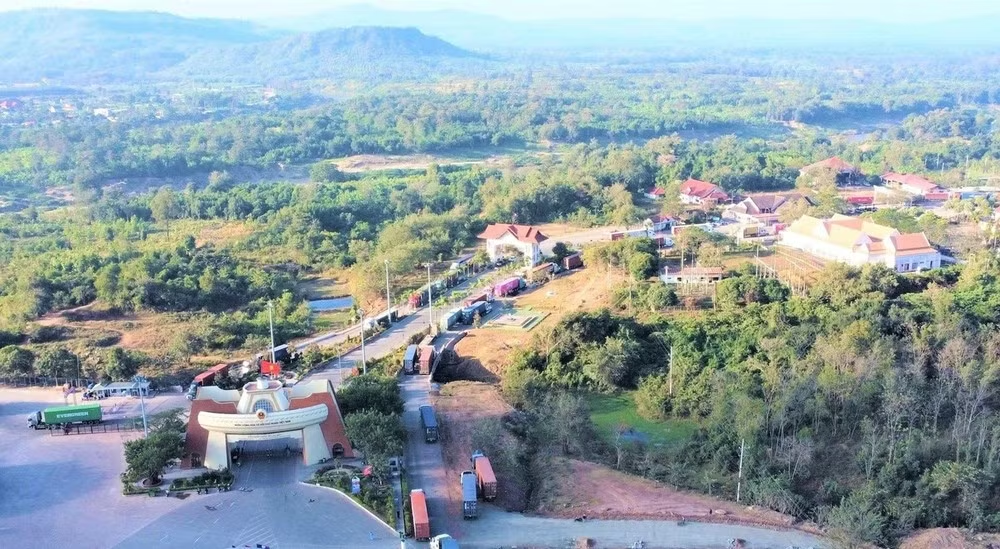
There was a time when National Highway 9 was crowded with transport vehicles from dawn until late at night. Convoys of container trucks from Thailand and Laos crossed the Lao Bao International Border Gate carrying goods towards central Viet Nam’s seaports. Duty-free shops, trade centres, hotels, and restaurants lined both sides of the road, while illuminated signs brightened the border skyline.
At weekends, shoppers from Dong Ha, Hue, and neighbouring provinces flocked to Lao Bao’s trade centres. Car parks were filled from morning until evening. Vietnamese, Lao, and Thai languages could be heard blending together amid bustling trade activities. Never before had Lao Bao witnessed such a large flow of people and goods, becoming a symbol of vitality and development aspirations in Quang Tri’s border region.
After more than 20 years of development, the two economic zones on both sides of the border significantly transformed the area and promoted the development of Quang Tri and Savannakhet provinces, particularly in Lao Bao. However, the prosperity of those years did not last indefinitely. As preferential policies gradually changed, the area’s attractiveness also declined. Streets that were once crowded with shoppers became quieter, raising questions about new development drivers for Lao Bao.
New momentum on the East–West corridor
A new turning point emerged with the Politburo’s Resolution No. 26-NQ/TW, issued on November 3, 2022, on socio-economic development and ensuring national defence and security in the North Central and Central Coastal regions through 2030, with a vision to 2045. The resolution outlined new directions for border gates along the East–West Economic Corridor, in which Lao Bao was identified as an important connection point.
Le Duc Tien, Vice Chairman of the Quang Tri Provincial People’s Committee, said that ministries and sectors are working with Quang Tri Province to build a project for the Lao Bao–Densavan Cross-Border Economic and Trade Zone for submission to the government.
Instead of relying on tax incentives and state-funded infrastructure investment support as in the past, the proposed project is expected to attract investors mainly through non-tariff mechanisms that facilitate investment in manufacturing, processing, and logistics services.
This approach aims to move Lao Bao–Densavan beyond conventional border trade and develop it into a new growth pole linking the economies of central Viet Nam, Laos, and Thailand.
In recent years, the volume of goods passing through the border area has increased rapidly. Within the border-gate economic model, Lao Bao is regarded as the core logistics hub of the East–West Economic Corridor.
According to the Lao Bao International Border Gate Customs, total import-export value from 2023 to the present has exceeded 3.5 million tonnes of cargo, with a trade value of more than 1,500 million USD, accounting for a significant share of Viet Nam–Laos border trade.
The range of goods has become increasingly diverse, including construction materials, fuel, agricultural products, and industrial raw materials, highlighting Quang Tri’s growing role in the regional logistics network.
Quang Tri Province has developed a comprehensive programme involving major development projects and strategic priority coordinates around Lao Bao, including Quang Tri Airport, My Thuy Deep-Water Seaport, the Southeast Quang Tri Economic Zone and national and international transport links designed to ensure the success of the cross-border economic and trade zone.
Among these projects, the large-scale My Thuy Deepwater Port plays a crucial role as a key import and export hub for the entire region. It is projected that the volume of goods cleared through My Thuy Deepwater Port in phase 1 (2026-2030) will reach over 13 million tons per year.
Nguyen Van Phuong, Secretary of the Quang Tri Provincial Party Committee, affirmed that Lao Bao is a crucial link on the East–West economic axis.
The province’s new development aspiration for Lao Bao has been clearly shaped through efforts to implement the conclusions of General Secretary and State President To Lam following his working visit with the Standing Board of the Quang Tri Provincial Party Committee on April 29, 2026.
Quang Tri is focusing on repositioning its development space according to the strategy of “reaching eastward and expanding westward”, with Lao Bao serving as a major focal point. The sea is viewed as the strategic direction for development, while the East–West Economic Corridor functions as the axis connecting the region with international markets.
The province seeks to maximise the advantages of its maritime economy, international border gates, logistics services, and energy sector.
Within this new development model for Lao Bao, Quang Tri has planned a system of inland container depots (ICDs) and large-scale, highly integrated logistics centres. The province is currently constructing two inland ports along road transport corridors connected to National Highway 9 and the Cam Lo–Lao Bao Expressway, providing links to the My Thuy and Cua Viet seaports as well as neighbouring provinces.
As evening falls over the Se Pon River, convoys of trucks continue their journeys through Lao Bao International Border Gate. The border river flows quietly as it has for generations, but the land on its eastern bank has changed dramatically.
From a remote frontier region, Lao Bao is steadily affirming its role as the gateway connecting the East–West Economic Corridor to the East Sea/South China Sea.