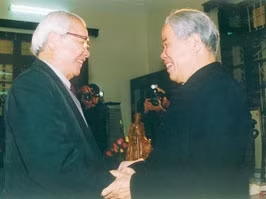
Mr Kiet and I have almost the same family background and revolutionary career. l was born to a poor farmer family, so I had to work hard to earn a living and support my family. So was Mr Kiet.
In addition, we began our revolutionary activities at a very early age.
In the pre-August revolution period and during the anti-French resistance war, I was on the northern battlefields while Mr Kiet was in the south. In particular, during the anti-US resistance war, I was assigned to support battlefields in the south. At that time, Mr Kiet was one of the senior Party leaders in the south.
In the early revolutionary stage and during the resistance wars against the French colonialists and American imperialists, I heard many stories about Mr Kiet, but we had few chances to meet each other. Until 1987, when Mr Kiet was appointed as permanent vice-chairman of the Ministerial Council and head of the State Planning Commission, we began to keep a close touch and have more time to work with each other.
Mr Kiet was highly spoken of by many people as a practical not theoretical man, words go with deeds. However, he showed his consistency in terms of ideas, opinion and principles of the Party, when settling internal and external issues.
Mr Kiet was a practical man as he kept a close touch with the people and revolutionary movements. He worked in many fields, including Party organisations and the Government agencies. These working environments helped him learn good experience and gave him creativity in the fulfillment of his tasks.
Despite not having conditions to study in and graduate from any schools and universities, Mr Kiet learnt hard from practice. In particular, he was capable of using intellect of cadres, people, and scientists, from which arose mature thinking that helped him make appropriate decisions.
Mr Kiet was a dynamic man, who always gave his best to his job. It is possible to say that Mr Kiet was a man who had the nerve to think and to do, to bear responsibility and to practise self-criticism.
When he worked as Prime Minister, he guided the establishment of powerful corporations and expressed his opinion about dominant role of the State economic sector, or permitted military units to develop economy.
It was him who proposed and provided directions on the ban of firecrackers shooting in Vietnam.
In addition, it was him who was determined to build the trans-Vietnam 500 Kv transmission line, despite different opinions about the issue. He said he was responsible for the job. It began after my visit to the Hoa Binh hydro-electric power plant. At that time, only three generator units generated electricity, even though four units had been installed. Furthermore, the Central part of Vietnam and the south were facing a serious shortage of electricity.
Moreover, Mr Kiet, as an experienced man with good understanding of people’s aspiration, was determined on the exploitation of Dong Thap Muoi (the Plain of Reeds).
In Government or Party activities, Mr Kiet was an outspoken man.
After the sixth Party Congress, Vietnam strongly implemented its renovation process with a focal task of renewing its economy. An urgent issue in the period was inflation. Vietnam faced a very difficult situation with an exhausted economy, featuring a high inflation of 774% and shortage of goods. Furthermore, the Soviet Union and Eastern European countries collapsed and cut all their aid for Vietnam, while Vietnam’s relationship with China was yet to be normalised and the US still maintained its embago against Vietnam.
How to overcome the difficulties? There were various opinions. The International Monetary Fund (IMF) said that Vietnam needed US $3 billion to curb inflation. How could Vietnam have US $3 billion at that time? Mr Kiet, as vice chairman of the Ministerial Council, and I, as chairman of the Ministerial Council, discussed measures to fight inflation. We agreed that there was the only way to develop Vietnam’s internal strength by relying on the people and encouraging them to create new potential. We agreed to make proposals in a report to the Politburo.
Firstly, production and thrift practice should be promoted. In agriculture, a contractual farming mechanism should be boosted. As a result, agricultural production witnessed a strong development and Vietnam basically settled the shortage of food.
Secondly, all goods sources, at home and abroad, were fully exploited. At that time, whoever had a chance to go abroad were encouraged to bring home goods. The State did not collect tax. As a result, after a short period, Vietnam had a lot of goods, thus helping ease consumer goods shortage pressure.
Thirdly, money should be attracted from the people. We decided to increase saving interest rates from 3% to 9%, equal to the increase of goods prices. Those who deposited their money for three times would enjoy 3% more. Therefore, people felt secured for their savings and banks attracted a lot of money.
So, the people took part in settling the shortage of goods and deposited surplus money to State-owned banks. The Party and State guaranteed their interest by stipulating that banks only could loan capital they mobilised and no more money would be printed. Hence a sharp drop of inflation from 774%.
The home and international contexts witnessed important events and complicated developments in the early 1990s. These include major events, such as the normalisation of diplomatic ties with China and the US and Vietnam’s participation in ASEAN.
The normalisation of Vietnam’s relationship with China was implemented gradually, in particular after the Chendu summit. In particular, from November 5-10, 1991, Mr Kiet and I led a Party and Government delegation to visit China. During the visit, the two sides issued a Joint communique on the normalisation of relationship between the two Parties and two States. The visit played an important role in the Vietnam-China relationship, which also helped settle many issues on land border and border in the Tonkin Gulf and promote economic, cultural, scientific and technological co-operation.
Vietnam’s admission to ASEAN. Vietnam faced more difficulties as the Soviet Union and Eastern European countries collapsed and Vietnam lost its diplomatic, economic and military support. Vietnam’s benefits at that time were peace, stability and development. Therefore, Vietnam had to break away isolation status and expand its friendship and co-operative ties. Policies towards the region, in particular toward ASEAN, would open up a new prospect for the promotion of external relations, making a contribution to the creation of peaceful and stable international environment, which in turn would help Vietnam develop. Morever, to have more friends and less enemies would create more favourable conditions for Vietnam’s national construction and defence. Therefore, the admission to ASEAN is stretagically important in Vietnam’s regional policies. This is a timely and proper decision by the Politburo.
Mr Kiet made significant contributions to Vietnam’s admission to ASEAN by attending many ASEAN summits and other important events.
Vietnam-US relations. The Politburo and the Party Secretariat held many discussions about the normalisation of Vietnam-US relationship. Mr Kiet and I, individually, provided guidance on strategic goals and the settlement of concrete issues with the US, such as MIA, Cambodia, assets, the establishment of liaison offices and the exchange of ambassadors. We sent our messages to the US government and people about Vietnam’s goodwill and policies on external affairs.
The Ministry of Foreign Affairs and many other ministries, agencies and localities nationwide successfully implemented open, diversified and multilateralised external policies by the Party and State, forcing the US to normalise the relationship with Vietnam, thus making a significant contribution to the industrialisation and modernisation process, and national construction and defence.
Mr Kiet and I had a close touch during the fulfillment of our tasks. We often exchanged ideas about our job.
Mr Kiet is really a talented Prime Minister and politician of high calibre of the Vietnamese Party and State, who has won praises from Vietnamese and foreign people.
![[Photos] Central and local agencies extend congratulations to Nhan Dan Newspaper on 101st anniversary of Viet Nam Revolutionary Press Day](https://en-cdn.nhandan.vn/images/8f440db7b9bfe62cb5397a6750a8b01b6b986b08e85d95c29b159dd4741de5aff02eaf4af770af868e24c1ae769f44d98bc8cb607db0056294178f08a73f9f09b210979a02378495c655160931f18fcc/doan-thu-truong-bo-cong-anjpg.jpg.avif)