Q: 2025 marks the 30th anniversary of Viet Nam-US diplomatic relations, the 10th anniversary of the bilateral Comprehensive Partnership, and the second year of upgrading ties to a Comprehensive Strategic Partnership. Looking back at 2025, what do you see as the most significant achievements and highlights in bilateral relations?
A: I really appreciate the opportunity to look back on 2025, which was truly an incredibly significant year for the US-Viet Nam relationship. This year was not just about reflecting on the past 30 years, but about envisioning the next 30 years and where we want to take this relationship.
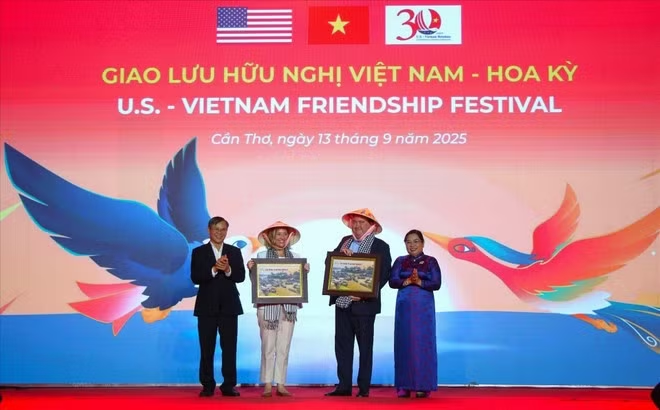
One of our major initiatives was the organisation of friendship festivals across Viet Nam. While ambitious at first, our outstanding teams at the US Embassy in Ha Noi and the Consulate General in Ho Chi Minh City, working closely with the Viet Nam Union of Friendship Organisations and the Viet Nam-US Society, successfully held festivals in Can Tho, Ho Chi Minh City, Da Nang, and Ha Noi.
They were a great way to showcase US-Viet Nam ties, and a great way to showcase American sports, culture, and music, to make the bilateral relationship easily approachable for people who may not be very familiar with the US or with the US-Viet Nam relationship. We were able to gather a lot of people, with several tens of thousands of participants nationwide, making it truly a special occasion.
Beyond people-to-people exchanges, our economic ties continued to expand. Trade and investment grew steadily, and we saw increasing interest from Vietnamese companies in investing in the US. Notably, the largest-ever Vietnamese investment delegation travelled to Washington, D.C. to attend the SelectUSA conference, which promotes greater Vietnamese investment in the US.
Security and defence cooperation also advanced, with US Secretary of War Pete Hegseth visiting Viet Nam, several US Navy ships making port calls, and the second Law Enforcement and Security Dialogue, along with the US-Viet Nam Political, Security, and Defense Dialogue, held in Washington, D.C.
Education cooperation reached new heights as well. In the spring, the largest-ever delegation of US university leaders - 21 in total - visited Viet Nam to explore partnerships with Vietnamese institutions. These efforts are already yielding results in the form of potential cooperative programmes. Viet Nam also regained its position as the fifth-largest source of international students in the US, with more than 30,000 Vietnamese students currently studying there.
There were many other important developments. The US transferred a third high-endurance Coast Guard cutter to Viet Nam, bringing the total number of US-provided cutters to three, stationed at Cam Ranh International Port in Khanh Hoa province. These are just some examples of how our partnership has continued to grow over the past three decades - again, not only looking back, but looking firmly toward the future.
We also signed a Memorandum of Understanding (MoU) on war legacy issues, reaffirming our commitment to continued cooperation in addressing the consequences of war. This includes ongoing efforts to help Viet Nam identify its own martyrs using the most advanced DNA technology, an initiative we are very excited about. At the same time, work continues to clean up the dioxin hotspot at Bien Hoa Air Base in Dong Nai province, clear unexploded ordnance, and support people with disabilities.
Altogether, there is a great deal for us to be excited about, and I very much look forward to what the coming years will bring for the friendship and partnership between our two countries.
Q: Economic, trade, and investment cooperation is a key pillar of Viet Nam-US relations. In your view, how can the two countries work together to build more mutually beneficial trade ties?
A: This question really goes to the heart of our relationship moving forward. Vietnam has set very bold and ambitious goals for itself: becoming a high-income economy by 2045, transitioning to a green economy by 2050, developing a strong digital economy, significantly expanding its pool of high-tech workers and engineers, and attracting greater high-tech investment.
Viet Nam also aims to strengthen technology transfer and play a more prominent role in global high-tech supply chains. Across all of these aspirations, the US sees itself as an important partner. Whether through American companies investing in Viet Nam, partnerships between US and Vietnamese firms, or cooperation between American universities - such as Arizona State University and Vietnamese institutions on programmes like semiconductor engineering, we are proud to support Viet Nam’s development objectives.
We are also closely following several important Party resolutions advanced under the leadership of General Secretary To Lam, including those promoting the private sector, reorganising government and administrative structures, advancing digital transformation, and strengthening global integration. In all these areas, the US considers itself both a capable and a willing partner.
For instance, Resolution 57 on breakthroughs in science, technology, innovation, and national digital transformation identifies 11 priority sectors for development, including artificial intelligence, robotics, data centres, and biotechnology. In each of these fields, there is a meaningful role for US companies, universities, and expertise. I expect cooperation in these areas to continue expanding.
We are already seeing encouraging progress, including discussions on developing data centres in Viet Nam, cooperation on AI education and workforce training, and engagement on Viet Nam’s plans to establish international financial centres in Ho Chi Minh City and Da Nang.
All of these initiatives are extremely exciting, and I believe they will help pave the way for the future of our relationship. High-tech cooperation, in particular, will be a defining hallmark of US-Viet Nam ties as we move forward into the next phase of our partnership.
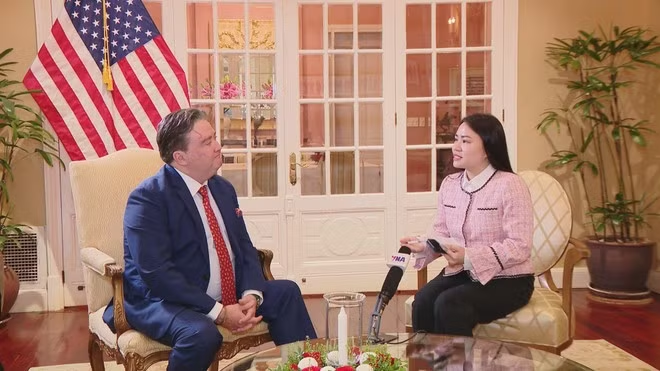
Q: Viet Nam aims to become a semiconductor powerhouse, with a target of training 50,000 engineers by 2030, while currently only about 5,000 are working in the field. How can the US support Viet Nam in developing high-quality human resources for this sector?
A: Workforce development will be essential for Viet Nam to achieve its long-term goals. Investors need confidence that Viet Nam has a skilled workforce capable of operating advanced manufacturing facilities and conducting high-level research. Building that talent base is therefore critical to attracting high-tech investment.
Infrastructure also matters. Reliable electricity supply is essential, especially for energy-intensive facilities such as data centres. Continued expansion of power generation and supply will be necessary to support Viet Nam’s ambitions.
In terms of human resource development, educational partnerships play a vital role. Collaborations such as those between Arizona State University and Vietnamese universities are particularly important. We also have a “two-plus-two” programme between the National Economics University and Boise State University in Idaho, allowing students to study two years in each country. These kinds of exchanges will remain crucial as Viet Nam develops its workforce and positions itself at the forefront of high-tech manufacturing.
I am very confident in Viet Nam’s ability to succeed. During my time here, I have seen firsthand how resilient and hardworking the Vietnamese people are. With strong leadership and clear vision, I am confident Viet Nam will achieve its goals, and the US will be very pleased to continue expanding opportunities for cooperation.
Reporter: Thank you very much.