Recognising these limitations, the city has called on the entire political system to take decisive and coordinated action to improve residents’ quality of life and build a capital that people want to visit and consider worth living in.
Identifying limitations and challenges
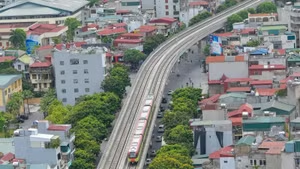
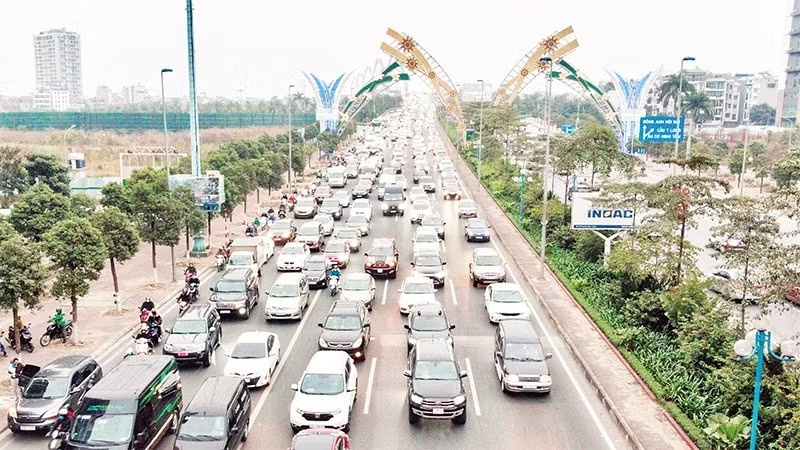
Although significant resources have been allocated to transport infrastructure and public transport, traffic congestion in Ha Noi continues to worsen.
Nguyen Phi Thuong, Director of the Department of Construction, said the city currently has more than eight million cars and motorcycles, while land allocated for transport accounts for only 12.15 per cent — far below the 20 per cent standard of developed cities. Personal vehicles are increasing by 5–10 per cent annually, whereas infrastructure expands by just 0.3 per cent. This imbalance is a key factor behind the increasingly severe traffic congestion.
Traffic congestion is also one of the main causes of air pollution. Since the fourth quarter of 2024, Ha Noi has frequently ranked among the world’s most polluted cities.
Recently, Ha Noi has made a noteworthy step forward by cleaning up To Lich River and preparing to implement projects to develop and renovate parks along both banks. However, beyond To Lich River, many other rivers and lakes still require rehabilitation. Greater focus and stronger efforts are needed to ensure that this progress is sustainable.
I have observed major changes and positive developments in Ha Noi recently, but there remain many challenges and difficulties, such as air pollution and pollution in rivers. To become a civilised and modern city where people are truly happy, these challenges must be addressed thoroughly in order to achieve higher development goals in the new period.
Ta Ngoc Tan,
Standing Vice Chairman of the Central Theoretical Council
A need for greater proactivity and determination
The Political Report of the 18th Ha Noi Party Congress clearly identifies these limitations and challenges.
Professor Phung Huu Phu, former Standing Vice Chairman of the Central Theoretical Council and former Standing Deputy Secretary of the Ha Noi Party Committee, praised the frank and self-critical spirit of the Political Report, noting that it openly points out shortcomings as a basis for focused corrective action.
Among the most persistent issues are long-standing urban problems such as traffic congestion, environmental pollution, and flooding. “These are urban ‘chronic illnesses’ that have lasted for decades.
If they are not resolved thoroughly, people will find it difficult to feel true happiness,” Professor Phu said. He added: “Happiness is not an abstract concept. Happiness means being able to breathe clean air, travel safely, eat safe food, and commute smoothly without congestion, crowds, or pollution. That is why Ha Noi today must be a city that means what it says - acting quickly, correctly, effectively, and decisively, with a proactive and resolute spirit.”
Ha Noi Party Secretary Nguyen Duy Ngoc stressed: “For issues such as traffic congestion, flooding, environmental sanitation, urban order, and food safety, the city has clearly identified their root causes. In the long term, we must develop comprehensive plans to address each issue fundamentally.
“I request that standing agencies such as the Department of Health, the Department of Construction, the Department of Agriculture and Environment, and the city police promptly complete detailed proposals and report them to the Standing Committee of the Municipal Party Committee. These plans must ensure rapid remediation of shortcomings and the most effective resolution of these problems.”