Remarkable progress
According to Nguyen Dinh Hoa, Deputy Director of the Ha Noi Department of Agriculture and Environment, when Ha Noi first began implementing the National Target Programme on Building New-Style Rural Areas, the city had the participation of 401 communes, ranking among the localities with the largest number of commune-level administrative units nationwide. Later, following administrative reorganisation, the number of communes decreased to 382, but on average, each commune initially met only one criterion for new-style rural areas.
“Nevertheless, the programme has mobilised the participation of the entire political system, with enthusiastic engagement from businesses and citizens alike, creating a far-reaching movement that has fundamentally and comprehensively transformed agriculture and rural life,” Hoa shared.
Over 15 years of implementation, residents across Ha Noi’s rural regions have actively joined hands to build their hometowns. The city has introduced many practical initiatives with distinctive approaches, such as the “Model New-style Rural Commune of Dong Trung linked with tourism”; the orientation towards organic and ecological agriculture; and the “Saturday for New-stye Rural Areas” and “Green Sunday” campaigns. Notably, the city has also gathered public feedback to assess citizen satisfaction.
According to the Ha Noi Coordination Office for the New Rural Development Programme, during the 2021–2025 period, Ha Noi achieved a significant milestone by fulfilling the city-level new-style rural development target in 2024 — a full year ahead of schedule.
The capital now leads the nation in new rural development with impressive figures: 100% of its communes have met the new rural standards, with 229 communes recognised as advanced new-style rural areas and 109 as exemplary models.
In addition, Ha Noi’s “One Commune, One Product” (OCOP) programme also ranks first nationwide, with over 3,400 products evaluated and classified. The city’s two craft villages, Bat Trang ceramics and Van Phuc silk, became Viet Nam’s first members of the UNESCO Creative Cities Network for Crafts and Folk Arts. Ha Noi’s handicrafts and processed agricultural products are now exported to more than 40 countries and territories.
The capital’s economy has grown strongly and living standards have improved continuously. Rural per capita income has risen from 13 million VND in 2010 to 74.3 million VND in 2024, the highest in the country. Ha Noi has also completely eradicated poverty.
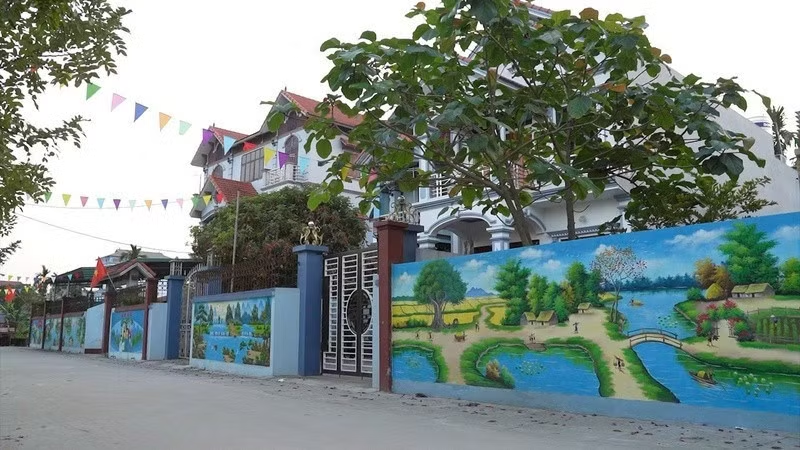
Rural infrastructure has been synchronously and modernly upgraded, with 100% of inter-commune and village roads concreted or asphalted, and all commune health stations meeting national standards. Between 2010 and 2024, Ha Noi mobilised over 185 trillion VND for rural development, with more than 21 trillion VND contributed directly by residents.
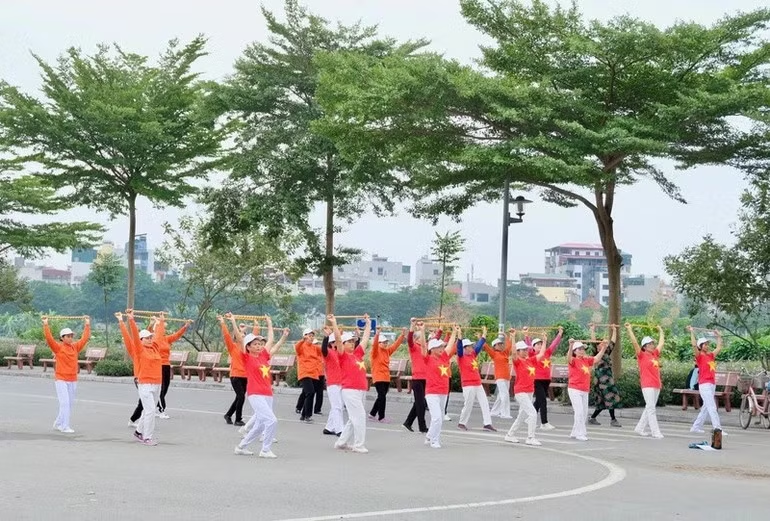
The New-style Rural Development Programme has truly become a reflection of the “Party’s will and the people’s hearts,” fostering profound changes across the economic, social, cultural, and environmental spheres; improving the quality of life; and shaping a modern and civilised rural landscape, providing a solid foundation for the capital’s next stage of growth.
A new phase of development
As the 2021–2025 phase of the new-style rural development programme draws to a close, Ha Noi is preparing for the next chapter. The government plans to integrate three national target programmes, new-style rural development, sustainable poverty reduction, and socio-economic development in ethnic minority and mountainous areas, into a unified framework with consistent management and implementation mechanisms. Among them, new-style rural development will continue to be a key focus, aimed at enhancing farmers’ livelihoods and narrowing the gap between rural and urban areas.
Ngo Van Ngon, Deputy Chief of the Ha Noi Coordination Office for the New-style Rural Development Programme, stated that the central government is drafting new criteria for the 2026–2030 National Criteria Framework for new-style rural areas, granting localities more authority to issue their own criteria. The national framework is expected to be issued in November or December, providing the basis for Ha Noi to formulate its city-level criteria.
According to the city’s orientation, Ha Noi’s communes will be classified into three groups for the next phase: Group 1: communes adjacent to existing urban areas, oriented towards urban development; Group 3: communes located in ethnic minority and mountainous regions (such as Ba Vi, Suoi Hai, Yen Bai, and Yen Xuan); Group 2: all remaining communes.
Based on this classification, specific criteria will be developed to suit local conditions and socio-economic needs, thereby ensuring that standards meet or exceed those set by the central government.
With a strong foundation, high political determination, and the unity of its people, Ha Noi is expected to continue advancing on the path of building a capital rich in identity, modern, civilised, and happy, in which progress is not only measured by growth figures but also by the quality of life and the happiness of its citizens.