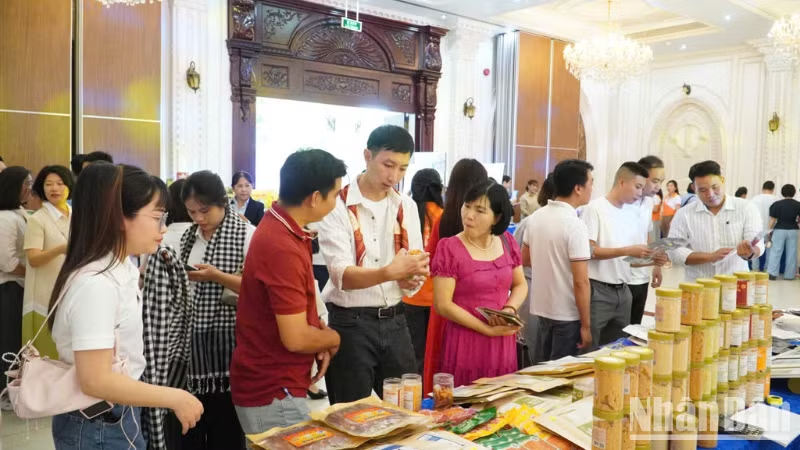
Going beyond trade promotion meetings, the programme connecting businesses in Can Tho with Ha Noi aims at more specific goals: seeking partners, expanding distribution networks and gradually bringing agricultural products, food and OCOP products from Can Tho deeper into the northern market.
According to the Can Tho Department of Industry and Trade, the city is the economic, trade, service, education, science and technology centre of the Mekong Delta, with many advantages in agriculture, food processing, logistics and trade.
The locality has a diverse range of products, from rice, fruit and seafood to OCOP products and processed foods with added value. However, the challenge facing businesses is not only to produce quality products but also to expand consumer markets, build sustainable linkages and improve competitiveness.
Meanwhile, Ha Noi has a modern distribution system, a well-developed retail network and diverse consumer demand. It is considered a market with great potential for products from Can Tho and provinces and cities in the Mekong Delta.
Building on the advantages of the two localities, Can Tho wishes to strengthen connections between production businesses and distribution systems in Ha Noi; and support the introduction of agricultural products, food and OCOP products into supermarkets, shopping centres, wholesale markets and modern sales channels.
Alongside traditional trade promotion, the locality also aims to support businesses in promoting e-commerce, digital transformation and building comprehensive linkage chains from production to consumption.
In the opposite direction, Ha Noi is also implementing many programmes to support the business community. Le Thi Hien, Deputy Director of the Ha Noi Investment Promotion and Business Support Centre, said that the city currently has around 450,000 registered businesses.
The support programmes focus on investment promotion, digital transformation, innovative entrepreneurship, business incubation in food processing and packaging, and human resource training.
Notably, in 2026, Ha Noi is providing full funding for 10 CEO training courses for small and medium-sized enterprises owned by women and enterprises employing a large number of female workers. The programme comprises more than 20 study sessions in Ha Noi, field visits to large enterprises and four days of study in several localities.
Can Tho is one of the destinations selected on multiple occasions. During this programme, the trainees had the opportunity to visit and learn from the experience of Can Tho Eco Resort, Minh Phu Seafood and Tan Hue Vien.
According to Hien, what Ha Noi businesses are interested in when visiting Can Tho is not only how businesses are operated. More importantly, it is the experience of turning advantages in land, rivers and waterways, local produce and culture into branded products with competitiveness and the ability to reach wider markets.
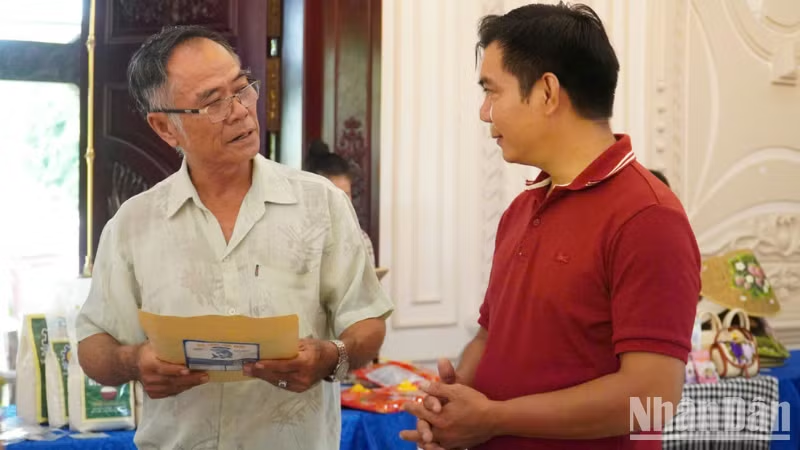
For Can Tho businesses, the opportunity to access northern distribution systems is becoming increasingly clear. Nguyen Phu Tri, Director of Minh Duc Thanh Trading One Member Company Limited, said that his business is developing a range of speciality products made from pangasius and snakehead fish, including dried pangasius, dried snakehead fish, ready-to-eat dried pangasius and snakehead fish, as well as smoked pangasius.
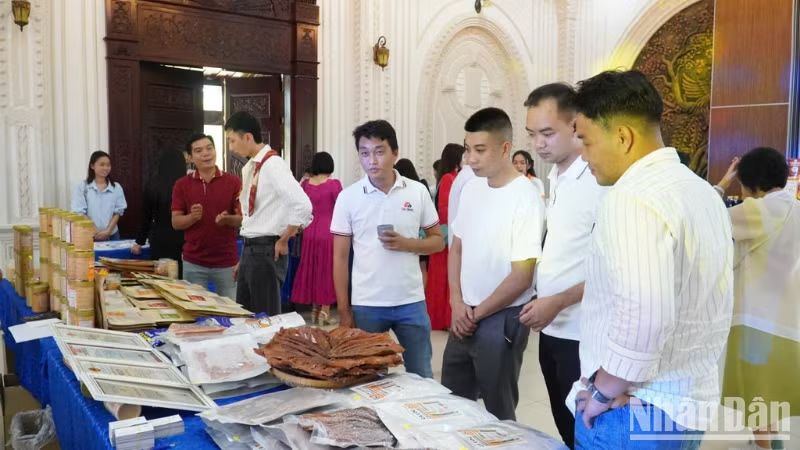
All of the company’s products have achieved four-star OCOP certification, while its factory has obtained ISO 22000 certification. This provides a foundation for the business to continue seeking distribution partners in the north.
According to Tri, the business already has several partners and is continuing to expand its connections. One of the issues of concern to the business is the transportation of goods from the south to the north, as logistics plays an important role when markets are expanded.
According to Ha Vu Son, Chief of the Office of the Can Tho Municipal Party Committee, activities to promote and connect businesses from Ha Noi with Can Tho have achieved positive results in recent times. Through these programmes, more than 30 businesses have participated in trade promotion activities, surveys and field investment visits in Can Tho in various fields such as energy, animal feed production, trade and services.
Based on these results, Ha Vu Son said that connectivity activities should continue to be implemented in a more practical direction, creating conditions for Ha Noi businesses to directly learn about the investment environment, visit businesses, access products and seek cooperation opportunities in Can Tho.
If maintained regularly and developed in greater depth, connectivity between Can Tho and Ha Noi will contribute to expanding outlets for Can Tho’s agricultural products, food and OCOP products; while creating additional opportunities for investment, trade and service cooperation between businesses in the two localities, thereby increasing product value and strengthening economic linkages in the coming period.


![[Video] Eight-month public investment disbursement reaches 50% of yearly plan](https://en-cdn.nhandan.vn/images/nyM650OGFWrOVWc-xajqNz57td8idIAL_VG9puyG2UZSh9a-ip79SRwvbzBwNEcQ_SZtLGThwR4Kp7S4xd9nklBm2seVye4c367gN-6eKf4/giai-ngan-von-dau-tu-cong.jpg.avif)