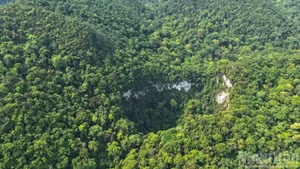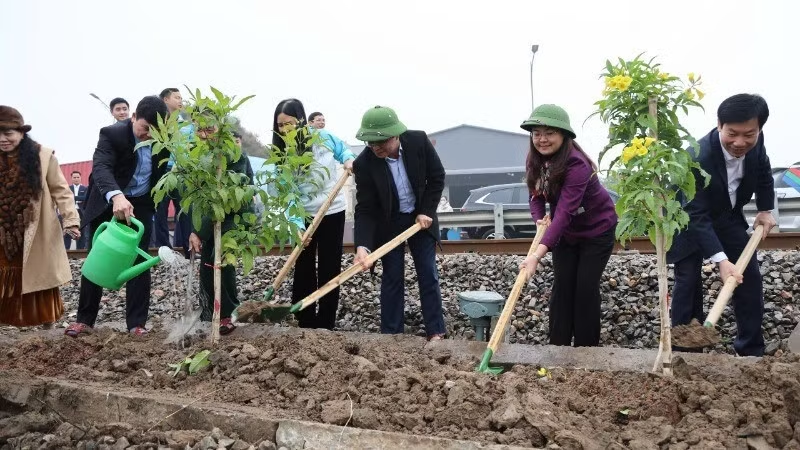
In 2025, despite numerous difficulties and challenges posed by climate change and extreme natural disasters, approximately 285,000 hectares of concentrated forest were planted nationwide (achieving 109.5% of the plan), along with 108 million scattered trees.
These efforts have played an important role in environmental protection, maintaining forest coverage at a stable 42.03%, and supplying raw timber for the wood-processing industry. Processed timber output reached 32.8 million cubic metres, while export value of timber and forestry products exceeded 18 billion USD, making a significant contribution to the country’s total agro-forestry-fishery exports.
After five years of implementing the One Billion Trees Planting Project for the 2021–2025 period, more than 1.439 billion trees have been planted nationwide, surpassing the target by 43.9%. Of these, 573.9 million are scattered trees (including 87.5 million urban trees and 486.4 million rural scattered trees), while more than 865 million trees have been planted in concentrated forests, equivalent to 429,125 hectares of forest. This includes 36,745 hectares of protection and special-use forests and 392,380 hectares of newly established production forests.
After five years of implementing the One Billion Trees Planting Project for the 2021–2025 period, more than 1.439 billion trees have been planted nationwide, surpassing the target by 43.9%. Of these, 573.9 million are scattered trees (including 87.5 million urban trees and 486.4 million rural scattered trees), while more than 865 million trees have been planted in concentrated forests, equivalent to 429,125 hectares of forest. This includes 36,745 hectares of protection and special-use forests and 392,380 hectares of newly established production forests.
In addition to native and rare species planted in special-use forests, many timber and long-lived species have been selected by localities for protection forests to enhance watershed protection, soil conservation, water retention, desertification prevention, and ecological preservation.
Production forests have been developed to provide large timber, fruit trees, and multi-purpose non-timber forest products. Urban tree species have also been planted along pavements, in parks, flower gardens, and public squares; within the premises of offices, schools, hospitals, factories, industrial parks, and export processing zones; at religious sites, in home gardens, and other public spaces in both urban and rural areas. These efforts create greener landscapes, provide shade for recreation and environmental protection, contribute to new-style rural development, and improve public health.
The One Billion Trees Planting Project is regarded as having made a highly significant contribution to climate change response and global nature restoration efforts, while delivering tangible progress in fulfilling Viet Nam’s international environmental and climate commitments in recent years.
Amid increasingly complex climate change impacts, frequent natural disasters, and extreme weather events, tree planting and afforestation have become ever more vital in mitigating disasters and safeguarding the ecological environment.
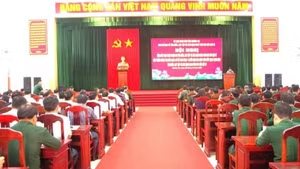
To effectively respond to this year’s “Tree-Planting Festival in eternal gratitude to President Ho Chi Minh”, ministries, sectors, localities, and agencies are urged to intensify communication and education efforts, raising awareness of the role, significance, and value of forests and trees in socio-economic development, environmental protection, climate change adaptation, and the enhancement of people’s quality of life.
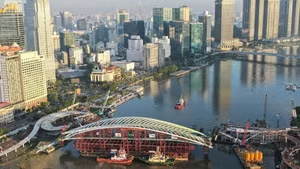
Authorities at all levels should organise the Tree-Planting Festival in a practical, efficient, economical, and safe manner, avoiding formality. Suitable timing, locations, and species should be selected in accordance with ecological conditions, seasonal cycles, and the cultural characteristics of each region and locality. Priority should be given to planting scattered trees in residential areas, schools, hospitals, industrial zones, urban areas, transport corridors, riverbanks, and canals, thereby enhancing landscapes, reducing pollution, and building greener living spaces.
At the same time, clear responsibilities must be assigned for the management, care, and protection of trees after planting. The participation of mass organisations, schools, enterprises, armed forces, and communities in post-planting care and protection should be encouraged. It is also necessary to mobilise and effectively integrate socialised resources, public investment funds, and other lawful programmes and projects for forest planting and protection.
Alongside tree planting and afforestation, forest protection and fire prevention must be strengthened. Greater application of information technology, digital technology, and artificial intelligence in forest management and protection should be promoted. Fire prevention and firefighting plans must be reviewed and updated to reflect practical conditions, with forces, equipment, and logistics prepared under the “four on-the-spot” principle to respond promptly to forest fire incidents. Inter-agency coordination should be enhanced to detect, prevent, and strictly handle violations of forestry law in a timely manner.