Over the past 80 years, the National Assembly of Viet Nam has accompanied the nation through historic turning points, from the early days of national founding to the process of renewal, integration and development. As the highest State power body, the National Assembly not only decides major issues of the country but is also the place that concentrates the will and aspirations of the people in the process of building a socialist rule-of-law State.
Towards the election of deputies to the 16th National Assembly and deputies to People’s Councils at all levels for the 2026-2031 term, Nhan Dan Newspaper organised a roundtable discussion with the participation of managers, politicians and experts to review the 80-year journey of the National Assembly of Viet Nam, and at the same time discuss new requirements and tasks placed on the National Assembly as the country enters a new era.
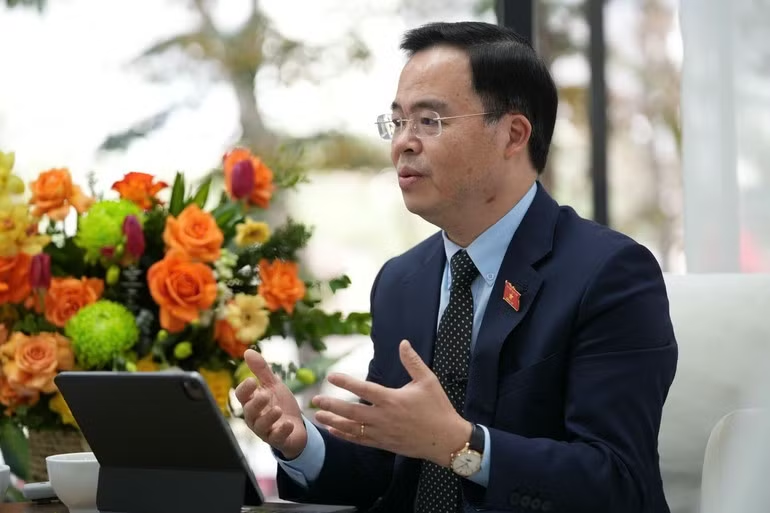
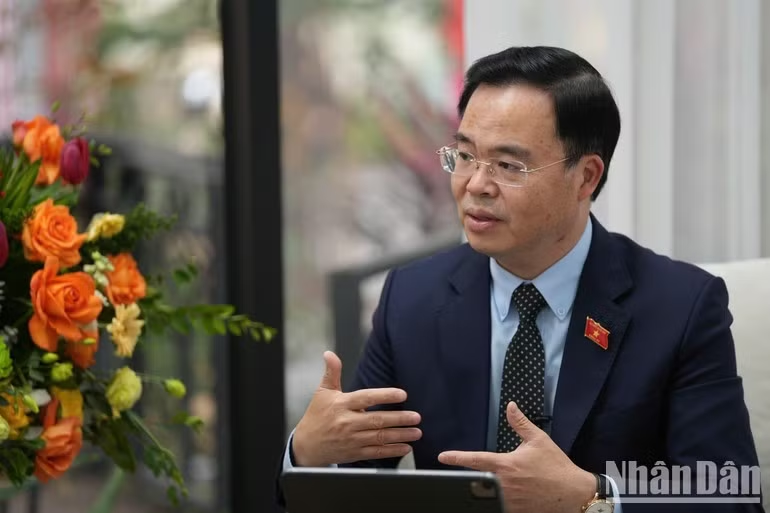
Continuing the series of discussions, with the theme “The National Assembly of Viet Nam and the strong transformation in the digital era”, on the afternoon of March 13, Doctor Tran Van Khai, deputy of the 15th National Assembly, Deputy Chairman of the National Assembly’s Committee for Science, Technology and Environment, shared many perspectives on the role of digital transformation in improving the effectiveness of parliamentary activities, enhancing transparency and better serving the people and voters.
Digital transformation promotes strong innovation in the operation of the National Assembly
Opening the discussion, looking back at the 80-year journey of formation and development of the National Assembly of Viet Nam (from January 6, 1946 to present), Doctor Tran Van Khai affirmed that science, technology and innovation, especially digital transformation, play a key and important role, helping the National Assembly strongly transform its mode of operation, clearly shown through three important highlights:
First, shifting from a model based largely on paper documents and manual procedures to a model based on data and digital processes.
Second, increasing the speed of handling work to meet the requirements of the Party and the State, reducing policy delay, especially improving the productivity of parliamentary work.
Third, establishing modern governance thinking: throughout the National Assembly system, a new mindset has been formed that considers data as a production resource and digital technology as the main management tool for all activities.
A particularly practical milestone was the Covid-19 period: the Resolution on the digital National Assembly recorded that the National Assembly adapted to a new working method, organised many online meetings, electronic voting (including from mobile devices), digitised documents for deputies, not only avoiding interruption but also making timely decisions, creating a legal corridor for the Government to act decisively.
An important turning point in this process was the issuance of Resolution No. 1343 of the National Assembly Standing Committee on building and developing the digital National Assembly for the period 2024-2026, with orientation to 2030. This Resolution clearly defines the goal of placing people, voters and deputies at the centre of the National Assembly’s digital transformation process.
Through the digital environment, legislative work, synthesis, analysis and legal system search are carried out faster and more accurately. At the same time, coordination between the National Assembly, the Government and agencies in the political system in the process of performing legislative, supervisory and decision-making tasks on important national issues has become increasingly close and effective.
According to Doctor Khai, digital technology helps the National Assembly become more public, transparent and closer to voters. Digital technology is expanding the “window of transparency” when National Assembly activities are widely broadcast and reported, allowing voters to follow parliamentary activities in real time and by topic. Digital technology also improves two-way interaction through systems for receiving, monitoring and managing voters’ petitions and complaints, creating a clear path for people’s feedback.
The National Assembly pioneers the “Digital literacy for all” movement
Mentioning the movement “Digital literacy for all – Digital National Assembly”, Doctor Tran Van Khai said that the movement concretises the requirement of Resolution 57 of the Politburo on widely implementing digital learning, disseminating and improving digital knowledge and skills for National Assembly deputies and officials of National Assembly agencies, while creating a lifelong learning culture within the National Assembly. The National Assembly has shown its pioneering and exemplary role in implementing this movement.
Starting from the concern raised by General Secretary To Lam about the movement “Digital literacy for all”: “Where do we start” when the general level of knowledge and skills is uneven, and how to begin effectively, the National Assembly assigned the Committee for Science, Technology and Environment to directly lead the development of the digital knowledge and skills framework, curriculum, lectures and learning materials based on the national digital skills framework to be implemented on the National Assembly’s digital platform at four levels: basic, intermediate, advanced and specialised.
Practical effectiveness has been demonstrated through improved digital skills, with legislative, supervisory and people’s petition activities in the digital environment reaching a higher level of quality.

Doctor Khai said that the movement has created a strong spreading effect. General Secretary To Lam directed that the digital literacy and digital National Assembly movement must be expanded not only within the National Assembly but also to the system of provincial People’s Councils and more than 3,000 communes. On the basis of upgrading from the digital National Assembly to digital People’s Councils, and finally to the highest level of “Digital citizen”, this model will be expanded and integrated into the national digital literacy application, allowing all people to participate in learning, improve skills and have results recognised transparently, similar to the vaccination data management during the Covid-19 pandemic.
Designing laws so that “the more digital, the more standards are required”
Sharing about key solutions to complete the legal framework for digital transformation and development of science and technology in the spirit of Resolution 57-NQ/TW of the Politburo, Doctor Tran Van Khai emphasised that the top priority is to continue to renew legislative thinking. Laws must ensure State management while encouraging innovation, eliminating the mindset of “if it cannot be managed, it is banned”, opening the way for pilot mechanisms, sandbox models and conditional liability exemptions.
At the same time, laws must be designed in the direction that the more digital, the more standards are required; institutionalise mechanisms for mobilising resources; complete the legal ecosystem for data; strengthen evidence-based legislation; and ensure that cybersecurity and data security are consistent requirements throughout the legislative and supervisory process, in accordance with the spirit of Resolution 57 - digital transformation must be safe, not carried out at all costs; and refer to modern digital governance frameworks (for example OECD) to improve principles of data governance and digital service governance centred on people and businesses.
Applying digital technology to make election work more convenient and transparent
The election of deputies to the 16th National Assembly and deputies to People’s Councils at all levels for the 2026–2031 term is entering an important stage. In the context of strong digital transformation in many fields of socio-political life, the application of digital technology in election work has received great attention from voters.
On this issue, Doctor Tran Van Khai said that the National Assembly Standing Committee considers the application of digital technology in election preparation and organisation as one of the key tasks.
Digital platforms contribute to transparency by integrating information on electronic identification from March 8, providing candidate information, polling locations and guidance procedures on official channels, reducing rumours and false information, while increasing voters’ ability to check and verify information, limiting errors and reducing voters’ time costs, suitable for the context of flexible movement and residence.
The nationwide election results will be updated quickly and accurately on March 15.
However, Doctor Khai emphasised that the application of digital technology in elections must serve three core governance goals: compliance with the law, convenience and transparency, while still ensuring the election principles of universal suffrage, equality, direct voting and secret ballot.
Taking practical effectiveness for the people as the measure
On this occasion, as a candidate for the 16th National Assembly, the Deputy Chairman of the National Assembly’s Committee for Science and Technology shared with Nhan Dan Newspaper that each deputy must act to build voters’ trust, and this must be the guideline for all actions.
“Even when we meet all requirements of the organisations that introduce candidates and are approved by the Viet Nam Fatherland Front or the National Election Council, we must always remember that it is not enough to speak well or give attractive messages, but must act concretely,” Doctor Khai stressed.
Emphasising that people are increasingly concerned about National Assembly activities, he said each deputy must always commit to listening to voters’ opinions to the end, especially strictly implementing the discipline of voter meetings.
According to Doctor Khai, practical effectiveness for the people must be taken as the measure, and voters’ petitions must be pursued to the end.
“I always remind myself that greater efforts are needed, with priority given to proposing laws that create digital content towards a digital Government, a digital society and a digital economy. Investing only in technology and infrastructure is not enough; it is important to improve digital knowledge and skills for all people to ensure everyone keeps up and no one is left behind in the digital transformation journey,” Doctor Khai said.
He expressed his hope that voters nationwide will fully participate in the election, exercise their rights and responsibilities as citizens, and choose worthy representatives, ensuring the highest effectiveness for the great national festival.