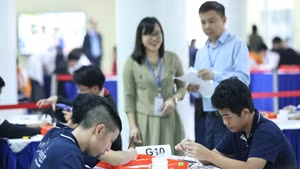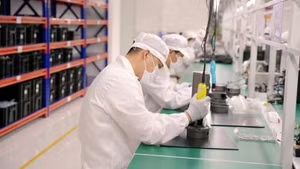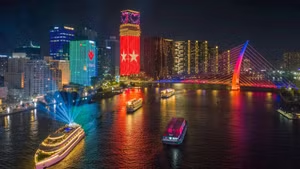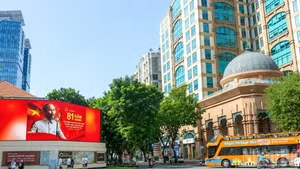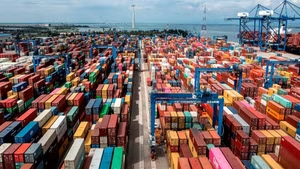
However, the city also faces considerable challenges that require fundamental and strategic solutions to achieve a breakthrough.
With its strategic position in Southeast Asia, Ho Chi Minh City is not only the economic engine of the country but also a cradle of innovation, creativity, and resilience in the new era.
According to experts, over the past decade, the city’s economy has expanded 2.7 times, while its per capita GRDP has doubled compared to 2010. The city has also recorded significant achievements in education and training, healthcare, culture, society, science and technology, all contributing to an improved quality of life for its residents.
Dr Du Phuoc Tan from the Ho Chi Minh City Institute for Development Studies noted that in order to maintain its role as a growth hub and a key driver of the Southeast region, the city has taken the lead in designing and piloting a number of special policy mechanisms in areas such as investment management, finance, urban governance, natural resources and the environment. It has also prioritised attracting strategic investors, enhancing scientific and technological governance, and promoting innovation and entrepreneurship.
In this new era, the city continues to assert itself as the “heart” of Viet Nam’s economy. With a combination of entrepreneurial spirit, reform efforts and strong commitment to sustainability, Ho Chi Minh City is striving to renew its growth model towards becoming a modern, dynamic metropolis capable of seizing global trends.
However, the city is grappling with challenges such as inadequate and uncoordinated infrastructure, traffic congestion, environmental pollution, a shortage of skilled labour, and increasing population pressures that strain the availability of social housing, hospitals and schools. Institutional and policy shortcomings, in particular, remain major barriers to sustainable development.
To overcome these issues, the city must clearly identify its core priorities, build a foundation of smart governance, improve quality of life, and strike a balance between economic growth and sustainable development. Addressing these challenges effectively will enable the city not only to retain its leading position domestically but also to expand its regional and global reach, becoming a model of a modern and liveable city.
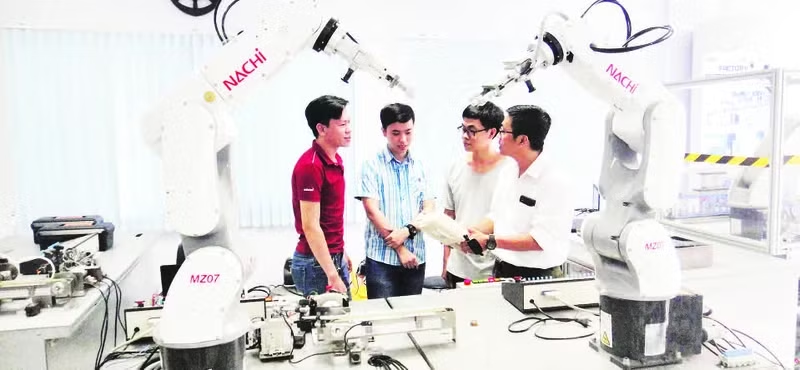
Amid the rapid advancements of the fourth industrial revolution, experts argue that Ho Chi Minh City should fully embrace and creatively apply a proactive “leapfrogging” strategy. This means prioritising the training and upskilling of the workforce in advance, particularly in high-level fields, and focusing investment on core technologies such as artificial intelligence, robotics, and big data analytics. These technologies should be applied to transform production models and pilot new forms of economic development.
The “leapfrogging” approach should be flexibly adopted with the mindset that “those who move faster will prevail.” To enhance competitiveness, Dr Du Phuoc Tan suggests that the city must follow a “value chain” approach—both within enterprises and in connection with global value chains—while developing a comprehensive ecosystem for green economic growth with a well-defined roadmap.
Notably, greater emphasis should be placed on communication to raise awareness among both citizens and businesses about green development, contributing to the sustainable growth of enterprises and the economy at large.
In addition, experts stress that institutional and policy constraints are a key factor hindering the mobilisation of development resources. Addressing these bottlenecks could unlock other solutions and remove remaining obstacles. Institutional reform, therefore, must be a top priority.
Ho Chi Minh City still holds significant untapped potential, with the greatest room for progress lying in institutional reform. Unlocking this potential is seen as the "breakthrough of all breakthroughs" and must be implemented swiftly.
With regard to human resources, the city needs bold policy innovations to encourage the participation of experts and scientists in publicly funded projects. It should also urgently operationalise the contents of Resolution No. 98/2023/QH15 on piloting special mechanisms and policies for the development of Ho Chi Minh City—particularly those concerning incentives to attract highly qualified professionals in research, development, and innovation.
Dr Le Bi Bo of the Ho Chi Minh City Cadre Academy emphasises that building a high-quality workforce is the foundation for successfully implementing policies. The city must focus on training and developing a team of competent officials and civil servants with vision and modern management skills to meet the increasing demands of development.