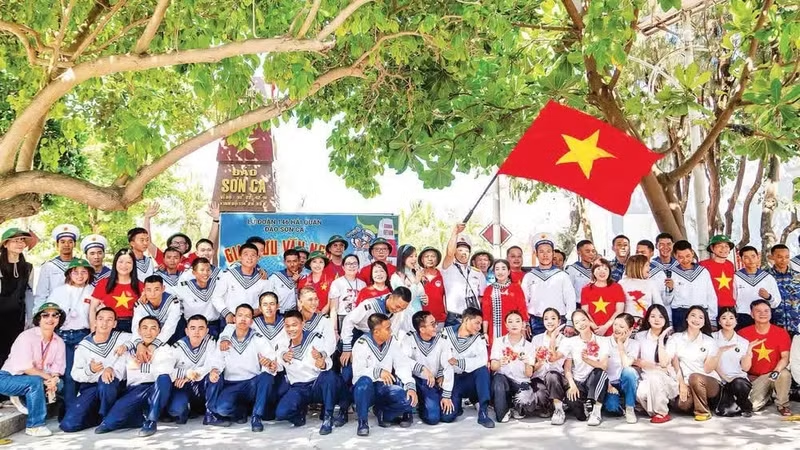
For more than half a century, generations of cadres, soldiers, and local people here have steadfastly remained by the sea and the islands, day and night safeguarding the sacred sovereignty of the fatherland. 51 years have passed. From an archipelago once almost completely white with only coral and sand, green has now taken firm root and gradually spread across this land in the middle of the ocean, so that Truong Sa (Spartly) stands proudly amid the sea and sky of the fatherland.
Keeping green shoots alive in Truong Sa (Spartly)
No one knows how many things drift from the mainland out to sea, but island soldiers remember very clearly that a coconut once washed ashore and unexpectedly sprouted a green shoot on a pale coral beach. The story of that coconut was told by an old soldier on a voyage to Truong Sa (Spartly) 18 years ago, like a message.
At that time, life on the archipelago was still full of hardship. Amid towering waves and storms, in a place of only men and stories told over and over again, the appearance of a new life quickly captured the attention of sea soldiers. It was so captivating that it was likened to “a beauty appearing in the middle of the ocean.” From then on, amid a busy working schedule filled with training programmes, the island commander carefully added one line: “Care for and water the new tree.”
Back then, fresh water was “blood” in Truong Sa (Spartly). In the dry season, ships had to travel more than 300 nautical miles to bring this source of life to the islands. Yet in their daily life, the sea soldiers still saved every precious cup of water used for washing their faces to water the tree. On patrol under the scorching sun, they still carried water to sustain the newly sprouting leaves.
Truong Sa (Spartly) soldiers, like trees, change leaves season after season. Generations of soldiers took turns caring for the coconut tree until it bore fruit, but they decided not to eat the coconuts and instead kept them all for seed. In a place where a season of sweet fruit is a whole fortune, they chose to save it for the next season. From that frugality, alongside square-fruited barringtonia and beach morning glory, the island began to have rows of coconut palms.
The aspiration of a saline land
Truong Sa (Spartly) has now changed considerably, but the sun, wind, and aspiration to make the islands greener have never ceased. In mid-April, before thunderstorms had arrived, ships still patiently carried thousands of saplings from the mainland. On the islands, rows of trees at the edges were covered in white coral dust because they had not been “bathed” for a long time.
Young soldier Pham Van Quyen smiled gently: “This season the sun burns from morning until night. We have to wait until the moon rises before it is time to plant trees.” When night falls, the island becomes lively in its own way. Under the moonlight, some dig holes, others push handcarts carrying water, and laughter and voices drown out the sound of the waves.
People often say “water first, fertiliser second, diligence third, and seed fourth,” but here, almost everything has to begin from zero. Soil must be transported from the mainland. Holes must be dug deep and lined with geotextile fabric to keep the soil from being washed through the coral crevices before a sapling can be placed inside.
The wind here does not merely blow; it lashes and tears. Major Pham Van Long, from Quang Tri, said: “The wind here is even harsher than the Lao wind back home. Standing guard at noon, the wind lashes your face until it stings.” Looking at the newly planted casuarina shoots, he added: “Here, planting a tree is not simply planting it, but keeping it from dying. But we keep hoping. After a few seasons, if it survives and grows green, it will help shield us from the sun and wind.”
The creativity of island soldiers is also deeply moving. Pipes collecting water from air conditioners are led into neatly arranged plastic containers. “We also save water from bathing and washing. Green trees and clean vegetables all need water. Not a single drop is wasted,” soldier Pham Van Quyen said eagerly.
A young officer named Hoang Van Hai laughed: “In the past, when we first arrived on the island and missed home, the older soldiers would assign us the job of scraping the scales off the fish which has tough skin and must be skinned completely; there is no such thing as scraping its scales. But new soldiers did not know that. We kept struggling with an impossible task and forgot our homesickness. Now, the younger soldiers train and plant trees, living together with the collective. It is much happier.” Hai then fell silent, his eyes still watching the young soldiers lift water containers from the cart to water the rows of trees swaying under the moonlight.
When green becomes flesh and blood
Colonel Ngo Dinh Xuyen, Deputy Chief of Staff of the Viet Nam People’s Navy, shared: “Planting trees in Truong Sa (Spartly) is both an urgent and long-term task. It is not only about having green colour, but also about improving the living environment and forming a sustainable ecosystem.” He stressed: “Trees here cannot rely on nature. They need human hands.”
But preserving that green is a long battle. Major Tran Manh Hung, who was once stationed on Song Tu Tay Island, recalled the storm in 2021, his voice lowering: “That night the wind roared terribly. We were on duty inside the unit, but our hearts were burning with anxiety. Hearing the trees outside cracking and breaking was as painful as hearing our own flesh and bones break. We knew the trees were enduring the storm, but we could not go outside because the wind could throw a person away at any moment. The helpless feeling of listening to the results of our efforts being torn apart in the darkness was very painful.”
The next morning, as soon as the storm had eased, before they even had time to tidy up their living quarters, the first thing the island soldiers did was rush straight to the green patches. What met them was a scene of devastation. Square-fruited barringtonia and casuarina trees that had stood with them for years had been uprooted and lay scattered everywhere, their leaves shredded by the salt-laden wind.
Major Hung continued: “Some young soldiers stood before the trees they had tended with their own hands, their eyes red-rimmed, as sad as if they had just lost a close friend.”
He paused, wiped a streak of sunlight from his face, and his eyes suddenly brightened with determination: “But we are soldiers. We were sad for a while, then told one another to start saving the trees. If any stump still had a little sap and hope, we raised it up again, built embankments and shelters around it, caring for it like a wounded soldier returning home. Here, if a tree falls, we plant it again; if it dies, we grow another. We are determined not to let the silvery white of salty sand overwhelm the green.”
There are places that were once green and then had to start over from the beginning like that. Today, on many islands, the green has gradually grown thicker. Only then can one understand that in Truong Sa (Spartly) Special Zone, trees do not grow on their own. Cool green gardens rise from the labour and devoted hearts of people on the mainland and those guarding the islands, meeting one another through care, watering, and planting.




![[Infographic] Key points from General Secretary and President To Lam’s opening remarks at the 14th PCC’S 4th plenum](https://en-cdn.nhandan.vn/images/j0QNt7m_5iy1OXpnUKiwG61aYhTv_B140GWhfriF26JwZbNNJ8LWetfvXUhz4Az6/1-8220.jpg.avif)