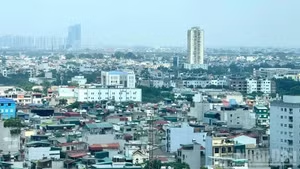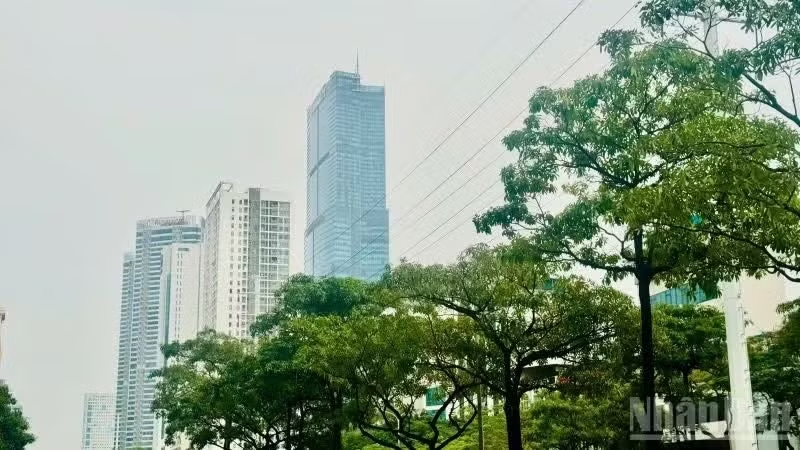
According to experts, the capital’s planning should be understood as a natural long-term transition process, helping to ease pressure on density and infrastructure in central areas while promoting growth in suburban districts.
If implemented effectively, this planning will not only improve quality of life but also help restore balance to the housing market, in line with Ha Noi’s long-term urban development orientation.
Supply recovers, selling prices continue to rise
In 2025, new apartment supply reached its highest level in the past five years, mainly coming from the mid-range segment (Grade B). Selling prices continued to rise, with the average primary price at around 102 million VND/square metre. Notably, products priced from 4 billion VND and above accounted for a large proportion, indicating that a new price benchmark is gradually being established, reflecting an increasingly clear trend of segment upgrading.
According to Do Thu Hang, Senior Director of the Research and Consultancy Department at Savills Ha Noi, market momentum is improving, but supply remains largely concentrated in the Grade B segment. Infrastructure expansion could open more opportunities to develop affordable housing products at more reasonable prices.
In 2026, the market is expected to receive approximately 18,454 new apartments, mainly in the Grade A and B segments. Nearby provinces such as Hung Yen and Bac Ninh are expected to play an increasingly important role in addressing unmet demand in Ha Noi, thanks to advantages in land availability and transport connectivity.
Mega-urban areas drive suburban shift, urban planning creates momentum
Mega-urban areas continue to play a leading role in supply and transactions. In 2025, projects such as Vinhomes Ocean Park (Gia Lam), Vinhomes Smart City (Nam Tu Liem), Vinhomes Global Gate (Dong Anh), and Vinhomes Wonder City (Dan Phuong) accounted for more than 50% of total new supply and transactions in the whole market.
Notably, all these projects are located outside the central core, spreading across strategic development directions to the east, west, and north of Ha Noi. This shows that the shift in development space has become increasingly evident in recent years.
This trend also reflects how the market is “moving ahead” of planning directions, as homebuyers and investment flows have proactively shifted towards areas with large land funds, improved infrastructure, and the potential for large-scale urban area developments.
In this context, Ha Noi’s master plan with a 100-year vision is considered a strategic long-term step, helping to reinforce and accelerate the shift already taking shape in the housing market.
According to Matthew Powell, Director of Savills Ha Noi, areas outside the centre such as Dong Anh are emerging thanks to increasingly improved connectivity advantages, especially as new bridges come into operation. This helps shorten travel time and expand access to central areas.
At the same time, the development of large-scale projects is being rolled out, offering full amenities from housing and retail to schools, hospitals, and green spaces. This is an important factor making these areas more attractive to households. “New urban areas are capable of meeting the diverse demands of residents, from working people to children and the elderly, while providing more spacious and higher-quality living environments compared to the inner city,” Powell noted.