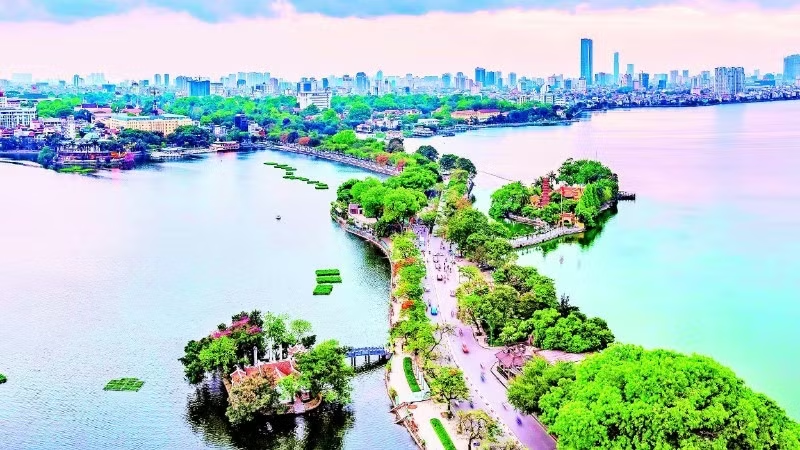
Ha Noi is entering its most beautiful weather days of the year. The city’s landscape is also changing as rivers and lakes, including the To Lich River, have undergone environmental remediation, becoming cleaner and greener.
Many rivers are being revived
Walking along the To Lich River, one can clearly feel the transformation of a river that was once heavily polluted. The river water is increasingly clear, reflecting the shadows of the trees. Many people are amazed to witness this rapid change. Nguyen Duc Hai, a resident of Ngoc Ha ward, said: “For decades, we have become accustomed to the pollution of the To Lich River. The city has invested in and renovated the river many times, but the problem hasn’t been completely solved; it always returns to its previous state after a while. Now, I see the river is cleaner. Although it’s not yet spotlessly clean, it’s still very good.”
During a meeting with voters in Constituency No.1, Ha Noi City, before the 10th session of the 15th National Assembly, General Secretary To Lam praised Ha Noi City for its proactive and decisive efforts in renovating the To Lich River. The General Secretary stated: “Recently, we have seen the To Lich River become cleaner and greener, which makes the people very happy…”
From being a historical and cultural river, the “dragon vein” of Thang Long – Ha Noi, the To Lich River has been seriously polluted for decades.
On November 27, 2024, during a meeting with the Standing Committee of the Ha Noi Party Committee, General Secretary To Lam requested the city to address the root causes of pollution, revitalise rivers, especially the To Lich River, and restore a clean flow to the capital. Following the General Secretary’s directive, the Ha Noi Party Committee and People’s Committee promptly established an inter-agency task force, assigning specific tasks to each department, agency, and locality.
Despite the tight timeframe, the city ensured that the To Lich River rehabilitation process was long-term and sustainable. Simultaneously with dredging the riverbed, all wastewater discharge points into the To Lich River were collected and channelled to the Yen Xa Wastewater Treatment Plant for treatment using modern Japanese technology. After treatment to meet standards, the wastewater is then replenished into the To Lich River, ensuring a continuous supply of clean water.
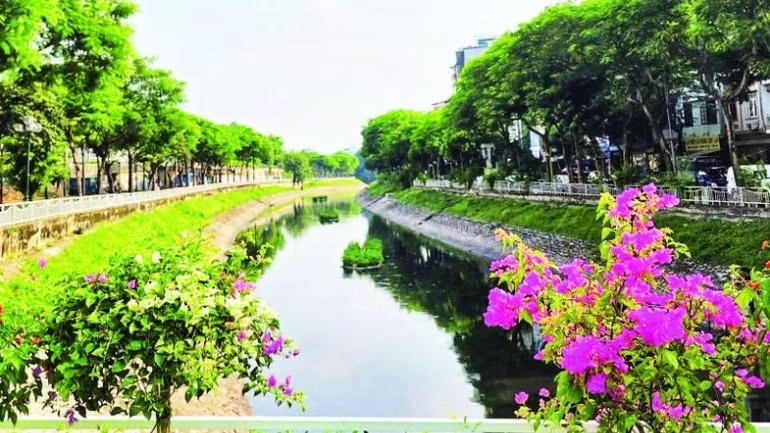
At the upstream area, two separate pipelines (120 cm in diameter, approximately 1,500 m long) officially began supplying water from West Lake on September 9, replenishing the To Lich River with an average of 15,000 m³/day, significantly improving its water quality. In many areas, the river water is clear and transparent, allowing visibility of the bottom. Many schools of fish swim freely.
Truong Quoc Bao, Head of the Yen Xa Wastewater Treatment Infrastructure Construction Project Management Board, shared: “Rarely has an environmental improvement project achieved such record progress. We received the order to deploy immediately, working three shifts, four teams day and night, including weekends and holidays, to meet the deadline. All for the goal of reviving the historical river of the Capital.”
Along with the To Lich River, Ha Noi is implementing the renovation of a series of large lakes. In 2025, a nearly 6-hectare park and regulating lake in Bo De ward was completed after almost two years of construction with a total investment of 173 billion VND. In early October, the Cu Khoi regulating lake project (Long Bien ward) also officially commenced construction with a water surface area of over 27 hectares, serving both to collect wastewater and create an environmental landscape.
In the northern part of the city, the communes of Dong Anh, Vinh Thanh, Thu Lam, etc., have renovated more than 100 ponds and lakes. The project to renovate and reinforce the Thiep River is being urgently implemented, creating an urban landscape for the northern part of the city.
For new urban areas, the construction of lakes is increasingly receiving attention. A prime example is the Vinhomes Global Gate lake urban area (located next to the Viet Nam National Exposition Centre, Dong Anh commune), where the investor has built a lake covering 32 hectares, both creating a landscape and regulating rainwater for the area.
The enduring beauty of a city of rivers and lakes
Ha Noi, since ancient times, has been centred around the Red River, thus forming a bustling Red River trading port. The Red River and other rivers in its system not only meander around the city but, over time, their course changes have left behind many lakes. Notable examples include West Lake and Hoan Kiem Lake.
Along with many other rivers and lakes, both within and outside the city, such as the To Lich River, Nhue River, Duong River, Cau River, Ca Lo River, Kim Nguu River, Lu River, Thiep River, etc., Ha Noi was once known as the city of rivers and lakes.
For a long time, due to a lack of proper understanding of their importance and inadequate management, many rivers and lakes became polluted. However, Ha Noi has focused on improving the environment of many rivers and lakes, such as Giang Vo Lake, Ngoc Khanh Lake, Bay Mau Lake, and especially reviving the To Lich River.
It’s impossible to make the To Lich River “clean and cool” as the folk song says overnight. Other rivers flowing through the inner city are heavily polluted, while the river system is interconnected. Therefore, rehabilitating the To Lich River is only the first step.
To address the issue comprehensively, Ha Noi has approved a project for restoring environmental quality and developing the system of four inner-city rivers, including To Lich, Kim Nguu, Lu, and Set, with synchronised solutions such as: pollution control and prevention; building a balanced and ecological inner-city river system; designing, planning, and improving the architectural landscape; strengthening capacity and raising awareness...
In early October 2025, Ha Noi will begin construction on a project to build a sewer system around the Lu River to collect all wastewater along the route to the Yen Xa Wastewater Treatment Plant, contributing to restoring the flow and creating a foundation for “reviving” the system of four inner-city rivers.
Experts highly praised Ha Noi’s efforts and proposed several solutions for more effective river environment restoration. Nguyen Hong Hieu, Deputy Director of the Water Resources Management Department under the Ministry of Agriculture and Environment, suggested that Ha Noi should develop and implement a river basin organisation model, gradually piloting water source restoration; invest in a comprehensive waste and wastewater collection and treatment system; and construct regulating structures to ensure flow and increase volume in inner-city rivers. He also emphasised the need for strict control of wastewater from industrial zones, craft villages, and residential areas.
Along with the city’s solutions to restore the beauty of rivers and lakes, experts believe that Ha Noi should strengthen environmental education, raise community awareness, and strongly promote environmental protection, creating a foundation of social consensus in the cleanup and restoration of its rivers.