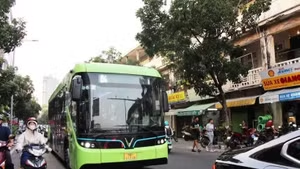
Under growing pressure on infrastructure, transport, the environment, and quality of life in urban areas, developing smart cities is seen as an important solution to optimise resources, improve governance efficiency, and enhance urban management.
Ha Noi develops the Smart City 3.0 model
A smart city is an urban model that applies modern technologies such as artificial intelligence (AI), the Internet of Things (IoT), and big data to enhance urban management and operations, and improve residents’ quality of life. In the context of rapid urbanisation and digital transformation, many localities in Viet Nam regard smart city development as a key objective.
Ha Noi is currently one of the leading cities in completing a smart city model. The accelerated process of developing and consulting on the plan for smart city development to 2030, with a vision to 2045, demonstrates strong political determination, while also reflecting the urgent need as the capital faces a series of challenges related to transport, the environment, and urban governance capacity.
The draft plan for smart city development in Ha Noi to 2030, with a vision to 2045, is designed according to the Smart City 3.0 model, with data at the centre and residents and businesses as beneficiaries. The architecture comprises four layers: smart infrastructure, centralised urban data, digital platforms, and a smart application ecosystem. In this structure, the Intelligent Operations Centre (IOC) is identified as the core of modern urban governance. The goal by 2030 is to synchronously form this architecture, operate the IOC at two levels of government, standardise and integrate data, and focus on addressing key issues such as flooding, traffic, the environment, public order and safety, and food safety. The vision to 2045 is to build a comprehensive smart city model linked to green growth and modern governance.
According to Luu Duc Minh, Deputy Director of the Academy of Managers for Construction and Cities (AMC), Viet Nam adopted early a plan for sustainable smart city development for the period 2018–2025, with orientation to 2030. However, this is a new field that requires learning from international experience and gradual concretisation under the practical conditions of each locality. From the perspective of urban management, he stressed that sustainable smart city development must begin with planning. The sustainable smart city development plan has established an appropriate framework of approach, in which learning from international experience is an important factor.
According to Le Vu Minh, Director of Consulting at FPT Digital, a smart city is a complex concept covering many areas, from infrastructure, energy, and the environment to digital government and community engagement. Rankings by IMD show that Ha Noi and Ho Chi Minh City are still at an early stage, reflecting a relatively modest level of development compared with international standards.
More “support” needed to move up
With support from the Government of the Republic of Korea (RoK), the Viet Nam–RoK cooperation project on smart cities and construction technology has been implemented, notably through the establishment of the Viet Nam–RoK Smart City and Construction Technology Cooperation Centre (VKC). The centre was initiated in 2022 by Viet Nam’s Ministry of Construction and the RoK’s Ministry of Land. Its objectives include technology transfer, human resource training, and the development of smart city solutions, as well as applying RoK’s Urban Planning Information System (UPIS) in Viet Nam.
Kim Byung Suk, President of the RoK Institute of Civil Engineering and Building Technology, assessed that cooperation among governments, businesses, and relevant organisations of the two countries is a key condition. The ultimate goal of smart cities is not technology itself, but improving quality of life and the happiness of residents.
From a broader perspective, Ngo Trung Hai, Secretary General of the Association of Cities of Viet Nam, noted that many cities currently remain at the level of understanding the concept or deploying operations centres focused mainly on cameras and traffic. A smart city cannot be merely a “camera city”, but must be a comprehensive model comprising multiple layers, from natural foundations and technical infrastructure to digital infrastructure and service infrastructure, all aimed at serving residents.
The application of a sustainable smart city criteria set with 17 groups of criteria and four levels is considered an important step forward, helping cities clearly identify where they stand and the roadmap ahead. Ngo Trung Hai assessed that this criteria set will provide a reference framework for each city to choose an appropriate path, optimise resources, and move forward steadily.
Developing smart cities in Viet Nam is a long-term process that requires perseverance and a comprehensive approach. Technology is only a tool, while institutions, data, planning, human resources, and public consensus are the decisive foundations. Removing institutional bottlenecks, building interoperable data systems, refining criteria sets, and promoting the State’s enabling role will be the key to ensuring that smart cities do not remain a slogan, but truly become a driver for improving quality of life and the competitiveness of Viet Nam’s cities in the future.