
In 2025, the labour force aged 15 and above reached 53.5 million people, an increase of 589.5 thousand compared to the previous year. However, the labour force participation rate was 68.6%, down 0.2 percentage points compared to the previous year, showing that the mobilisation of human resources in society is not yet commensurate with its potential...
Improving the quality of human resources, especially young human resources, is not only an immediate requirement but also a vital condition for Viet Nam’s labour market to shift from being “large” but not yet “strong” to being both “large” and “strong” in the new economic context. Notably, the quality of human resources remains a major “bottleneck” of the labour market.
The proportion of trained workers holding degrees or certificates in 2025 was only 29.2%, meaning that many workers have not received formal training and lack the necessary skills and professional qualifications to meet the increasingly high demands of the economy.
Meanwhile, the labour structure continues to shift in the direction of reducing the proportion of agriculture, forestry and fisheries, and increasing the proportion of industry, construction and services – sectors that require a labour force with higher skills and craftsmanship.
Another limitation is that the proportion of workers in informal employment remains high. In 2025, informal workers accounted for 63.1% of the total number of employed workers; of which the rural area accounted for as much as 73.3%.
Informal employment is often unstable, has low income, and lacks adequate social security protection, thereby reducing the overall quality of the labour market and limiting the ability to improve national labour productivity.
The unemployment rate among the working-age population in 2025 stood at 2.22%, reflecting the relatively good labour absorption capacity of the economy. However, if considered comprehensively, the labour market still shows a situation of underemployment and inefficient use of human resources.
The underemployment rate among the working-age population was 1.65%, concentrated mainly in agriculture, forestry and fisheries. In addition, the rate of labour underutilisation reached 3.9%, showing that a segment of workers has the need to work but has not been fully met in terms of working time and job opportunities.
This reality shows that Viet Nam’s labour market today is not only facing the requirement of creating more jobs, but more importantly, creating sustainable jobs with productivity and stable income, suitable to workers’ capabilities. In that overall picture, young people are the group facing the highest risks.
In 2025, the youth unemployment rate (ages 15–24) was 8.64%, nearly four times higher than the overall unemployment rate. In urban areas, this figure rose to more than 11%. This clearly reflects the mismatch between training and labour market demand: a portion of young people are trained but lack appropriate skills, while the market lacks workers with craftsmanship, practical skills and adaptability.
If they are not trained correctly and in a timely manner, this group not only faces immediate unemployment but also risks becoming a labour force “trapped” in precarious and informal jobs in the long term, affecting the quality of national human resources.
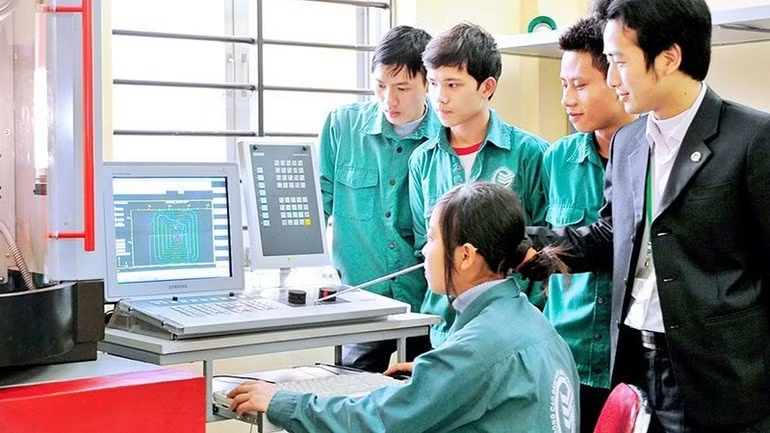
In light of the above limitations, improving the quality of the labour market needs to be identified as a central task in the socio-economic development strategy. First of all, vocational training, skills training and retraining for workers must be strengthened, especially for young people and workers in the informal sector, in order to increase the proportion of trained workers holding degrees and certificates.
The requirement is to strengthen the linkage between the training system and the needs of the labour market, ensuring that training is associated with employment, and reducing the mismatch between labour supply and demand.
For young people, supporting the transition from education to employment and shortening the time taken to find a job after training is of particularly important significance.
Another issue that needs attention is gradually narrowing the informal labour sector by expanding participation in social insurance, improving job quality, and developing sustainable employment models, especially in rural areas.