Wasted talent and misaligned resources
According to statistics from the Ministry of Home Affairs, in 2025 the labour force reached approximately 53.2 million people. The unemployment rate among working-age individuals was 2.22% (down 0.03% from the previous year); the underemployment rate was 1.65% (down 0.34 percentage points from the same period last year).
This improvement stemmed from efforts by functional agencies and job service centres nationwide to strengthen labour supply–demand connections, through organising frequent and diverse job fairs and online linkages between localities.
Additionally, some centres have developed electronic job transaction platforms, introducing employment opportunities for demobilised soldiers and returning overseas workers, helping many people secure stable jobs.
Yet, in reality, localised unemployment persists. Many sectors in need of labour—such as information technology, semiconductors, and artificial intelligence (AI)—are experiencing strong growth, but Viet Nam has yet to meet demand.
The proportion of workers with college-level qualifications or higher who are employed outside their specialisation, or unemployed, is higher than among low-skilled workers.
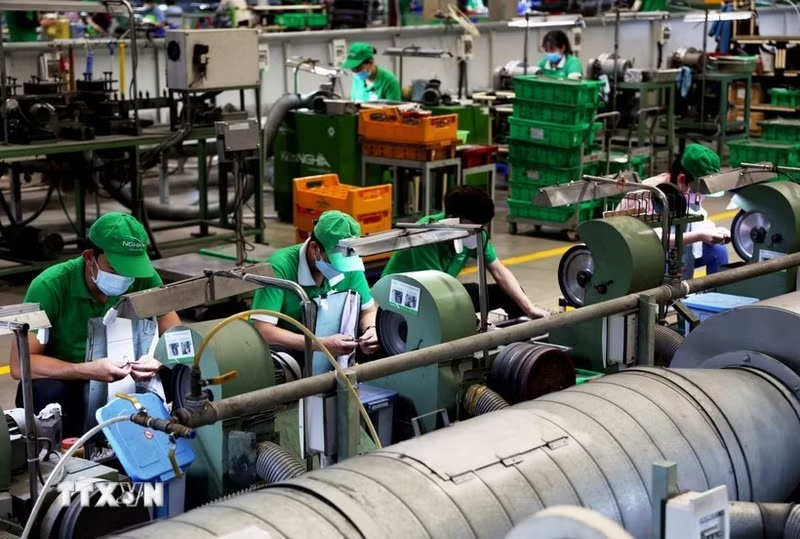
The root cause lies in the low quality of the workforce, with only about 29.2% of Vietnamese workers currently trained with vocational certificates, failing to adequately meet market requirements amid integration and digital transformation.
Addressing this issue, Vu Quang Thanh, Deputy Director of the Ha Noi Employment Service Centre, noted that while the overall unemployment rate in Viet Nam remains low, youth unemployment is rising, particularly among workers affected by restructuring and the green transition.
Statistics from the General Statistics Office under the Ministry of Finance show that approximately 1.6 million young people aged 15–24 are currently jobless and not participating in education or training, accounting for 11.5% of the total youth population.
In Ha Noi alone, 2025 saw significant fluctuations, with around 11,000 workers affected by organisational restructuring.
Prof. Dr Giang Thanh Long from the National Economics University observed that the proportion of workers with college-level qualifications or higher who are employed outside their specialisation, or unemployed, is higher than among low-skilled workers. This highlights a serious mismatch between training and actual job demands, leading to a major waste of intellectual capital and social resources.
Vocational education as the cornerstone of reform
According to forecasts, Viet Nam’s labour market in 2026 will continue its growth momentum. But for this process to become more pronounced and sustainable, the labour market must overcome numerous challenges, particularly meeting the demand for high-quality human resources and adapting to digital transformation.
To swiftly and sustainably improve workforce quality, policies must be developed in a coordinated manner, both short-term and long-term.
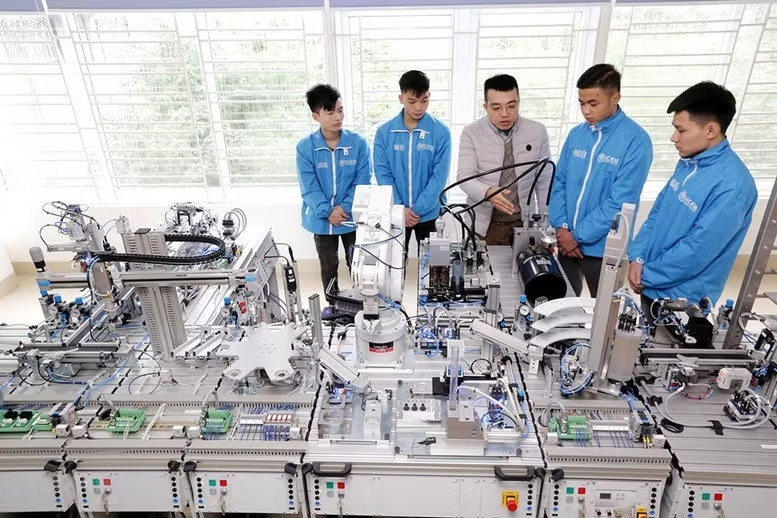
Politburo Resolution No. 71-NQ/TW on breakthroughs in education and training development affirms that vocational education plays a pivotal role in building a high-skilled labour force and forms an important component of the “open, interconnected, lifelong learning education system”.
Therefore, vocational education must be regarded as a key task in exploiting the “golden population window”, providing universal vocational training for young people, and enhancing workforce quality.
However, in reality, the vocational education system still faces numerous obstacles. The country currently has over 1,163 vocational education institutions, but most are small-scale with uneven quality.
The Ministry of Home Affairs has therefore issued guidance for localities to reorganise the vocational education network towards streamlining and efficiency.
Without proper preparation, Viet Nam risks facing a “labour shortage”, where demand surges but supply falls short due to skill gaps.
From late 2025 into early 2026, thorough preparations must be made to increase the number of skilled workers with industrial discipline.
Without proper preparation, Viet Nam risks facing a “labour shortage”, where demand surges but supply falls short due to skill gaps. Reorganising vocational schools is not merely about reducing numbers, but also a test of strategic thinking and reform capacity for each locality.
Moreover, student streaming must be reshaped more decisively and effectively. In Viet Nam, many students enter vocational schools passively, without proper orientation, leading to suboptimal training quality.
Prof. Dr Giang Thanh Long pointed out that while Vietnamese society still favours university degrees and undervalues vocational training, in many developed countries such as Japan and Germany, vocational training systems are highly organised, with clear early streaming aligned closely with labour market needs.
Vocational trainees are equipped with standardised knowledge, ready to work immediately upon graduation, and have opportunities for career progression.
From the perspective of human resources forecasting, Tran Anh Tuan, Vice Chairman of the Ho Chi Minh City Vocational Education Association, proposed that to balance labour supply and demand, businesses and policymakers need to adopt measures on market analysis, technological innovation, implementing appropriate demand-stimulation policies, and fostering economic harmony and stability.
He also emphasised the importance of strengthening state management of human resource development, promoting synchronous linkages and cooperation in career guidance, enrolment, training linked to practice, and labour utilisation needs.
Additionally, inter-sectoral coordination is essential. This includes establishing robust mechanisms to encourage businesses to invest in technology and vocational training, and forming innovation centres through school–business collaboration.
Labour market analysis and forecasting products serve as a “strategic compass”, providing trend information on human resources, salaries, and future skills needs. These data not only help businesses plan personnel proactively but also give workers and managers a solid basis for sound decisions, contributing to building a modern, sustainably developing capital labour market.
Vu Quang Thanh, Deputy Director of the Ha Noi Employment Service Centre