The practical implementation has achieved many important results but also revealed many limitations, requiring a change in approach.
This is clearly demonstrated by the decision to integrate three national target programmes in the 2026–2035 period, which was recently approved by the National Assembly.
The report of the Central Steering Committee for National Target Programmes in the 2021–2030 period shows that, after five years of implementing the National Target Programme for socio-economic development in ethnic minority and mountainous areas in the 2021-2025 period, six out of nine basic task groups have achieved or exceeded the set plan.
In particular, the target for poverty reduction rate in ethnic minority areas reached an average of 3.4%, exceeding the programme’s projected target of 3.2%; the average income of the population reached 43.4 million VND, a 3.1-fold increase compared to 2020; and the target group for education and the workforce of working age receiving vocational training suitable to needs and conditions reached an average of 54.8%, exceeding the programme’s target of 50%.
Essential infrastructure in remote, mountainous, and particularly difficult areas has been invested in more comprehensively. The preservation and promotion of the cultural identity of ethnic groups has also been emphasised, linked with community tourism, opening up new livelihood opportunities for the people.
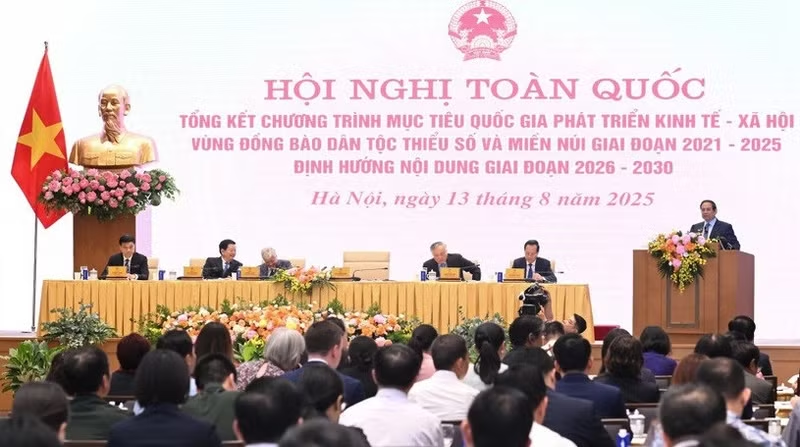
At the conference summarising the National Target Programme for socio-economic development in ethnic minority and mountainous areas for the 2021–2025 period, Prime Minister Pham Minh Chinh emphasised that implementing the Programme is not only a responsibility and obligation, but also a “command from the heart”, possessing profound humanistic value. The Prime Minister also pointed out that the results are uneven across regions and localities, and the lives of a segment of the population still face many difficulties. The implementation of the Programme is fragmented, disjointed, and lacks coordination, cohesion, and focus, requiring a comprehensive, people-to-people approach.
During discussions at the 10th session of the 15th National Assembly, many delegates pointed out “bottlenecks” in the implementation of national target programmes. Delegate Le Thi Thanh Lam (Can Tho City delegation) argued that although the New Rural Development Programme and the Sustainable Poverty Reduction Programme have achieved and exceeded many targets, the Socio-Economic Development Programme for Ethnic Minority and Mountainous Areas still has some unfulfilled objectives, especially regarding social infrastructure and lifting villages out of particularly difficult areas. The reasons include dispersed human resources, overlapping tasks, and the excessively high matching fund ratios of many localities, exceeding their balancing capacity.
Sharing the same view, delegate Lo Thi Luyen (Dien Bien delegation) emphasised that for particularly difficult localities, applying a rigid matching fund mechanism will reduce the feasibility of the programme; therefore, it is necessary to reduce, or even waive, the matching fund requirement for localities receiving high levels of central government budget support, and to avoid mandatory integration of funding between national target programs.
Another limitation is the disparity in effectiveness between localities: areas with more favourable conditions and better staff capacity tend to implement programmes quickly and effectively, while more difficult areas experience slower progress.
Based on the practical experience of the 2021–2025 period, on December 11, 2025, the National Assembly passed Resolution No. 257/2025/QH15 approving the investment policy for the National Target Programme on building new rural areas, sustainable poverty reduction, and socio-economic development in ethnic minority and mountainous areas for the 2026–2030 period, deciding to integrate three national target programmes into a single unified programme for the 2026–2035 period.
It is evident that integration, aimed at increasing investment and concentrating resources more effectively in the most disadvantaged areas, while simultaneously shifting thinking from program management to serving development, with people at the centre — both as subjects and targets of policy — can create fundamental changes, removing current bottlenecks through the synchronisation of objectives and solutions, overcoming duplication and overlap, and making it easier for localities to implement, monitor, and evaluate effectiveness.