At the national conference reviewing operations in 2025, the 2021–2025 term, and deploying key tasks for 2026 of the Ministry of Culture, Sports and Tourism, the role of cinema, particularly historical and revolutionary war films, was emphasised as an important “conduit” in nurturing and preserving Viet Nam’s cultural identity.
History brought vividly to the screen
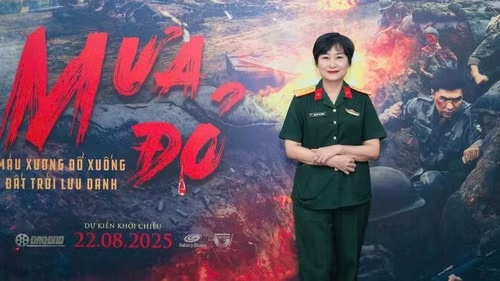
In her presentation at the conference, Colonel Nguyen Thu Dung – Director of the People’s Army Film Studio and Deputy Head of the Steering Committee for the production of the feature film Mua Do (Red Rain) – affirmed that Viet Nam possesses a glorious historical legacy, forged through thousands of years of nation-building and defence. Core values such as fervent patriotism, the spirit of great national unity, indomitable will, humanity, and loyalty have created the enduring “Vietnamese soul” across historical periods.
Within that cultural flow, cinema is not merely an art form or a simple means of entertainment, but a distinctive medium to safeguard, popularise, and promote traditional values, contributing to the building of a solid spiritual foundation for the people.
Recent practice shows that historical and revolutionary war films play a special role in recreating the past and bringing to life the nation’s glorious pages of history. Not only do they help the public to understand history correctly and deeply, but they also serve as an emotional bridge for today’s generation to better appreciate the value of the present and to grasp the spirit and noble qualities of the Vietnamese people. As Colonel Nguyen Thu Dung emphasised: “Themes of the armed forces and revolutionary wars always have enduring vitality and strong appeal to audiences, especially the younger generation.”
It can be affirmed that the time when historical films were considered niche, produced on commission and then shelved, has receded into the past. In recent years, innovations in creative thinking, thematic approaches, and cinematic language have given this genre a fresh face. A series of works such as Truyen Thuyet Ve Quan Tien (Legend of Quan Tien), Binh Minh Do (Red Dawn), Dao, Pho va Piano (Peach, Pho and Piano), and Dia Dao – Mat Troi Trong Bong Toi (Tunnels – Sun in the Darkness) demonstrate the unceasing efforts of artists in bringing history closer to contemporary life.
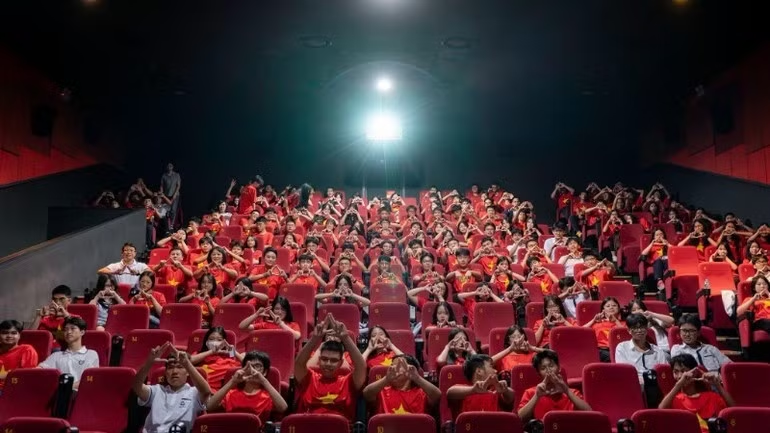
A vivid recent testament to the reach of historical films is Mua Do (Red Rain), a production of the People’s Army Film Studio. Recreating the 81 days and nights of fierce fighting at the Citadel of Quang Tri, the film has left a profound imprint on society’s cultural and spiritual life. According to information from the General Political Department of the Viet Nam People’s Army, Red Rain has attracted over 8.3 million cinema viewers, millions of views on digital platforms, and was screened at hundreds of mobile screening points nationwide, with revenue exceeding 700 billion VND – ranking among the top-grossing films globally in 2025.
Sharing insights into the film’s success, Colonel Nguyen Thu Dung explained that it was not accidental, but the result of a scientific, rigorous production process – from surveys, historical research, and meetings with witnesses, to the application of modern technology. More importantly, the film adheres to correct ideological orientation, awakens patriotic spirit, honours the heroic sacrifices of soldiers, and conveys messages of responsibility and aspiration to contribute to the younger generation. This affirms that, when properly invested in, revolutionary war themes can achieve superior results in ideology, art, and communication.
Renewing creative approaches to connect past and present
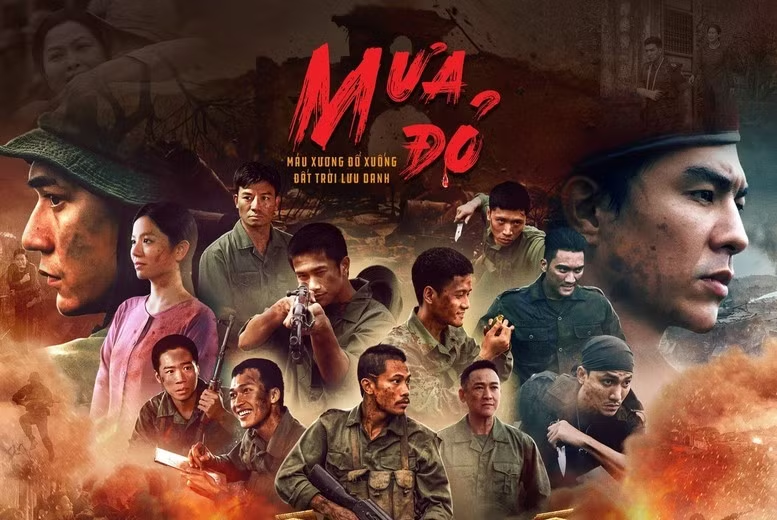
To ensure historical films continue to lead on the ideological-cultural front, it is crucial to ceaselessly innovate creative mindsets and cinematic language. Colonel Nguyen Thu Dung believes that exploiting historical themes requires fresh perspectives, rich in suggestion, deepening character psychology, ensuring historical authenticity while being emotionally resonant, thereby creating natural empathy with viewers, especially younger audiences.
Alongside recreating the heroic past, today’s cinema also bears an important responsibility in portraying the image of “Uncle Ho’s Soldiers” in the new era. These are soldiers with solid political mettle, mastering science and technology, ready to charge forward in natural disasters and epidemics, actively participating in rescue and relief operations, and serving in international peacekeeping forces. Building the image of soldiers with the “breath of the era” will open up new creative possibilities and create lasting appeal to the public.
From the practice of producing cinematic works at the People’s Army Film Studio, Colonel Nguyen Thu Dung assesses that looking towards 2026 and further to 2045, Vietnamese cinema in general, and the People’s Army Film Studio in particular, are facing new opportunities.
A good film only fully realises its value when it reaches a wide audience, conveys positive messages, and contributes to consolidating the Party’s ideological front firmly in the hearts of the people.
The Strategy for Developing Viet Nam’s Cultural Industries to 2030, with a vision to 2045, sets the key task of creating more cinematic works with high ideological and artistic value, making Viet Nam’s cinema commensurate with regional and global development.
To reach audiences more effectively in today’s multi-platform media context, Colonel Nguyen Thu Dung also believes that propaganda and promotion must be given special importance. A good film only fully realises its value when it reaches a wide audience, conveys positive messages, and contributes to consolidating the Party’s ideological front firmly in the hearts of the people. Therefore, the task of connecting, communicating, and bringing the image of soldiers and the army’s fine values closer to society cannot be underestimated.
Historical films are not merely stories of yesterday, but also an important endogenous resource guiding the present and future. With the close attention and direction of the Party, State, and Central Military Commission, along with the creativity and responsibility of the artistic community, there is every reason to believe in the emergence of cinematic works of stature, worthy of the nation’s glorious history, contributing to disseminating Viet Nam’s mettle, intellect, and culture in the new era.