Hanoi is changing fast and new infrastructure is needed to deal with the city’s rapid growth but when it comes to a heritage, such as Long Bien Bridge, so treasured by many, how does Hanoi find the balance? The public is looking to authorised agencies and the authorities for the solution, the solution which harmonises urban development with preservation.
The historical witness of the capital city
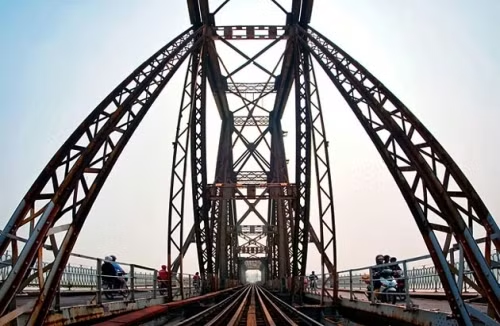
Long Bien, the first bridge built to span the Hong (Red) River, was opened to traffic in 1902, becoming the largest construction in Indochina at that time. The masses were in awe of its imposing structural beauty.
The bridge was designed by French engineers but the sweat of more than 3,000 Vietnamese workers built it over three years the gigantic steel structure that undulates like a giant dragon across the Red River.
Over the past 100 years, the bridge has welcomed generations of Hanoians back to the city. .Many people say that Chuong Duong Bridge, also crossing the Red River, demonstrates the achievements of the national renewal process and Long Bien Bridge is the historical witness of the heroic city.
In February 1947, Long Bien Bridge witnessed the retreat of the legendary Capital Regiment soldiers from Military Zone 1 to the Viet Bac base (the Northernmost Vietnamese base) after days and nights of fierce fighting in Hanoi. Then in October 1954, Long Bien Bridge welcomed the victorious army back to liberate the capital city after the Dien Bien Phu victory, concluding the nine-year resistance against the French.
During the war with the US, bombs fell upon the bridge 14 times, damaging seven spans and four large pillars. In protection, two 11.5m air defense artillery posts were set up on the Red River’s alluvial and soldiers used the highest points of the bridge’s structure for artillery emplacements to fight off enemy aircraft. After the war, damaged spans were replaced by semi-permanent girders on new pillars.
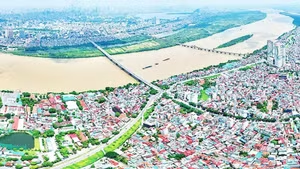
Today, with other bridges crossing the Red River like Thang Long, Chuong Duong, Vinh Tuy and Thanh Tri, Long Bien is no longer the main urban transport route across the river but for Hanoians and the millions who love the city, the capital is not Hanoi without Long Bien Bridge.
Which solution brings the balance?
Over a century has worn Long Bien Bridge. It is now too degraded to serve transport but today the city needs more than ever a modern public transport system to facilitate development. Development and heritage preservation clash when it comes to Long Bien Bridge.
In 2005, the Ministry of Transport (MoT) approved a project to upgrade the Yen Vien – Ngoc Hoi urban railway route, linking areas in the north and the south of Hanoi with downtown. Under the project, a double railway will serve the route, a section of which runs on Long Bien bridge’s railway lane.
According to the Transport Engineering Design Company, the project’s consultant design agency, the position, which meets Long Bien Bridge, has been selected because it is where there is the shortest distance between the two banks of the river and requires the least amount of land clearance, minimising the impacts on Hanoi.
The MoT also proposed two major plans to tackle the rising transport demand, of which Long Bien is a part of the story, and both received a huge amount of concern from the public and experts. The first plan was to build a new bridge exactly where the old one stands, keeping the central part with the railway track intact, while removing nine spans of the bridge, which would be preserved and displayed for tourism. The second proposal was to construct a new bridge, with a similar design to the original, and to keep the old one for preservation.
Many people strongly object to both plans with protesters claiming that the bridge should “live” with Hanoi residents rather than in a museum as an object for display. They also argued that the removal of Long Bien Bridge and the construction of its replacement would seriously damage the heritage space. According to them, the best solution is to upgrade the bridge, focusing on replicating its original beauty whilst making it traffic safe.
According to Tran Trong Hanh, the Vice President of the National Council of the Vietnamese Architects’ Association, Long Bien Bridge is not only a transport construction but a treasured heritage needing preservation. Therefore, the cultural value of the construction should be placed first.
He stressed that the consultancy agency should be made up of experts in traffic but also in arts and heritage so they can formulate a design which balances the two needs. Any proposal should highlight the artistic and cultural value of the bridge and be made public so further experts and the whole community can have a say, he added.
From the viewpoint of cultural researcher Phan Cam Thuong, Long Bien Bridge is important because it not only served as an infrastructure for road and railway transport over a century but played a great role in the cultures of Hanoi’s centre and its neighbouring area.
When it comes to road transport, Hanoi has other bridges crossing the red river. For railway transport, however, it is very difficult to move the railway track running across the Red River through Long Bien Bridge. Thuong affirmed though that it is possible for the monument to be upgraded enabling trains to continue whilst preserving its original structure and design.
Hanoi, a big urban centre, growing quickly, needs, to develop an urban railway system, as it is an effective means of public transport which can help ease traffic congestion. At the same time, it is also essential to preserve and promote the cultural and historical value of the city’s heritages, including Long Bien Bridge.
The MoT and the city administration need to listen to the opinions of the public, experts and scientists so as to select the best solution for the upgrade of Long Bien Bridge under the motto, ‘harmonising preservation and development’ as stated by Head of Office of the Hanoi Municipal People’s Committee Nguyen Thinh Thanh.