The young French independent documentary filmmaker sees making films about Viet Nam as a way to understand part of his roots — and himself.
The bridge as a symbol
In his previous 35-minute film, F. Bibonne employed multiple camera angles to capture Long Bien Bridge, with its passing trains and streams of people and vehicles, evoking a wealth of emotion. Much like the narrative thread connecting childhood memories, recollections of his grandmother, and her birthplace with Bibonne’s own desire to better understand her homeland, the film’s title evokes the image of a bridge in Viet Nam as a point of connection in everyday life — between regions, and above all within the human psyche, linking past and present in order to envision the future.
Numerous objects, events, and stories connecting Viet Nam and France, as well as Eastern and Western cultures, made Bibonne feel he could not stop exploring this land and its people. This was further encouraged by several international accolades his debut film received: two Best Documentary Short awards at the Los Angeles Film Awards (January 2022) and the New York International Film Awards (February 2022), as well as being shortlisted for the Roma Prisma Independent Film Awards (December 2021).
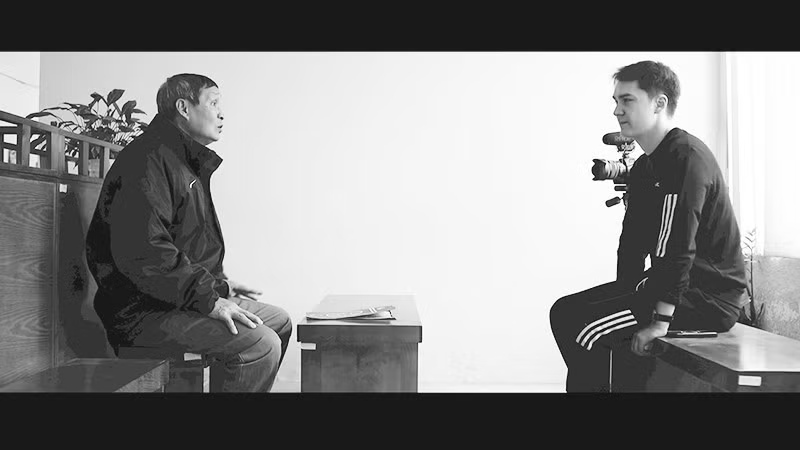
Bibonne’s account of making the second film is particularly compelling. Initially, he had planned to make a film about a French figure with a special connection to Viet Nam — Philippe Troussier, who at the time was head coach of the national team. After spending a month in Viet Nam filming, interviewing his subject, watching a full football match, and conducting further research, he had to return home. Then another setback arose: the head coach also left his post. “I was a bit confused: What was the purpose of the film? How could I use this character?” Bibonne recalled.
A third sequel to follow the second
To find the answer, Bibonne temporarily set aside the project and turned inward, seeking to understand what constitutes the spirit of Viet Nam and his own filmmaking style. He chose to spend more time in Viet Nam, studying life there, reflecting on his own journey and that of his family, and discovering small, simple yet profound stories to serve as the narrative thread of the film.
Instead of making a film about football, he realised he was pursuing the same objective as in “Once upon a Bridge in Viet Nam” and decided to continue the journey. He adopted a structure he favours: beginning with classical music, connecting it to football, and gradually expanding beyond Ha Noi to incorporate more traditional elements, linking both traditional music and local football.
Thus, the second sequel came into being. The film takes viewers back through the history of football in Viet Nam — from Nam Dinh (now Nam Dinh Ward, Ninh Binh Province, home to a textile factory dating back to the French colonial period), to the port city of Hai Phong, and to Ha Noi.
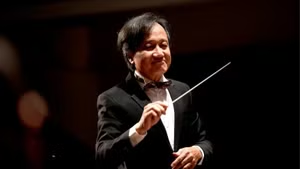
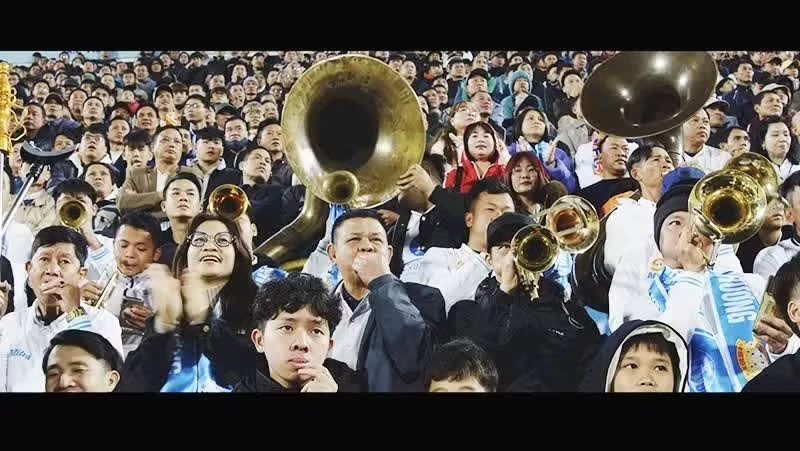
F. Bibonne does not overlook a particularly unique destination in local football: a women’s football team of the San Chi ethnic minority in Binh Lieu District, Quang Ninh Province. He also artfully weaves together the pastime of football among musicians of the Viet Nam National Symphony Orchestra — their shared laughter over glasses of draught beer after friendly matches, and their candid conversations — revealing how closely intertwined football and music are in Viet Nam. He deliberately includes images of fans in the stands at Thien Truong, Lach Tray, and Hang Day stadiums, who bring Western classical instruments to cheer for their teams — drums, cymbals, trumpets…

At the film’s screening in Ha Noi (BHD Pham Ngoc Thach cinema, April 5), F. Bibonne observed the audience and noted that “many people were in tears,” perhaps moved by the images that stirred deep memories within them. “Some people in the film industry have suggested that I submit the film to the Ha Noi International Film Festival this November. I am currently refining details and rearranging both English and Vietnamese subtitles to produce a better version for the festival,” he shared.
The third sequel may well focus on fine arts, as part of the “Once upon a Bridge in Viet Nam” series, before he brings the project to a close. As for what comes next, he does not yet have an answer. However, as he puts it, stopping documentary filmmaking in Viet Nam “is impossible,” because this is where his life is.
Football commentator Vu Quang Huy appears as a companion figure in the film and also contributed valuable historical footage from his personal archive, which has been woven into the narrative. Naturally, the film would be incomplete without the jubilant “street celebrations” following each victory of the Viet Nam national team — moments in which, by immersing himself, F. Bibonne profoundly felt the Vietnamese people’s passion for football and their strong sense of community.