Synchronising planning and strengthening legal framework for clean water supply infrastructure
Nghe An is implementing multiple groups of solutions to upgrade and complete its centralised domestic water supply system, ensuring that water quality meets regulatory standards in support of the national target programme on new-style rural development and broader socio-economic development goals.
According to Hoang Phu Hien, Vice Chairman of the Nghe An Provincial People’s Committee, the province has reviewed a wide range of documents related to the planning, management, and operation of water supply systems. He noted that both urban and rural clean water infrastructure must be managed in a synchronised manner, operated safely, and ensure quality in accordance with regulations. The province has also prioritised reviewing, transferring and effectively exploiting water supply infrastructure assets, particularly deteriorating rural facilities.
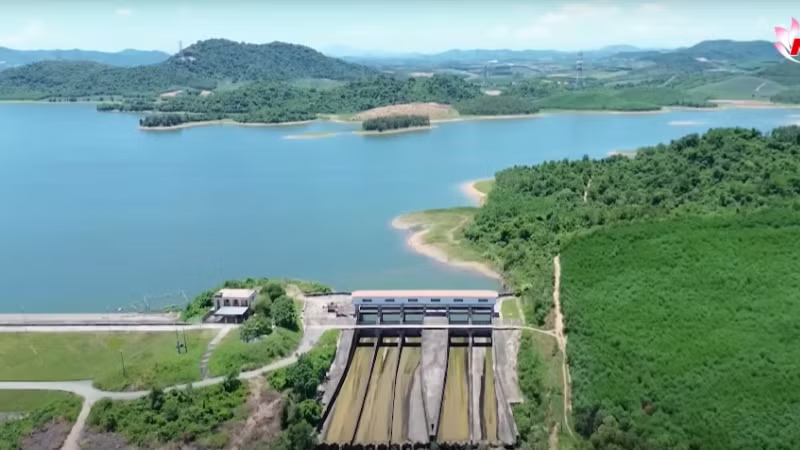
At present, the province has 561 centralised domestic water supply facilities, including 492 gravity-fed systems (mainly in mountainous areas) and 69 pumped systems, with a total capacity of around 80,000 cubic metres per day, serving more than 115,000 households across 160 communes. However, many rural facilities operate unsustainably due to outdated infrastructure and insufficient maintenance funding, as they are largely managed by communes or local communities.
Upgrading facilities, addressing water shortages, and mobilising investment
In implementing Decree No. 43/2022/ND-CP on the management of water supply infrastructure assets, Nghe An is accelerating the classification and transfer of facilities to units with sufficient operational capacity. Several key facilities, such as the Kim Son Township Water Plant in Que Phong District, are being transferred to the provincial Centre for Rural Water Supply and Environmental Sanitation for management.
A number of projects to expand and increase the capacity of water supply facilities have also been proposed for inclusion in the 2026–2030 public investment plan. These include upgrading the Hung Linh Water Plant (Hung Nguyen Nam) to a capacity of 10,000 cubic metres per day to serve 15,000 households; expanding the Long Thanh system (Yen Thanh) to 8,500 cubic metres per day for 20,000 households; developing the Nam Hung–Nam Nghia–Nam Thai Water Plant with a capacity of 8,000 cubic metres per day; and upgrading the Dien Yen Water Plant to 6,000 cubic metres per day.
Nghe An has also coordinated with the Ministry of Finance to propose two major projects using ODA and concessional loans: a sustainable clean water supply project funded by the World Bank, and an irrigation and clean water upgrading project financed by IFAD.
Vice Chairman Hoang Phu Hien stressed that: “No resident should lack access to standard domestic water. The province will allocate maximum funding, combined with socialised investment, to upgrade water supply infrastructure, particularly in areas severely affected by climate change and water source pollution.”
According to a 2024 report by the Nghe An Sub-department of Irrigation, many localities continue to face shortages of standard clean water, especially in the districts of Hung Nguyen, Yen Thanh, and Dien Chau. Meanwhile, mountainous areas such as Ky Son, Tuong Duong, Que Phong, and Quy Hop are facing difficulties due to complex terrain and limited investment resources.
The proportion of rural clean water meeting standards in Nghe An stands at just 53 per cent, below the national average of 58 per cent, although the rate of households using hygienic water sources has reached 89.45 per cent.
Nguyen The Anh, Deputy Head of the Irrigation Works Management Division, said many facilities have been in use for over a decade without upgrades. Most are managed by communes or communities with no fee collection and no maintenance funding, leading to rapid deterioration.
He proposed incorporating clean water projects into new public investment plans, developing tailored facilities for mountainous, ethnic minority and coastal areas, revising policies to attract businesses to invest in rural clean water, and gradually transferring facilities to public service units in accordance with Decree 43.
Towards safe, sustainable, and standardised clean water
Alongside infrastructure investment, Nghe An has strengthened inspection and supervision of water quality.
The provincial People’s Committee has required water supply enterprises to apply new technologies such as pipeline pressure monitoring, real-time water quality supervision and automatic meter reading. However, application in older rural facilities remains limited due to high costs.
Vice Chairman Hoang Phu Hien affirmed: “Upgrading clean water infrastructure is a mandatory requirement in new-style rural development. Local authorities must closely supervise water supply service quality, sign agreements with enterprises, and accelerate network connections, particularly in expanding residential areas.”
Nghe An’s efforts demonstrate strong determination to ensure standard, safe, and sustainable domestic clean water supply. Although significant challenges remain — especially in mountainous areas and at deteriorating facilities — the mobilisation of diverse resources, policy innovation, and community engagement make the goal of province-wide access to standard clean water achievable in the coming period.