According to the Ministry of Agriculture and Environment, the entire region aims to cultivate 400,000–410,000 ha of winter crops, with an estimated output of 4.8–5 million tonnes.
Diversifying crops and staggering harvest schedules
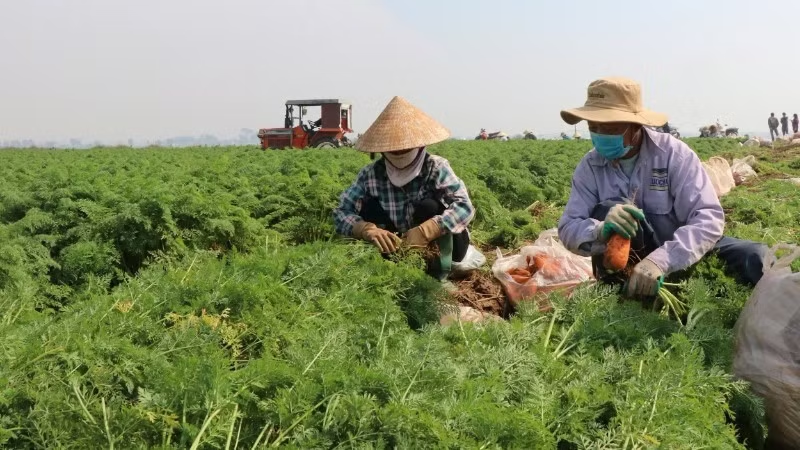
In recent days, across many fields in Hung Yen Province, farmers have been rushing to harvest the summer–autumn rice crop to prepare land for winter cultivation. As soon as the rice is harvested, tractors are deployed to turn the soil and shape the beds, creating favourable conditions for winter crops. In higher fields, some areas have already been planted with maize seedlings and various vegetables. Meanwhile, other plots are being prepared and left to drain before cool-season seedlings are transplanted.
Director of Yen Phu Agricultural Services Cooperative Nguyen Huu Hung said farmers place great expectations on the winter crop, as it is considered the “golden season” with the highest yield and profit of the year. Despite persistent rain and flooding at the beginning of the season causing many difficulties, the weather has now become favourable, crops are growing well, and a bumper harvest is expected.
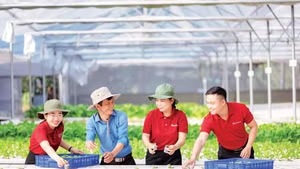
To ensure stable markets and prices, the cooperative proactively diversifies its vegetable varieties, including cabbage, tomatoes, cauliflower, kohlrabi and carrots. It also applies staggered planting across three phases to regulate supply: the early crop is expected to be harvested in mid-November, the main crop will focus on serving Tet, and the late crop will supply the post-Tet market.
According to the Department of Crop Production and Plant Protection (Ministry of Agriculture and Environment), the winter crop structure for 2025 is evenly distributed: 50% of the area is allocated to warm-season crops (maize, sweet potato, soybean, warm-season vegetables), and the remaining 50% to cool-season crops (potatoes, cool-season vegetables).
Hung Yen Province’s Department of Agriculture and Environment aims to cultivate 43,100 ha of winter vegetables and industrial crops. The province prioritises high-quality crop varieties that bring strong economic returns and meet market preferences. Special focus is placed on crops with longer storage capacity and suitability for processing, such as bottle gourd, pumpkin, cucumber, tomato and potato.
Hung Yen also targets each locality to develop at least two to three “large-scale concentrated production fields” for winter crops, each covering 10 ha or more. At the same time, the province is strengthening partnerships with enterprises in winter crop production to improve income and economic efficiency for farmers.
In Hai Phong, Deputy Director of the Department of Agriculture and Environment Luong Thi Kiem stated that the city aims to cultivate around 29,200 ha of winter crops, including 22,200 ha of vegetables with an estimated output of 650,000 tonnes.
The locality will maintain, expand and develop large-scale concentrated production zones, linked along value chains and associated with branding, geographical indications and labels for products such as carrots, cabbage, kohlrabi, cauliflower and tomatoes.
According to the Department of Crop Production and Plant Protection (Ministry of Agriculture and Environment), the winter crop structure for 2025 continues to follow the 50–50 ratio between warm-season and cool-season crops.
Alongside crop diversification, many localities are staggering planting schedules to ease market pressure. Several provinces are also expanding crop areas with stable markets and strong demand, such as pickling cucumbers, chillies, bottle gourds, pumpkins, processing potatoes, medicinal plants, edible mushrooms and medicinal mushrooms.
Adhering to production plans and seasonal timelines
Nguyen Quoc Manh, Deputy Director of the Department of Crop Production and Plant Protection (Ministry of Agriculture and Environment), noted that to ensure a successful winter crop, Departments of Agriculture and Environment across northern provinces and cities must mobilise all available resources to restore production and strive to meet or exceed planned targets.
Localities should take advantage of dry weather to prepare soil for early winter planting, ensuring proper seasonal timing. They must also guide farmers to actively tend and protect warm-season winter crops affected by storms and floods.
At the same time, replanting should be carried out where crops have died or are too weak to recover. For warm-season crops, appropriate varieties should be selected and sown as early as possible; for legume and vegetable groups, planting should be arranged in multiple phases to make efficient use of land and labour, avoid price drops and increase economic returns.
Intensification and increased cropping should also be prioritised by planting short-cycle cool-season leafy and root vegetables. Particularly, continuous staggered planting should be implemented, with sowing immediately on high and mid-high fields and specialised vegetable land to ensure the earliest possible harvest, thereby maintaining vegetable supply for the market, especially before and after Tet.
To ensure a successful winter crop, Departments of Agriculture and Environment across the northern provinces and cities must mobilise all available resources to restore production and strive to meet or exceed planned targets.”
Deputy Director of the Department of Crop Production and Plant Protection (Ministry of Agriculture and Environment) Nguyen Quoc Manh
According to Deputy Minister of Agriculture and Environment Hoang Trung, localities must closely monitor weather conditions, proactively develop and implement effective production plans, and ensure assigned sectoral growth targets. They must adhere to crop production plans and pest/disease prevention measures issued by the Department of Crop Production and Plant Protection. Adequate frost-prevention materials, short-term seed varieties and reserve inputs should be prepared to enable swift recovery after natural disasters.
Localities should also expand and replicate efficient, high-profit and sustainable production linkages and models; transfer technological advances and modern cultivation practices to improve productivity, quality and climate resilience of northern agricultural production. Trung further urged provinces to strengthen linkages, develop raw material regions, and promote mechanisation and processing.
Trade promotion should be intensified, along with supply–demand linkages, support for branding and traceability for key products. Additionally, market information must be regularly updated so that localities can formulate appropriate and effective production and consumption strategies for agricultural products.