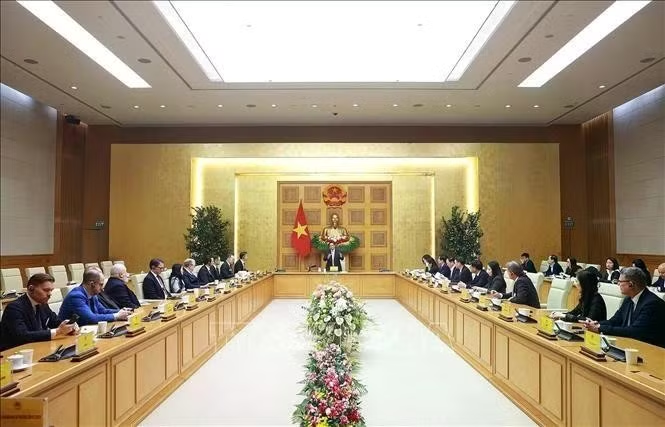
At a February 3 meeting with a delegation of Swiss and European businesses led by Dr Philipp Rösler, President of the Swiss–Viet Economic Forum (SVEF), the PM commended the forum and Rösler for their active role in connecting Viet Nam with partners, promoting investment cooperation and enhancing Viet Nam’s profile among European and global business communities.
Updating the delegation on the key outcomes of the 14th National Congress of the Communist Party of Viet Nam, particularly the country’s development strategy with centenary goals set for 2030 and 2045, the PM said the country is striving for double-digit economic growth from 2026 onwards.
Rösler congratulated Viet Nam on sustaining robust growth amid global uncertainties and praised its long-term development vision, including plans to establish an international financial centre and pursue double-digit growth in the coming years.
He affirmed that Swiss and European partners stand ready to cooperate with and support Viet Nam in achieving its strategic goals.
Representatives of Swiss and European enterprises highly valued Viet Nam’s investment climate, noting their long-term cooperation and investment plans in sectors such as finance, textiles, climate change response, emissions reduction, pharmaceuticals, biotechnology, semiconductors, data infrastructure and artificial intelligence.
They called for continued support from the Government via policy openness and stability, streamlined administrative procedures, and stronger supporting ecosystems to help them enhance investment efficiency.
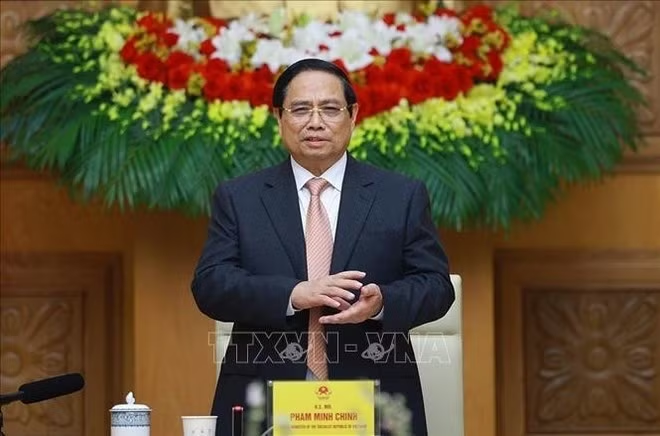
Addressing business proposals, the PM outlined Viet Nam’s priorities and incentives for green growth and digital development. To achieve double-digit growth, he said the country is advancing three strategic breakthroughs—institutional reform, modern and integrated infrastructure, and high-quality human resources and governance—while shifting to a new growth model by renewing traditional growth drivers and fostering new ones based on science, technology, innovation and digital transformation.
Viet Nam is accelerating clean energy development, including wind, solar and nuclear power; promoting sustainable agriculture through such initiatives as the one-million-hectare high-quality, low-emission rice programme in the Mekong Delta; developing a carbon market; and expanding green transport through greater adoption of electric vehicles and reduced reliance on fossil fuels, he went on.
PM Chinh noted that the country has rolled out strong incentives for the semiconductor industry and is implementing two chip projects, alongside efforts to train 100,000 semiconductor engineers by 2030 and build national, sectoral and local databases to support AI development. He also highlighted opportunities in pharmaceuticals, biotechnology, ecological agriculture and modern rural development.
He expressed his hope that Swiss and European enterprises will scale up both direct and indirect investment, intensify technology transfer, support workforce training, share management expertise, invest in research and development, and help Vietnamese businesses integrate more deeply into global value and supply chains.
Welcoming the breakthrough progress in Viet Nam – Europe relations, particularly following the upgrade to a comprehensive strategic partnership, and the sound Viet Nam – Switzerland ties, PM Chinh reaffirmed Viet Nam’s commitment to improving the investment climate, ensuring political and institutional stability, maintaining social order and safety, cutting red tape, and protecting the rights and legitimate interests of investors so that they can optimise their investments in the country.
He also called on Swiss and European businesses to support Viet Nam’s efforts to develop the international financial centre, encourage the remaining EU member states to ratify the EU – Viet Nam Investment Protection Agreement (EVIPA), urge the European Commission to lift the IUU fishing “yellow card” on Vietnamese seafood, and contribute to Viet Nam’s long-term development through sustained investment, technology transfer, innovation cooperation and the promotion of international standards on environmental, social, and governance (ESG) and sustainable finance.