Accelerating public investment disbursement in Q1 2026
According to the Ministry of Finance, the total public investment plan funded by the state budget in 2026, as assigned by the Prime Minister to ministries, central agencies, and localities, amounts to 995,348.05 trillion VND. Combined with locally balanced budgets and capital plans carried forward from previous years, the total public investment capital plan for 2026 had reached 1,008,610.9 trillion VND at the time of reporting.
This figure represents a continued increase compared to 2025, underscoring the pivotal role of public investment in driving breakthroughs in infrastructure and serving as vital “seed capital” to generate strong growth momentum in 2026 and the years ahead.
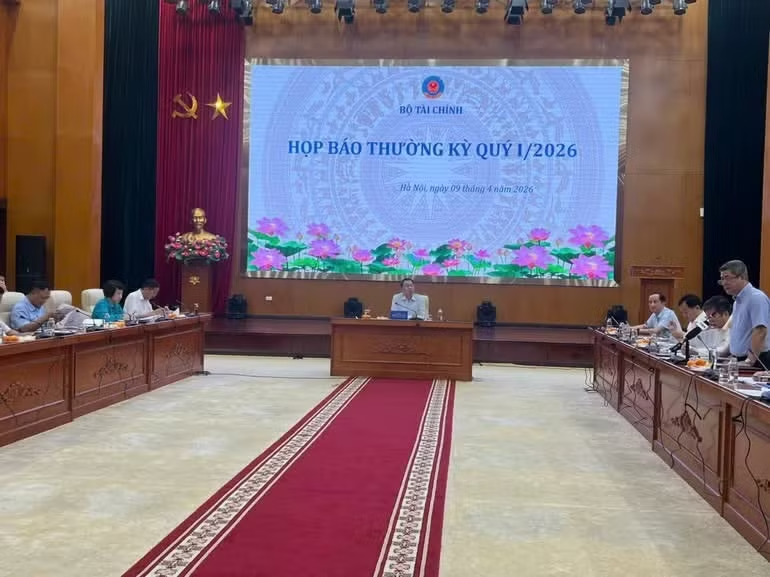
At the Ministry of Finance’s first-quarter press briefing, it was reported that by the end of March 2026, nationwide public investment disbursement was estimated at approximately 110.3 trillion VND, equivalent to 11% of the plan assigned by the Prime Minister. This marks a clear improvement compared to the same period in 2025. Specifically, the disbursement rate in Q1 this year was 1.2 percentage points higher than last year, while the absolute value increased significantly by around 30 trillion VND year-on-year.
In the early months of the year, public investment disbursement is typically slow due to bottlenecks related to investment procedures and site clearance. However, in 2026, these issues have been addressed from the outset, reflecting the Government’s efforts to remove obstacles and its determination to complete projects early, avoiding year-end backlogs.
Streamlined mechanisms: Driving early-year disbursement
To achieve an increase of approximately 29.981 trillion VND in disbursed public investment capital in Q1 2026, the Government identified public investment disbursement as a key political task and a crucial driver of growth from the very beginning of the year. Ministries, sectors, and localities were instructed to focus on core solutions to accelerate disbursement.
Deputy Minister Nguyen Duc Chi affirmed that, from the Ministry of Finance’s perspective, mechanisms and policies governing public investment projects — such as capital allocation, procurement, payments, settlement, and decentralisation — have been implemented in a smooth and effective manner, creating the most favourable conditions for disbursement.
Le Tien Dung, Deputy Director General of the Infrastructure Development Department under the Ministry of Finance, said the ministry had proactively implemented management measures to meet capital demand for the 2026 plan across ministries, sectors, and localities. Priority has been given to strategic, inter-regional infrastructure projects with strong disbursement capacity and rapid spillover effects. At the same time, the State Treasury has been directed to disburse funds immediately once all conditions are met, ensuring alignment with project implementation schedules.
In parallel, the Ministry of Finance has submitted proposals to the Government and the National Assembly to amend the Law on the State Budget and the Law on Public Investment. These revisions aim to effectively address bottlenecks in public investment disbursement, notably by strengthening decentralisation and delegation of authority to the grassroots level.
Under the proposed framework, the National Assembly, the Government, and the Prime Minister will allocate only the total medium-term public investment capital. Based on this ceiling, localities will be granted full autonomy in allocating funds to specific projects, in line with actual needs and implementation progress.

Removing bottlenecks in the allocation of 41.6 trillion VND
By the end of March, ministries, sectors, and localities nationwide had allocated and assigned detailed plans for 2026 investment capital totalling 984.95 trillion VND.
However, 14 ministries and central agencies, along with 22 localities, had yet to allocate 41.6 trillion VND.
The main reasons for the delay include ongoing completion of investment procedures, which has yet to meet the conditions required for capital allocation under regulations, as well as proposals by some ministries and agencies to reduce their capital plans in order to reallocate funds to units with greater demand.
Deputy Minister Nguyen Duc Chi emphasised that existing mechanisms and policies have been designed to facilitate public investment disbursement to the greatest extent possible. Therefore, the key bottleneck lies in implementation, requiring a focused review to promptly identify and resolve remaining obstacles.
To promptly identify difficulties in the disbursement process, Le Tien Dung said that, following the Prime Minister’s directive, the ministry has proposed the development of a KPI framework to monitor and evaluate disbursement progress of ministries, sectors, and localities on a weekly and monthly basis.
At the same time, the ministry is accelerating the digitalisation of data aggregation processes to meet weekly reporting requirements, thereby supporting more effective direction and management by the Government and the Prime Minister in this critical task.