Traditional craft villages, from centuries-old pottery kilns and lantern streets to carpentry and mat-weaving villages along the Thu Bon River, demonstrate that Hoi An’s heritage flow is being sustained through creative, inspiring approaches, particularly by the younger generation.
Craft villages as sustainable livelihoods
Spring in Hoi An glows with the golden hues of apricot and chrysanthemum blossoms, honeyed sunlight washing over mossy walls of ancient houses and yin-yang tiled roofs.
About three kilometres west of the town centre, the tranquil Thanh Ha pottery village emerges amid the scent of damp clay, wisps of kiln smoke and the steady rhythm of the potter’s wheel.
In 2025, Thanh Ha Pottery Village was named the best community-based tourism destination by the Ministry of Culture, Sports and Tourism. Earlier, in 2019, Thanh Ha pottery was recognised as a National Intangible Cultural Heritage.
Today in Thanh Ha, from kilns and courtyards to modest display spaces, every corner revolves around ceramics.
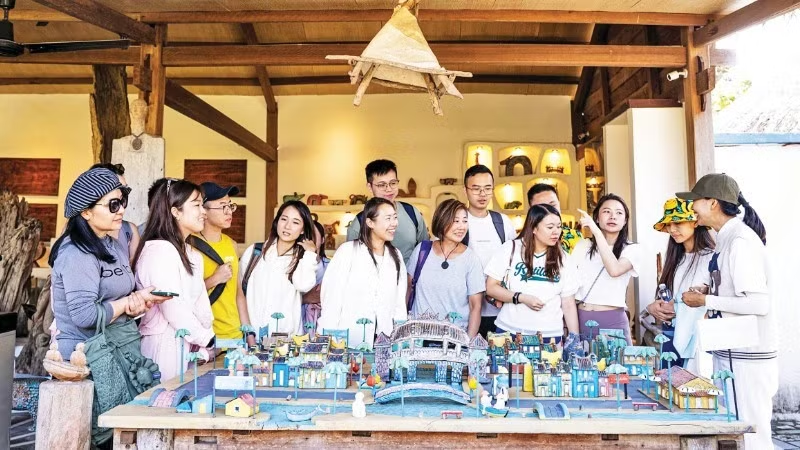
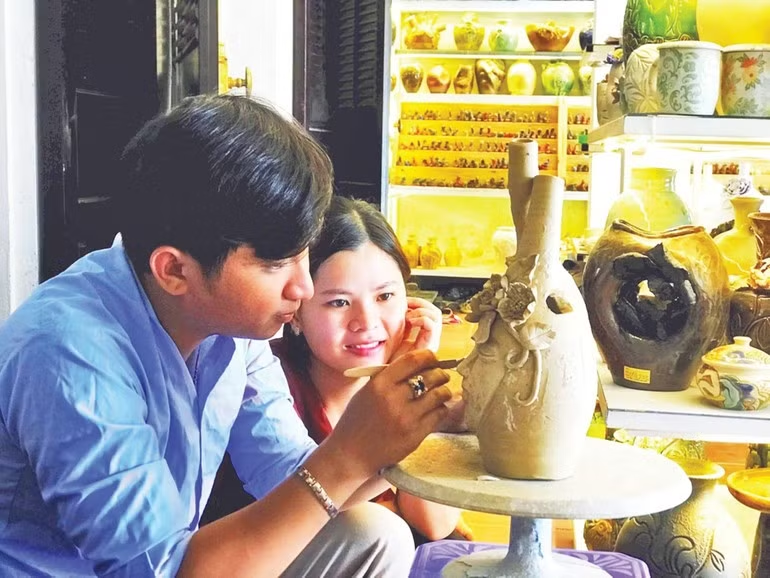
Following a group of Korean visitors, I stopped by Son Thuy Pottery Workshop run by Nguyen Viet Lam and Tran Thi Tuyet Nhung, two outstanding representatives of the village’s young artisans who are tirelessly seeking new directions for Thanh Ha ceramics.
Drawing on knowledge gained through formal education and hands-on practice, Lam, born in 1988, has been patiently experimenting to recreate the village’s traditional glaze colours.
According to Lam, a ceramic product must go through five basic stages: clay preparation, wheel-throwing, decorative patterning, glazing and firing, with a minimum completion time of 15 days.
Son Thuy is currently the first and only workshop in Thanh Ha to apply glazing and fire at around 1,200°C for 12 hours, producing durable, highly aesthetic pieces. As a result, Son Thuy ceramics fetch prices three to four times higher than unglazed ware and travel with visitors to many countries, serving as “cultural ambassadors” for Hoi An.
Equally noteworthy are hands-on experiences that allow visitors to try their hand as pottery artisans, activities popular with international tourists and domestic groups with children and young people.
Thanh Ha Pottery Village now has 37 households with nearly 70 direct workers, earning an average monthly income of 7-10 million VND.
In 2001, the village welcomed just 674 visitors, generating more than 8 million VND in revenue; by 2025, visitor numbers had surpassed 251,000, 95% of whom were international.
Returning to the ancient town at dusk, the kaleidoscope of lanterns lighting up every street prompts many groups of visitors to pause for photos. Hoi An lanterns are not merely decorative objects but cultural symbols. Unlike paper or plastic lanterns common in many Asian countries, Hoi An lanterns are wrapped in silk, brocade or linen, making them both durable and visually striking.
In Cam Ha, everyone knows artisan Huynh Van Ba, who made a major contribution by improving collapsible lantern frames, making them easier to transport and more widely adopted. Building on that foundation, Vo Dinh Hoang, 41, founded the Dé Lantana lantern line, incorporating nipa palm paper into his designs to tell new stories of memory and identity.
At the Ocean International Lantern Festival 2025, his Hoi An Craft group won the top prize, affirming the successful fusion of traditional techniques with contemporary creative thinking.
Beyond display, lanterns have become tourism products in their own right. In 2023, the online travel platform Tripadvisor, ranked the Hoi An lantern-making experience among the ten most attractive experiences in Viet Nam.
At workshops such as Ha Linh, Long Vy and Thanh Truc, visitors can build frames, stretch fabric and paint patterns themselves. One Australian female tourist shared: “The lantern I brought home may not be perfect, but it’s tied to a very beautiful afternoon in Hoi An, Viet Nam.”
Unlocking creative currents
Along the Thu Bon River, Kim Bong carpentry village awakens at dawn to the sounds of saws and chisels.
In the 16th and 17th centuries, when the Hoi An trading port flourished, Kim Bong carpentry reached its zenith, developing four branches: construction carpentry, household furniture, fine arts woodwork and boatbuilding.
Kim Bong’s imprint can still be seen in many wooden structures across Hoi An, Da Nang and beyond, helping to shape the region’s architectural identity.
After many ups and downs and facing the risk of decline, Kim Bong today not only preserves its traditional craft but also actively innovates, diversifies products and has become an appealing experiential destination.
At Huynh Ri Carpentry Workshop, the early-spring welcome seems all the more joyful and proud as its owner, 56-year-old artisan Huynh Suong, has just been honoured with the title of People’s Artisan at the beginning of 2026.
As the 13th generation of the renowned Huynh carpentry lineage in Hoi An, Suong has personally trained hundreds of local apprentices into skilled craftsmen and encouraged his children to pursue formal fine arts education to carry on the trade.
Alongside Kim Bong carpentry village is the Kim Bong sedge mat-weaving village, which preserves and recounts stories of culture and folk knowledge.
Pham Thi Cong, born 1989, after many years working as a tour guide, returned to her village to revive the traditional craft.
Riverside spaces have been transformed into performance and experience areas where visitors can join in harvesting sedge, drying, dyeing and weaving mats.
Her workshop has achieved OCOP three-star status; in December 2024, and Kim Bong mat weaving was officially recognised as a traditional handicraft.
Notably, in recent years Hoi An has seen the emergence of models that bring contemporary art into craft village spaces, such as Vo Tan Tan’s Taboo Bamboo Workshop in the Cam Thanh coconut forest and Le Ngoc Thuan’s Driftwood Village in Cam Ha, places where local bamboo and wood are elevated into materials for sculpture and installation art.
Overall, Hoi An’s craft village tourism is shifting from a sightseeing-shopping model to one of experience, interaction and storytelling.
Challenges remain, however, including the risk of commercialisation diluting identity, pressure from large visitor numbers, uneven experience quality, scarcity of traditional materials, and the need to balance conservation with development.
Experts suggest that rational tour planning, establishing quality standards for experiences, supporting artisans, training locals in tourism skills, and encouraging youth creativity rooted in indigenous values are essential pathways forward.
In recent years, Hoi An’s younger generation has stepped in with fresh thinking. Following the 2025 Hoi An Young Leaders Training Programme, 50 young people developed 14 innovation projects focused on heritage and craft village preservation.
More recently, the Quang Region Green Destination Club, together with around 20 tour operators nationwide, conducted surveys and added ten typical craft villages in Hoi An to a new tour map, aiming to diversify Da Nang’s tourism products in 2026.
According to Luong Bich Ha, Director of Wide Eyed Travel & Tour, Hoi An’s craft village culture holds strong potential to grow in harmony with green, environmentally friendly tourism trends, particularly handicrafts and healing-oriented products, which are attracting increasing interest from European, American and Australian markets.
Within the venerable silhouette of the ancient town, Hoi An contains a vibrant energy space, where traditional crafts are being rekindled through the combined efforts of artisans, the community, policy support and youthful creativity.