Amid concerns over potential waste, teachers’ pressure in making textbook selections, and financial burden on parents, many ideas argue that it is time to seriously consider developing a common national textbook set that ensures stability, scientific rigour, and suitability for teaching and learning capacities nationwide.
Benefits of a unified set of textbook
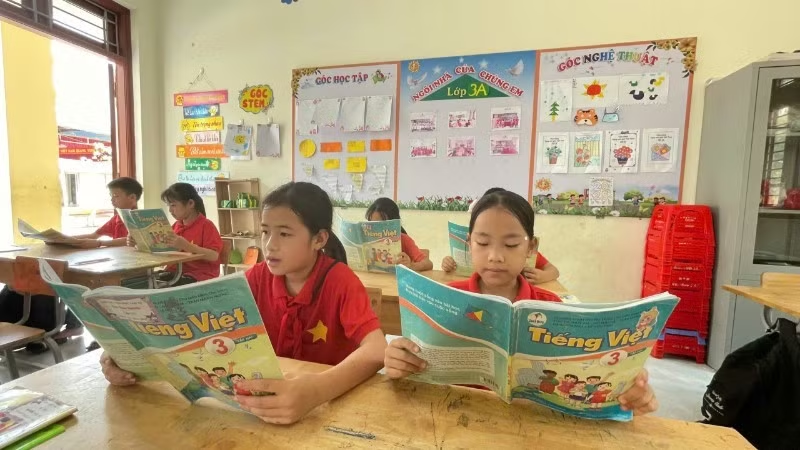
Since the implementation of the policy to socialise textbook compilation, Viet Nam’s general education system has many textbook sets published by different publishers. This has increased diversity, it has also led to significant limitations.
In many localities, teachers struggle with textbook selection, spending considerable time reviewing and comparing different sets of textbooks to find those most suitable for their students’ abilities. The existence of many textbook sets has also resulted in a lack of consistency in teaching in localities nationwide. Teachers moving from one province to another often face difficulties, having to familiarise themselves with an entirely new curriculum structure and knowledge standards based on different sets of textbooks.

Experts said that building a unified set of textbooks does not mean denying autonomy or creativity in education. On the contrary, a standardized set of textbooks would provide a stable common foundation, ensuring core knowledge and skill requirements for students across the country.
A unified set of textbooks would help reduce cost burdens, limit commercialisation in textbook compilation, and create greater consistency in testing and assessment. Teachers would be better able in lesson preparation, while students would access more balanced content aligned with their psychological and developmental stages.
In particular, as the new general education curriculum requires strong continuity between education levels, a unified set of textbooks would help adjustments and updates to be implemented in a more coordinated and effective manner.
Addressing this issue, National Assembly Deputy Nguyen Thi Viet Nga (Hai Phong City) said that assigning the Ministry of Education and Training to develop a nationwide unified set of textbooks is a matter of significant public concern, because it relates to costs, quality, and the risk of monopoly.
“I believe that the current guiding viewpoint of the National Assembly and the Government is correct: we must not return to a monopoly mechanism textbook as in the past, but neither can we allow too many sets of textbooks to continue causing waste and difficulties for teachers and students,” she stressed.
Which solutions are feasible?
Responding to questions from a Nhan Dan Newspaper reporter on feasible and cost-saving approaches, the National Assembly deputy from Hai Phong proposed several solutions.
First, a unified set of textbooks should follow a selective approach from existing effective textbook sets instead of compiling an entirely new set, which would be very costly. The Ministry of Education and Training should organise independent evaluations of all existing sets of textbooks, select the best books from each set, and combine them into a national standard set of textbooks. The structure, knowledge framework, and learning outcomes would then be adjusted. This approach would save time and budget while taking advantage of many author teams already tested in practice.
Second, the current mechanism of many sets of textbooks should be maintained, but there is one standard set of textbooks, while other sets function as supplementary materials, giving schools greater autonomy.
Third, strict requirements must be imposed to prevent the re-establishment of monopoly.
If the Ministry of Education and Training compiles textbooks without close oversight mechanisms, there is a real risk of returning to the old model. Therefore, it must ensure: an independent appraisal council with international experts; full transparency in selection, appraisal, and pricing processes; a clear separation between state management and textbook compilation; and pricing for the unified textbook set must be regulated by the state to prevent inflated costs.
Nguyen Thi Viet Nga emphasised: “The most important point is that a unified textbook set must truly serve students, not for group interests or convenience in management.”
Sharing solutions to building a unified textbook set that could be applied as early as the 2026–2027 school year, Ly Van Dien, Principal of Yen Trach Primary School (Thai Nguyen Province), suggested that it should not select only one of the three textbook sets currently in use since the 2020–2021 school year, as this could lead to monopoly and waste the strengths of other sets. Through years of teaching experience, using many textbook sets for subjects, he noted that each existing set of textbooks has its own strengths and meets requirements on objectives, content, and method. All have undergone appraisal and selection at different education levels, demonstrated scientific value and teaching effectiveness, and teachers have received adequate training.
“If selection is made from these three sets of textbooks, choosing one set for each education level would be a reasonable approach. It can be applied immediately and save costs,” Dien said.
Some teachers expressed their concern that compiling an entirely new textbook set would likely fail to meet the timeline for application in the coming school year. Conversely, choosing one existing set while discarding the others would waste knowledge and efforts and unfairly disadvantage non-selected sets, because all current textbook sets have their own strengths.
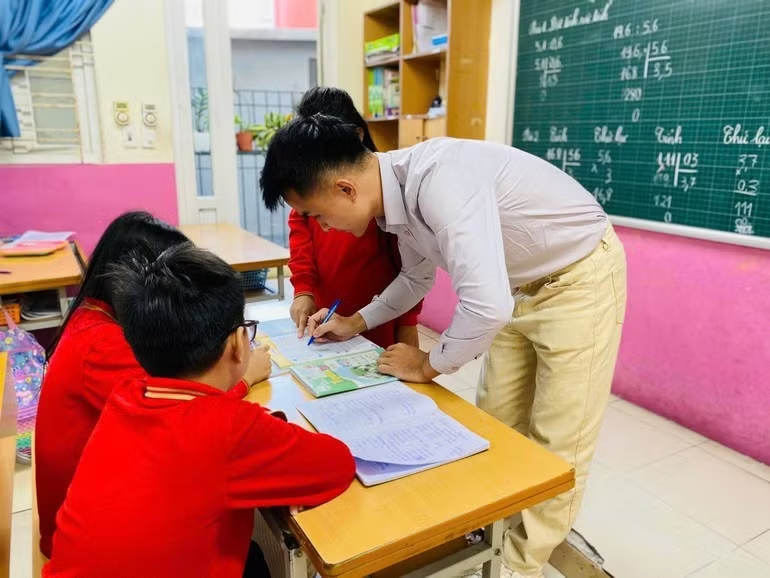
Dang Ngoc Tram, Principal of Dinh Tien Hoang High School (Ha Noi), affirmed that teachers at her school unanimously agreed that each education level should select one of the three existing textbook sets. This approach would ensure quality and progress without regional disruption or the need for retraining teachers.
Regarding difficulties, many opinions acknowledged that compiling a new textbook set would ensure consistency in content. However, compiling a complete new set of textbooks for 12 grades would require approximately four to five years, including drafting, editing, pilot teaching, appraisal, consultations with teachers and experts, and teacher training. Meanwhile, the requirement for a unified set of textbooks to be used in the next school year makes this option largely unfeasible. The fastest approach, therefore, would be to select lessons from different textbook sets and integrate them into a coherent subject sequence. If selecting an entire single textbook set from the existing three is difficult, as all have been appraised, approved, and widely used, making such a choice potentially unfair.
Other opinions propose a combination model, whereby the state takes a lead in compiling a standard textbook set through a rigorous appraisal council, while allowing many supplementary materials and open educational resources to enable flexible teaching. This would ensure a shared knowledge foundation while giving creative space for teachers.
In addition, a reasonable transition roadmap is essential: thoroughly reviewing existing textbook sets, adopting their strengths, addressing shortcomings, and expanding consultations with teachers and scientists before issuance. In the long term, the application of digital technology would facilitate textbook management and updates through digital versions, reducing printing costs and ensuring equitable access between regions.
In the context of ongoing and profound reforms in general education, a unified textbook set is considered a solution with high stability and meeting requirements for equity, quality, and efficiency. However, successful implementation needs careful, scientific preparation and consensus from teachers, parents, and education managers.