Followings are Ninh Binh with a growth rate of 10.65%, Phu Tho at 10.52%, Bac Ninh at 10.27% and Quang Ngai at 10.12%. The common feature of this group is a solid industrial and service foundation, along with the ability to attract and effectively utilise FDI.
Although there are still five localities in the group with growth rates below 7%, the data show that no area has fallen into stagnation, demonstrating the effective spillover impact of the Government’s macroeconomic policies.
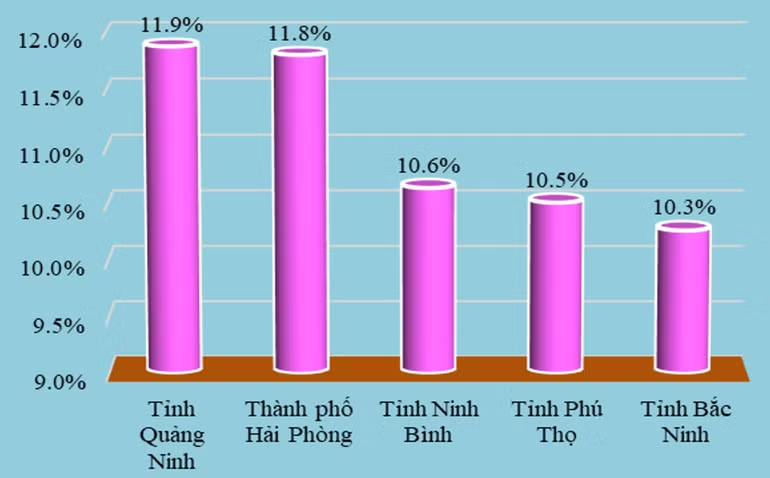
Moreover, the growth rates of gross regional domestic product (GRDP) of localities in 2025 ranged from 5.84% to 11.89%. Notably, the majority belonged to the group of provinces and cities with a stable growth rate from 7% to 10% (23 out of 34 provinces and cities).
At a press conference announcing socio-economic statistics for the fourth quarter and the full year of 2025, held in Ha Noi on the afternoon of January 5, the General Statistics Office released a report on GRDP growth rates of 34 provinces and cities.
Group of localities achieving strong double-digit growth rates
Accordingly, the most prominent highlight was the group of localities recording strong breakthroughs in GRDP growth rates. Leading the country were Quang Ninh, Hai Phong, Ninh Binh, Phu Tho and Bac Ninh, with growth rates ranging from 10.27% to 11.89%, significantly higher than the national average.

The General Statistics Office under the Ministry of Finance assessed that the breakthrough of the leading group was not accidental. Specifically, these localities share common characteristics such as economic development orientations that are suitable for local conditions and comparative advantages; relatively solid industrial and service foundations; and effective implementation of institutional reform solutions, improvements in the investment and business environment, and enhanced effectiveness and efficiency of governance. The promotion of internal strengths combined with the attraction and effective use of investment capital flows, especially FDI, has created strong momentum for high GRDP growth.

Ha Noi ranked 16th with a GRDP growth rate of 8.16%, while Ho Chi Minh City ranked 21st with a growth rate of 7.53%. Despite not in the Top 10, these two cities, together with Hai Phong, Dong Nai and Bac Ninh, continue to play a pillar role in the economy, making the largest contributions to national GDP growth. These are the five localities with the largest economic scale nationwide; in 2025, this group contributed as much as 55.4% to national growth.
Statistical data show that Ha Noi and Ho Chi Minh City contributed 36.1 percentage points to national growth. Hai Phong recorded an economic growth rate of 11.81%, contributing 8.58% to overall national growth, continuing to affirm its leading position with high and stable growth over many years.
Dong Nai recorded an estimated GRDP growth rate of 9.63%, contributing 5.49% to overall national growth, continuing to affirm its position as one of the key industrial localities in the Southeast region. Meanwhile, Bac Ninh’s GRDP growth in 2025 was estimated at 10.3%, ranking fifth out of 34 localities, mainly due to the strong expansion of its key economic sector of “manufacture of electronic products, computers and optical products”, which grew by over 20%.
The Red River Delta continues to serve as the national growth driver
In terms of economic region, the Red River Delta continues to play its role as a key growth driver of the country. Its GRDP growth rate was estimated at 9.74%, higher than the national average, contributing up to 36.41% to overall national growth, the highest among all regions. This result highlights the prominent role of major economic centres, processing and manufacturing industries, and modern services, together with the effective spread from leading localities such as Ha Noi, Hai Phong, Bac Ninh and Quang Ninh.
The Northern Midlands and Mountainous region recorded an estimated GRDP growth rate of 8.53%, contributing 7.77% to overall national growth. Localities in the region such as Thai Nguyen, Phu Tho, Bac Giang and Lao Cai have been gradually narrowing the development gap with other regions nationwide.
The North Central region recorded an estimated GRDP growth rate of 8.37%, contributing 6.47% to overall growth. The regional growth mainly came from manufacturing and processing industries, energy, along with the recovery of tourism and services, contributing to enhancing the region’s role in the national economic structure, with representative localities such as Thanh Hoa and Nghe An.
The South Central and Central Highlands regions were estimated to grow by 7.74%, contributing 9.56% to overall growth. The growth of this region is associated with the development of the processing industry, renewable energy, high-tech agriculture and tourism services, particularly in coastal localities and major tourism centres such as Da Nang, Khanh Hoa, Hue, and Lam Dong.
The Southeast region continues to be the largest-scale economic region nationwide, with an estimated GRDP growth rate of 7.98% and a contribution of 31.40% to overall growth. This region is home to many major industrial, service, logistics and financial centres. Among them, Ho Chi Minh City, Dong Nai, and Binh Duong play the leading role, creating strong spreading growth momentum for the whole country.
The Mekong Delta recorded an estimated GRDP growth rate of 7.24%, contributing 8.39% to overall growth. Although its growth rate was lower than that of some other regions, it remained relatively stable, with limited breakthroughs, as most economic activities are fundamentally linked to commodity agriculture, agricultural product-processing industries and intra-regional logistics services.

Public investment, the digital economy, and the green economy: the “key” to sustainable growth
Assessing the GRDP growth results in 2025, Nguyen Thi Huong, Director General of the General Statistics Office, said there were signs of positive recovery but also many issues to address, including regional disparities, growth quality, sustainability and long-term competitiveness. For example, some large provinces and cities (Ha Noi, Ho Chi Minh City, Binh Duong, Hai Phong, Quang Ninh, Bac Ninh, etc.) recorded outstandingly high growth, while many mountainous localities, the Central Highlands and the Mekong Delta grew at much lower rates. This reflects imbalances in the allocation of resources and development opportunities, with the risk of widening the gap between rich and poor regions.
In addition, GRDP growth in many localities still depends heavily on traditional sectors such as the processing industry, construction, and wholesale and retail trade. Innovation, science and technology, and high value-added services have not become the main driving forces, making growth less sustainable.

Meanwhile, Le Trung Hieu, Deputy Director General of the General Statistics Office, said that although the picture of the local economy is very positive, the gap between the leading group (nearly 12%) and the lower group (nearly 6%) remains very large and requires solutions to narrow it. Therefore, the General Statistics Office believes that in the coming period, more reasonable regulation and allocation of resources will be needed to support lower-performing localities so that they are not left behind.
“Making use of scale, accelerating the disbursement of public investment capital, and developing new sectors (digital transformation, green economy) will be the key to maintaining sustainable growth momentum for the entire local economic system in the coming years,” shared Le Trung Hieu, Deputy Director General of the General Statistics Office.