In recent days, the investor and contractors have been making round-the-clock efforts to accelerate construction progress, aiming to bring the project to completion as soon as possible and realise the target of 3,000 km of expressways by the end of this year in accordance with the government’s direction.
Although, during the final sprint, the central region experienced prolonged exceptionally heavy rainfall, causing significant difficulties and pressure, the units have continued to make efforts to construct the remaining items to ensure the project’s completion and opening to traffic on December 19, in line with the schedule assigned by the prime minister.
“Through mountains and passes”, opening the route
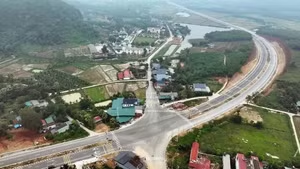
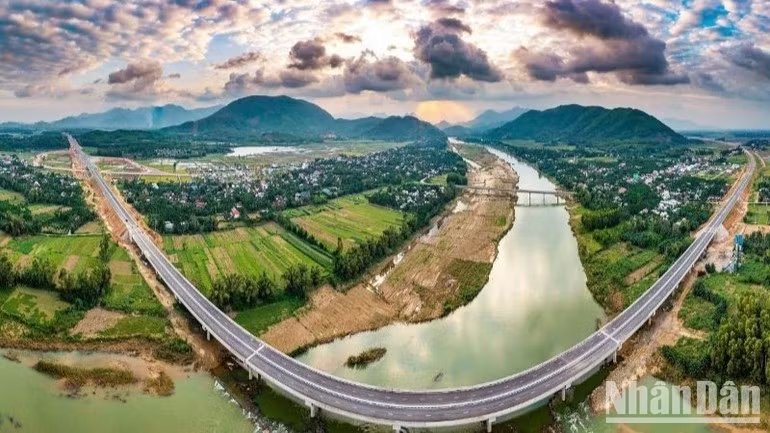
The Quang Ngai–Hoai Nhon Expressway project was launched on January 1, 2023, with a total investment of more than 20.4 trillion VND. The total length is 88 km, of which more than 60 km runs through Quang Ngai Province and nearly 28 km through Gia Lai Province. This is the largest project among the 12 component projects of the North–South Expressway phase 2021–2025.
Once completed, the project will shorten travel time from Quang Ngai to Gia Lai, ease traffic pressure on National Highway 1, contribute to the early completion of the national transport infrastructure network, create new development space for the central region, open a new economic connectivity axis, and generate growth momentum for the whole country.

With the milestone of opening the route around December 19, over recent months thousands of workers and engineers on the Quang Ngai–Hoai Nhon Expressway project have seized every hour and minute to carry out construction with the highest determination, striving to complete the final items as soon as possible.
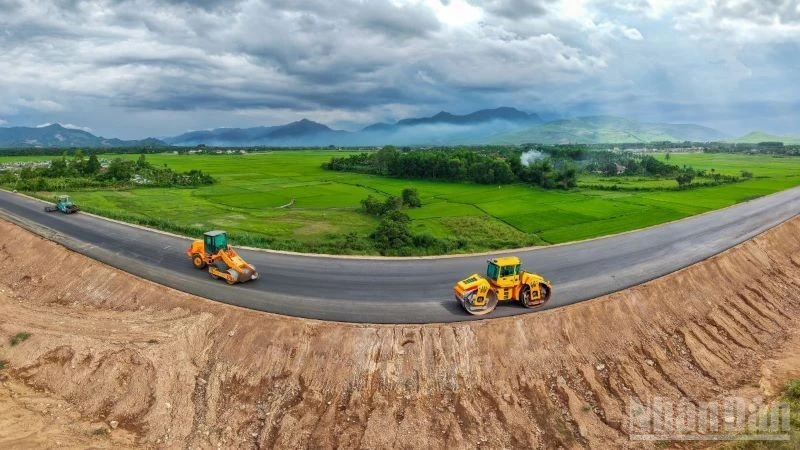
To save time, contractors have arranged for workers to have lunch and night meals right at the construction site. As the contractor responsible for about 75 km of the project’s 88 km length, Tran Dai Xuan, Deputy Project Director (Deo Ca Group), said that by now the main route has completed asphalt paving, and construction teams have shifted to completing traffic safety items such as signage, anti-glare screens, guardrails, road markings, and site cleaning.
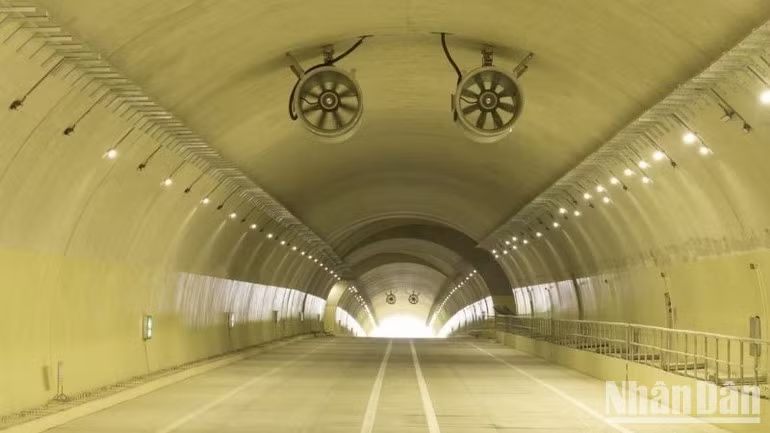
Along the Quang Ngai–Hoai Nhon Expressway there are three mountain road tunnels with a total length of 4,500 m; among them, the 3,200-metre-long Binh De Tunnel (Tunnel No. 3) is a special-grade structure. Tunnel construction faced many difficulties due to geological changes compared with the initial surveys.
“When drilling Tunnel No. 2 and Tunnel No. 3 deep into the mountain, the construction unit discovered geological conditions that differed completely from the initial geological survey, requiring changes to construction methods. However, Deo Ca Group drew on experience from many previous complex projects and innovated the ‘Deo Ca NATM tunnelling method’, helping shorten construction time by four months for Tunnel No. 1 and about six months for Tunnel No. 2. For Tunnel No. 3 alone, the unit shortened the schedule by around eight months compared with the original plan. This is evidence of the capability of Vietnamese enterprises to ‘overcome mountains and cut through passes’,” Mr Xuan emphasised.

In addition to difficulties related to site clearance and material supply for the project, Mr Xuan also acknowledged that the greatest challenge in the final sprint was unfavourable central region weather, with prolonged exceptionally heavy rainfall severely affecting construction organisation.
Identifying this as a key project of the group, Mr Xuan said that the group’s leadership mobilised all resources, from finance to more than 1,000 pieces of equipment and 3,000 personnel, for rapid deployment from the start of construction, with strong determination to complete the project, resolve obstacles, and meet requirements for quality, safety and efficiency on schedule.
“Under the government’s direction, the project was required to shorten the schedule by eight months and complete by the end of 2025. With the support of ministries, sectors, localities, the investor, and contractors, the project reached the finish line just before December 19, contributing to the achievement of the goal of putting more than 3,000 km of expressways nationwide into operation by the end of this year,” Mr Xuan said enthusiastically.
Binh De Tunnel — the ‘heart’ of the project
It is no coincidence that Tunnel No. 3 (Binh De Tunnel, named after the mountain range marking the boundary between Quang Ngai and Gia Lai) is likened to the “heart” of the Quang Ngai–Hoai Nhon Expressway project. This is the largest newly built expressway tunnel along the entire North–South Expressway and is considered the “heart” of the project, where all pressures related to engineering, safety and progress are concentrated into every metre inside the mountain. Under the prime minister’s requirement to shorten the schedule, Binh De Tunnel was identified as the project’s “critical path”, with immense progress pressure, because only when this tunnel was opened could the entire route be opened.
Bui Hong Dang, Director of the Tunnel Construction Command Board, shared that completing and opening Binh De Tunnel today is the result of thousands of sleepless nights inside the mountain and thousands of consecutive shifts by nearly 1,000 engineers and workers working continuously 24/24 without rest. There was no concept of holidays or Tet; everyone seized every hour and minute to break through the tunnel. Throughout construction, many engineers and workers temporarily set aside personal joys and missed important family moments so that this national key project could be completed on schedule.
After nearly three years of “eating and sleeping in the tunnel”, Nguyen Khac Tu, a drilling machine operator, shared: “The construction schedule was tight, meals had to be taken quickly, but everyone maintained determination. Towards the end, when the tunnel entered the finishing and equipment installation stage, morale became even higher, progress pressure eased, and everyone eagerly awaited the inauguration day.”
Mr Dang emphasised: “Although we prioritised accelerating progress, labour safety and construction quality were always our top priorities. Just a single tear in the waterproofing layer could affect the safety and durability of the project. Therefore, every stage was strictly controlled.” In Phase 1, Binh De Tunnel uses only one tunnel tube for two-way traffic, so the tunnel operation centre plays a very important role in ensuring safety and smooth traffic flow. The tunnel operation centre includes a monitoring and control complex using ITS and SCADA systems, along with a fire prevention and firefighting system.
According to the design, to meet large scale and very high projected traffic volumes, Binh De Tunnel is equipped with 20 jet fans at suitable positions along the tunnel to ensure air regulation and maintain a safe environment for road users, especially in case of incidents. The tunnel’s lighting system has also been invested with more than 1,730 lighting units with capacities ranging from 40 W to 120 W, meeting safety requirements and enabling continuous operation in the specific environment.
With day-and-night efforts by thousands of people driven by a “command from the heart”, the Quang Ngai–Hoai Nhon Expressway project is approaching the finish line, completing an important piece in the national target of more than 3,000 km of expressways.
Cao Viet Hung, Deputy Director of Project Management Board 2 (the investor), assessed that the continuous rain in Quang Ngai in early December hindered contractors’ construction activities. From December 11, the weather became dry, and the investor instructed contractors to take advantage of favourable conditions, increase machinery and manpower, and organise a ‘three shifts, four crews’ approach to quickly complete remaining items such as installing signage and road markings and cleaning surfaces along the route.
By mid-December, the project had completed the embankment filling for the main route and overpasses; basically completed asphalt concrete paving; and completed installation of guardrails and median barriers.
Previously, the section from Km79 to Km88 was technically opened to traffic on August 19, 2025. Just before the opening, when the weather cleared, the final metres of road were asphalt-paved, with all items strictly supervised by consultants and engineers to ensure quality.
The project completed on-site construction on December 15 and proceeded with cleaning and site clearance to open the route in accordance with the directions of the prime minister and the Ministry of Construction.
“Nearly three years since groundbreaking, the project faced many difficulties related to site clearance, scarce material supply, price fluctuations, prolonged rain and wind, and severe impacts on many items. However, amid hardship, the spirit of officials, contractors, engineers, and workers was continuously strengthened, uniting efforts to overcome challenges and complete the task with determination, aspiration and the never-give-up spirit of bridge and road builders,” Mr Cao Viet Hung affirmed.