
According to the Ministry of Industry and Trade, in 2024, the scale of the e-commerce market is over 25 billion USD, up more than 20% compared with 2023, accounting for around 9–10% of the country’s total retail sales of goods and consumer services.
This figure continued to boom in the first nine months of 2025, with revenue on major e-commerce platforms reaching 305.9 trillion VND (about 12.2 billion USD), an increase of 34.35% year on year. For the whole of 2025, the e-commerce market is forecast to reach 39 billion USD.
These figures not only reflect the strong vitality of the economy but also demonstrate a clear shift in consumer demand from traditional stores to e-commerce.
Change to develop
In reality, many commercial streets in big cities are now witnessing scenes of quiet decline, with large numbers of shops closing down. This is a clear signal of a digital revolution in which e-commerce is no longer a supplementary channel but has become the primary driving force, forcing the retail sector to restructure to survive.
According to the Ministry of Industry and Trade, in the first half of 2025, more than 5,500 shops and household businesses nationwide ceased operations, mainly in big cities such as Ha Noi and Ho Chi Minh City. This not only affects jobs of tens of thousands of employees but also changes the urban appearance, turning once vibrant areas into quieter streets with many vacant retail premises.
The main cause of this situation is due to boom in e-commerce after the Covid-19 pandemic, as consumers have gradually changed their habits and shifted strongly in their purchasing behaviour. Accordingly, shoppers are no longer keen on strolling through streets and trying on products in crowded stores, instead opting to shop online with just a few taps on their smartphones.
E-commerce platforms now dominate the market, with sales growing 34.35% in the first nine months of 2025, reaching 305.9 trillion VND. Young people, the main consumer group accounting for over 60% of the population, prioritise speed, convenience, and competitive prices, enabling e-commerce not only to compete with but to overwhelm the market share of traditional retail.
From an economic perspective, this is not a recession but an inevitable market transition. Fixed costs such as shop rentals, staffing, and logistics have risen faster than revenue, forcing traditional business models to restructure. In practice, e-commerce is expanding at an annual growth rate of 20–25%, while traditional retail grows by only 7–8%.
Many major brands in fashion and food services have begun to adjust flexibly. Instead of opening a series of outlets on the same street, they now maintain only small showrooms where customers can experience products, try them out, and receive guidance how to purchase online.
The omnichannel model, combining offline and online channels, not only helps maintain brand presence but also cuts operating costs significantly, about 30–40%, according to some studies.
This shift is even more evident in the agricultural sector, which was once considered difficult to adjust to e-commerce. Previously, agricultural products were thought to be only suitable for traditional markets or supermarkets. Today, fruits, vegetables, and processed agricultural products are being sold online effectively.

At Viet Nam Agriculture Week 2025, the Agency for Domestic Market Surveillance and Development successfully connected supply and demand, helping a business to sell a 50-kg sturgeon for 102 million VND through an online auction, meanwhile nearly six tonnes of ST25 rice were sold within just two hours via livestream on a social network.
Tran Huu Linh, Head of the Agency for Domestic Market Surveillance and Development, said that that livestream sessions connecting agricultural consumption is a new approach aligned with digital commerce trends. They help spread product value and bring Vietnamese agricultural goods closer to domestic consumers.
This also demonstrates the power of digital transformation. E-commerce helps directly connect farmers with consumers, boosting domestic consumption and exports while reducing logistics costs.
Toward a sustainable e-commerce environment
Although Viet Nam’s e-commerce market has asserted a leading position in Southeast Asia, ranking third after Indonesia and Thailand, with more than 60 million online shoppers, however, rapid growth also brings risks.
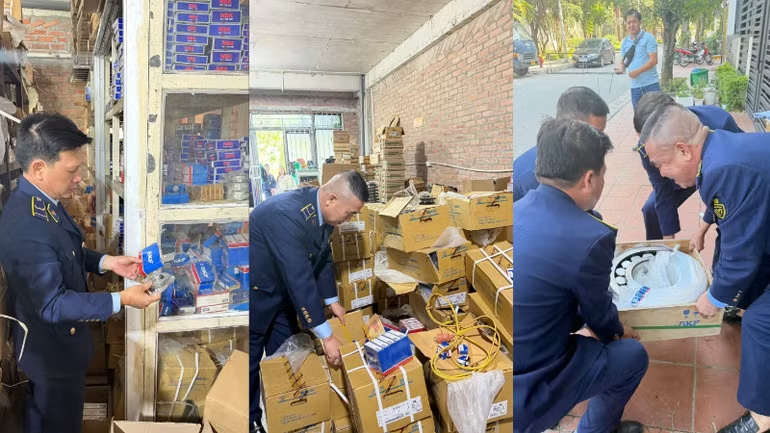
Counterfeit and imitation goods on e-commerce platforms have become a hotspot, with more than 161 violations detected by market surveillance forces in the first six months of 2025, resulting in fines of nearly 3 billion VND and infringing goods valued at over 1 billion VND.
This situation not only undermines consumer trust but also causes losses amounting to thousands of billions of VND for legitimate businesses. For example, counterfeit cosmetics, mobile phones, and fashion products often “hide” behind livestream sales, making them difficult for consumers to identify.
Therefore, for e-commerce to develop in a long-term, transparent, and safe manner, consumer protection is a fundamental foundation for sustainable development. The E-commerce Law 2025, expected to take effect in 2026, may expand management scale to social network platforms and livestream activities, requiring seller identification through VNeID with verified payment accounts.

These measures would create a “firewall” against fraud, assigning responsibility to e-commerce platform operators to control product origins, invoices and documentation, and to remove infringing online shops within 24 hours once counterfeit goods are detected.
In addition, experts believe that to address current shortcomings in e-commerce management, it is essential to promote the application of information technology and invest in facilities, equipment, and human resources to meet practical situation, thereby strengthening efforts to combat counterfeit goods in the online space. At the same time, functional forces need to proactively enhance coordination, inspections, and information gathering to detect and handle violations related to online sales and logistics networks. Specifically, it is necessary to review and refine legal regulations, especially the Law on Electronic Transactions (amended) and the Law on Consumer Protection (amended), and to require supplemented responsibilities from social network platform owners and e-commerce marketplaces.
Furthermore, comprehensive management of transactions between buyers and sellers should be strengthened, with closer monitoring of online goods in circulation, so as to prevent the abuse of e-commerce for trading counterfeit, smuggled, or origin-unknown goods in the coming time.