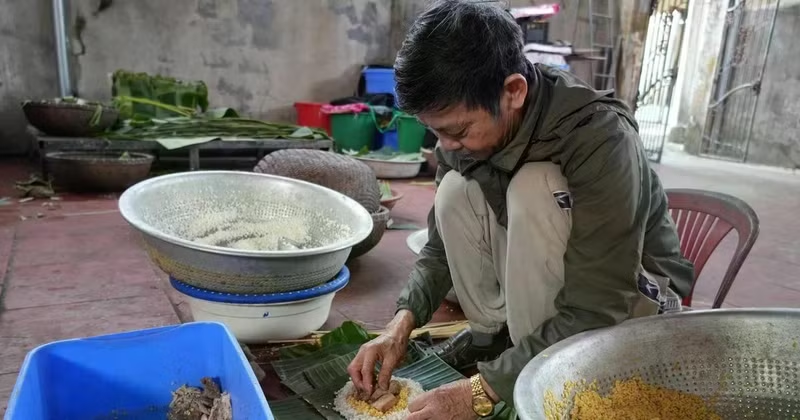
These days, residents of Thuy Duong chung cake village, in Thuy Nguyen Ward (formerly Thuy Duong Commune, Thuy Nguyen District), Hai Phong City, are bustling with preparations to supply chung cakes to the market.
In the months approaching Tet, the whole village is livelier than on ordinary days, with elderly people and children busily working with baskets of rice, mung beans, dong leaves, bamboo strings and pork to produce the best chung cakes for consumers.
Thuy Duong chung cake village is famous for its traditional chung cake-making craft that has existed for hundreds of years. In the past, the entire village made chung cakes, but today only about 20 households remain attached to the trade.
Those who keep the craft alive are mainly middle-aged and elderly people, driven by their love for and pride in the profession passed down by their fathers and grandfathers.
Meanwhile, fewer young people follow the trade because the work is arduous while the income is not high. Nevertheless, whenever Tet approaches, the craft village becomes lively again, busy preparing orders to supply chung cakes to people in many regions across the country.
Long-time experienced villagers say that to make a delicious chung cake, every step must be done carefully, from selecting ingredients and wrapping to boiling.
The main ingredients of chung cake are rice, mung beans, pork, pepper, salt and spices. The leaves used for wrapping are usually dong leaves or banana leaves, which are carefully selected and thoroughly cleaned.
The rice must be fragrant and sticky nep cai hoa vang, thoroughly rinsed and soaked in water for about 1 hour and 30 minutes. The pork used for the filling must be pork belly with a balanced ratio of lean meat and fat to create the cake’s rich, creamy taste.
Mung beans must be of good quality, hulled, cleaned and steamed until cooked. The cakes are wrapped tightly by hand, forming sharp-edged squares, with rice, filling and beans divided in appropriate proportions.
After wrapping, the cakes are carefully tied with bamboo strings and then simmered in a pot for 12 hours so that they become soft, fragrant and can be preserved for a long time.
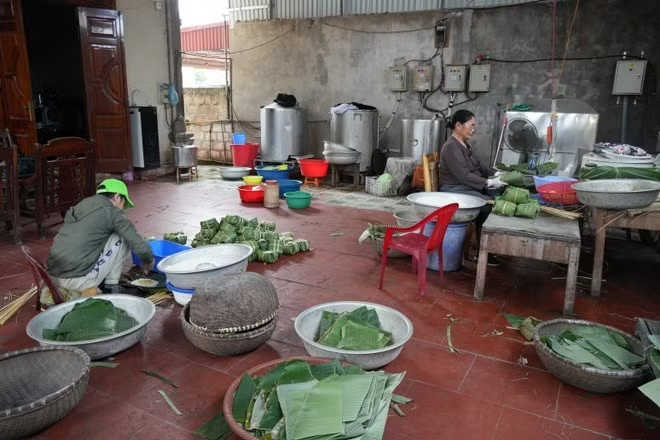
Pham Thi Thoi, from Thuy Duong village, Thuy Nguyen Ward, who has made chung cakes for many generations, said that in the days close to Tet, the number of customers placing orders increases many times compared with normal days.
Therefore, her family has had to mobilise additional helpers to meet customer demand. However, she only accepts orders from the beginning of the twelfth lunar month until the 25th day of the twelfth lunar month, for fear of not being able to complete them in time.
Thoi said that the output of chung cakes this year has declined compared with previous years due to higher input material costs. Each chung cake yields a profit of only 5,000–7,000 VND after deducting expenses.
Nguyen Tat Lo, from Thuy Duong village, Thuy Nguyen Ward, shared that in his family, ingredients for making chung cakes must be carefully selected. Pork must be taken from the hind leg, choosing the best cuts and avoiding inferior parts, and it must be fresh. When boiling the cakes, sufficient cooking time must be ensured so that the cakes are soft and fragrant, meeting the standards handed down by their ancestors. All stages of cake-making must follow tradition.
People in Thuy Duong do not use tap water, well water or river water to boil the cakes, but only rainwater or clear, sweet water from the village pond. This is precisely what creates the distinctive flavour of the local chung cakes.
Nguyen Van Diep, an official of the Culture Department of Thuy Nguyen Ward, Hai Phong City, said that in previous years, everyone in the village, from young to old, made chung cakes. However, nowadays the craft is mainly carried on by elderly and middle-aged people, with very few young people remaining attached to it.
During Tet, orders for chung cakes surge sharply. Local authorities have coordinated with relevant agencies to strengthen communication and inspections on food safety and hygiene.
The ward has developed plans and established inspection teams on food safety and hygiene, as well as signed commitments with chung cake-producing households.
This Tet season, in addition to orders sent to various places, some companies and enterprises have also coordinated with production households to organise hands-on cake-making experience programmes at workplaces, allowing workers to experience this traditional craft.
The price of chung cakes this year is also higher than in previous years, averaging between 80,000 and 120,000 VND per cake; many families supply up to thousands of chung cakes to the market each day.
Thuy Duong chung cakes are not only well known domestically but also carry the flavour of traditional Tet to Vietnamese communities living abroad.
As Tet draws nearer, Thuy Duong chung cakes are distributed everywhere. The reputation of Thuy Duong chung cakes, together with their distinctive flavour, leaves a lasting impression on anyone who tastes them, with the aroma of sticky rice, the nuttiness of mung beans and the rich fattiness of pork.
The traditional craft of making Thuy Duong chung cakes not only brings the flavour of traditional Tet to households everywhere, but also conveys the affection of local people for a warm and happy new Spring.