A journey to search for and identify fallen soldiers
In April 2025, Team 584 under the Quang Tri Provincial Military Command discovered and exhumed two sets of remains in the Cau Nhi area. Among the artefacts was an aluminium canteen engraved with the name “Tuyen” and the number “170071”, providing a clue for identification.
After a process of verification and cross-checking by relevant authorities and Division 308, on January 22, 2026, the Quang Tri Department of Home Affairs issued a decision confirming that the remains in grave No. 1955, Section G4 of Hai Lang Martyrs’ Cemetery belonged to martyr Tran Minh Tuyen, who sacrificed on May 26, 1972.
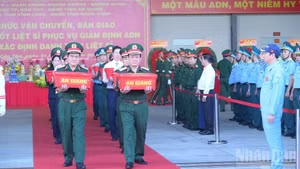
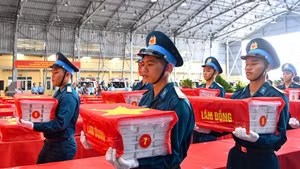
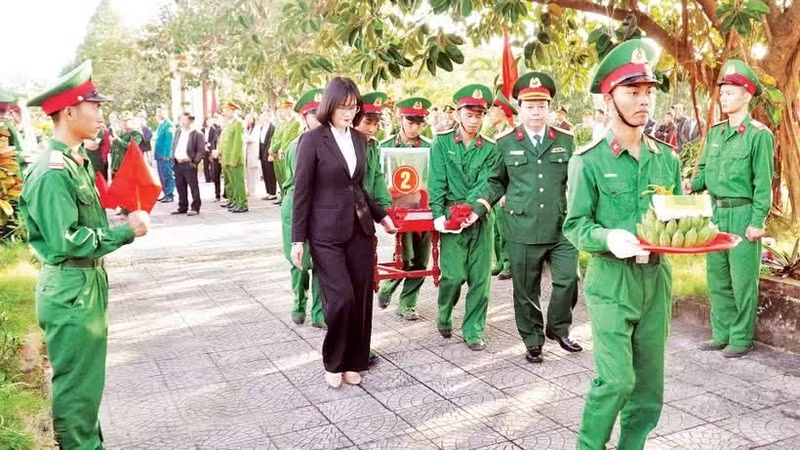
After more than half a century of waiting, martyr Tran Minh Tuyen’s family’s sacred wish for reunion has come true. The remains were exhumed and repatriated from Hai Lang Martyrs’ Cemetery to his hometown and reburied at Thuy Duyen Martyrs’ Cemetery in Nam Thuy Anh Commune (Hung Yen Province) on March 29, 2026, with the coordination of local authorities, relatives, and the liaison board of Division 308’s policy mission. The family’s long-standing wait across generations has finally come to an end.
Tran Van Tam, the martyr’s younger brother, said that Tuyen was the eldest son, who sacrificed his life at the age of 20 before starting his own family. Two years later, the family received the death notice. Since then, their mother’s greatest wish had been to find her son’s grave and bring him back to his ancestral homeland. Today, the family is overjoyed to have found his resting place, fulfilling the wish of their late mother.
Over the years, under the leadership and direction of the Party and State, along with the efforts of ministries, sectors, localities, and forces directly involved, the search for fallen soldiers’ remains has been carried out in a continuous and persistent manner. Notably, during the 2021–2025 period, nearly 7,000 sets of remains were found and repatriated nationwide.
In a modest home in Duc Hoa Residential Quarter, Dong Hoi Ward, Quang Tri Province, Hoang Van Bon (born in 1960) emotionally recounted the story of his brother Hoang Van Hoang, who sacrificed on the Cam Lo battlefield on February 7, 1968.
Due to difficult living conditions, Bon only began his search in 1999. “Sometimes by car, sometimes by motorbike, I have searched across cemeteries in Quang Tri Province and the Cam Lo area, but I have yet to find him. Now, thanks to the Party and State’s policy, especially the ‘500-day campaign to accelerate the search for, recovery, and identification of fallen soldiers’ remains’, I strongly hope that one day I will be able to bring my brother home,” Bon said, his voice choked with emotion.
In recent years, with the leadership of the Party and State, this work has been carried out persistently. In the 2021–2025 period alone, nearly 7,000 sets of remains were found and repatriated nationwide. Nearly 13,500 samples (including remains and relatives’ samples) have been collected, helping identify more than 100 fallen soldiers through DNA testing and over 2,500 through documentary verification; nearly 60,000 biological samples have been gathered to build a gene database of fallen soldiers’ relatives.
However, the remaining workload is enormous. About 175,000 sets of remains have yet to be found, and more than 300,000 graves remain unidentified. Meanwhile, conditions are becoming increasingly difficult as time passes and traces of war continue to fade.
Therefore, it is necessary to improve the quality of implementation, innovate methods, promote the application of science and technology, and strengthen discipline alongside determination and extraordinary efforts.
A call from the heart
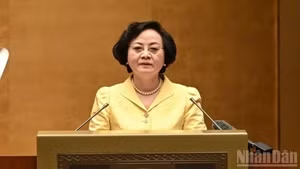
On April 2, at the Quang Tri Ancient Citadel — a special national relic site — Pham Thi Thanh Tra, Secretary of the Party Central Committee, Deputy Prime Minister, and Head of the National Steering Committee for the search for, recovery, and identification of fallen soldiers’ remains, launched the “500-day campaign to accelerate the search for, recovery, and identification of fallen soldiers’ remains.”
Accordingly, phase 1, from January 2026 to July 2027, will complete sampling of all unidentified graves in fallen soldiers’ cemeteries nationwide (about 230,000 graves), along with newly discovered remains. Phase 2, from July 2027 to December 2030, will study and propose sampling for graves with partial information but not yet identified through documentary methods, as well as newly recovered remains.
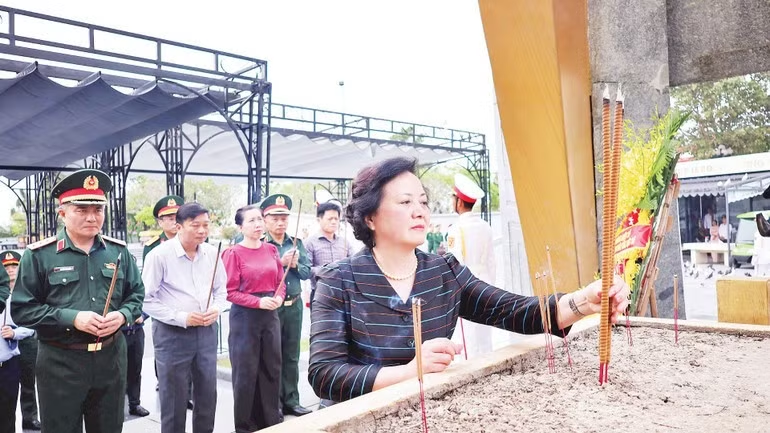
The Deputy Prime Minister emphasised that the search for, recovery, and identification of fallen soldiers’ remains is not merely a professional task, but above all a profound expression of the moral tradition of “remembering the source when drinking water”, a sacred political responsibility of the Party, State, and people, and a tribute to those who devoted their lives to the nation. More than that, it is a call from the heart — one that urges us not to delay, not to be satisfied with what has been achieved, but to act with greater determination to bring heroes and fallen soldiers back to their homeland, their families, and their names.
The launch of the 500-day campaign is not just an action initiative, but a strong affirmation of the determination of the entire political system. For the first time, the search for and identification of fallen soldiers has been organised as a nationwide “campaign”, with clear targets, timelines, and the coordinated mobilisation of the military, local authorities, scientific sectors and fallen soldiers’ families.
One of the campaign’s highlights is the enhanced application of DNA technology in identifying remains. Previously, identification largely relied on artefacts, locations or testimonies; now, science offers a more accurate and objective pathway. The forensic system under the Ministry of National Defence has formed a relatively synchronised professional network. Since 2016, the National Forensic Institute has received more than 13,100 samples from remains and over 2,800 from relatives for analysis and comparison — a massive workload requiring strict procedures and high expertise.
Towards the 80th anniversary of the War Invalids and Martyrs’ Day (July 27, 1947–July 27, 2027), the campaign sets meaningful targets: locating and repatriating around 7,000 sets of remains, analysing about 18,000 DNA samples, building a gene database of relatives, and clearing areas still contaminated with unexploded ordnance to pave the way for the search.
The war has receded, but responsibilities still lay ahead. Hundreds of thousands of unidentified remains yet to be recovered are a reminder that there must be no delay. The 500-day campaign, therefore, is measured not only in time, but in dedication, with the aspiration to close the gaps of loss and pain. Through this, the present generation demonstrates its responsibility, duty, and deep gratitude for the sacrifices of previous generations, further enriching the nation’s humanistic tradition of “remembering the source when drinking water” and “payment of gratitude”.