The 14th National Party Congress underscored that economic development must be inseparable from environmental protection, efficient resource use, and proactive climate change response, while capitalising on new opportunities arising from the global green transition to generate momentum for the economy.
In line with this spirit, accelerating green transformation, energy transition, and establishing market mechanisms to reduce greenhouse gas emissions is not only an external obligation but also an intrinsic necessity of the development process. Among these, the creation and operation of a carbon credit market – beginning with a domestic carbon credit exchange – carries particular importance.
According to Tran Van Tung, Head of Forest Management and Development at the Viet Nam Forestry Corporation, green and energy transformation must be pursued decisively and systematically, tied to energy security, environmental security, and economic competitiveness. He emphasised the need to foster a circular economy and efficient resource use; encourage enterprises to innovate technology and raise standards; and proactively adapt to new global trade and investment requirements.
The early establishment of a domestic carbon credit market will help Vietnamese enterprises strengthen competitiveness, harness new-generation free trade agreements, and mitigate risks from external green trade defence measures
He argued that this is a modern economic instrument aligned with global emission management trends, contributing to Viet Nam’s fulfilment of international commitments on greenhouse gas reduction and advancing towards carbon neutrality.
The Government’s issuance of Decree No. 29/2026/ND-CP on the domestic carbon exchange marks a specific and timely step in institutionalising the Party’s major policies adopted at the 14th National Party Congress. The Congress highlighted the imperative of proactively adapting to new global trade and investment standards.
Tung noted that as many countries, particularly major markets such as the European Union, introduce carbon taxes and environment-related technical barriers, the early establishment of a domestic carbon credit market will help Vietnamese enterprises strengthen competitiveness, harness new-generation free trade agreements, and mitigate risks from external green trade defence measures.
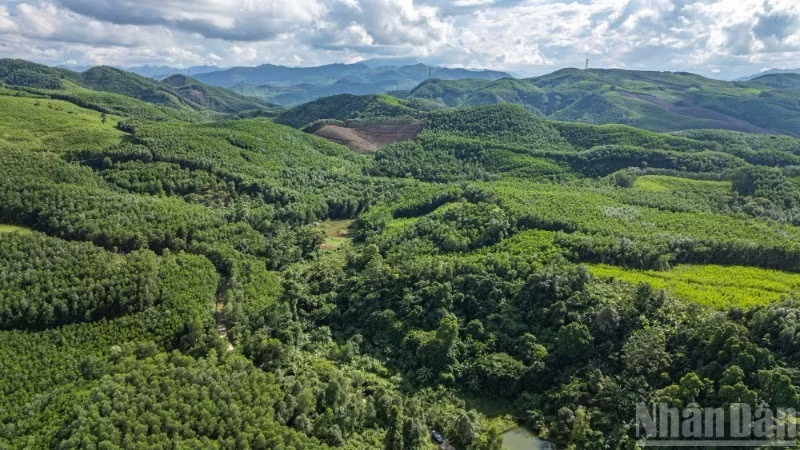
Viet Nam is recognised as having significant potential in forest carbon. The country’s total forest area stands at approximately 14.87 million hectares, with a national forest coverage rate of around 42% and annual carbon absorption estimated at nearly 70 million tonnes of CO2. Forest carbon credits represent a vital value of the forest ecosystem and a new resource for sustainable development.

Effective utilisation of this potential not only supports forest protection and development but also generates additional financial resources for nature conservation, livelihoods for forest-dependent communities – particularly in remote and disadvantaged areas – while advancing Viet Nam’s sustainable development goals.
At the 14th National Party Congress, Party General Secretary To Lam stressed that opportunities only truly become drivers of development when resolutions are organised and implemented systematically, synchronously, and decisively.
According to Tran Van Tung, given Viet Nam’s potential, developing the carbon credit market, especially forest carbon credits, requires continued refinement of the legal framework, the establishment of measurement, reporting, and verification systems to international standards, and capacity-building for management officials, enterprises, and market participants. Without thorough preparation and strong determination, these advantages could easily be lost amid intensifying international competition.
Effective implementation of the 14th National Party Congress Resolution on green transformation and the green economy is the shared responsibility of the entire political system, the business community, and society.
International experience shows that following recent United Nations Climate Change Conferences, particularly with unified global carbon credit standards under UN auspices, the carbon market has entered a new phase of development characterised by fierce competition and increasingly stringent transparency requirements. In this context, any delay could leave latecomer countries paying a heavy price.
Effective implementation of the 14th National Party Congress Resolution on green transformation and the green economy is the shared responsibility of the entire political system, the business community, and society.
Success in these tasks will not only drive green growth and sustainable development but also serve as a vivid demonstration of the Party’s organisational capacity in the new period, clearly reflecting the spirit of innovation, decisive action, and the aspiration to build a prosperous, sustainable nation as set forth by the Congress.

![[In Pictures] Bridge columns and underpasses in Ha Noi begin to turn green](https://en-cdn.nhandan.vn/images/nyM650OGFWrOVWc-xajqN-rTZ68Rlmc1fiGJOhBRYHH_N-Xs0TE8Psnfce7ORTs-KVfoJaEblqjNufFrgeF3e2xFkGtLQVaXm04VcmMKBEkANUyiOkpz4zAuIKgydVrrfBxmGez0E_YJIag0u_Uil0E7jpuJXsIxeMmGjoY1-W4/1791863309074-2994714492692222878-2994714492692222878-adb9ff3f4175c70066ed8bb80cfbead9.jpg.avif)