The performance was boosted by an impressive June, when overseas shipments approximated 1.1 billion USD, up 21% from the same month last year. The rebound reflected improving demand across major markets, with exports to China continuing to surge and the US showing clear signs of recovery. Meanwhile, exports to the EU, Japan and the Middle East remained relatively stable.
Shrimp remained the top foreign currency earner, generating 445.9 million USD in June, up 20.7% year-on-year. Tra fish exports rose 7.7% to 209.1 million USD, while other fish products increased 19.8% to 198.8 million USD.
Several categories posted even stronger growth. Tuna exports climbed 28% to 85.9 million USD, squid and octopus shipments rose 26.5% to 77.9 million USD, while exports of crab and other crustaceans jumped 55.1% to 45.3 million USD. Shellfish recorded the fastest growth, soaring 77.8% to 31.3 million USD.
China, including Hong Kong, remained Viet Nam's largest market in June, with exports rising 32.2% to 256.6 million USD. Shipments to the US increased sharply by 48.3% to 195.3 million USD, reflecting the return of orders after months of weak demand. Exports to Japan edged up 0.3%, while those to the EU, the Republic of Korea (RoK) and ASEAN grew by 6.3%, 29.5% and 16.5%, respectively.
For the first six months of the year, shrimp continued to dominate Viet Nam's aquatic exports, earning 2.3 billion USD, up 13.6%, and accounting for more than 40% of the total value. Growth was mainly driven by robust demand from China, particularly for black tiger shrimp, lobster, frozen shrimp and premium products for restaurants and high-end consumers.
However, exporters continued to face stiff competition in the US from suppliers in Ecuador, Indonesia and India while anti-dumping and countervailing duties, the Seafood Import Monitoring Programme (SIMP), the Marine Mammal Protection Act (MMPA) and stricter traceability requirements added to compliance costs.
Tra fish remained the second-largest export item, bringing in 1.1 billion USD, up 12.1%, and accounting for 19.4% of total aquatic export earnings. The product continued to benefit from stable global demand for affordable whitefish and Viet Nam's advantages in production capacity, pricing and processing.
Other fish products also generated 1.1 billion USD, up 12%, highlighting the sector's increasingly diversified export structure.
Among marine products, squid and octopus exports rose 18.8% to 380.2 million USD, while crab and other crustaceans increased 26.2% to 206.2 million USD. Shellfish exports climbed 33.1% to 155.3 million USD. Tuna was the only major product posting weaker six-month results, with exports slipping 2% to 452.7 million USD, despite strong growth in June.
Le Hang, Deputy General Secretary of VASEP, said the sector's growth reflected not only recovering consumer demand but also exporters' ability to diversify markets and adjust product portfolios.
She noted that exporters have become more flexible in responding to smaller orders, shorter delivery schedules and increasingly strict requirements on pricing, quality, traceability and certification.
China remained Viet Nam's largest importer during the first half, purchasing 1.5 billion USD worth of aquatic products, rising 37.9% and accounting for 25.8% of total shipments. This market was the main growth driver for shrimp, tra fish, lobster, shellfish as well as live and frozen seafood.
Exports to the US reached 897.9 million USD, almost unchanged from a year earlier, indicating that demand has yet to recover fully despite June's strong performance.
Shipments to Japan totalled 787.5 million USD, up 0.7%, while exports to the EU fell 0.8% to 536.7 million USD, partly due to the bloc's "yellow card" warning on illegal, unreported and unregulated (IUU) fishing. Exports to the Middle East dropped slightly, 0.1%, to at 166.6 million USD.
Meanwhile, exports to the RoK rose 9% to 419.4 million USD, ASEAN 15.8% to 380.2 million USD, and other markets 17.1% to 1.1 billion USD, underscoring the effectiveness of Viet Nam's market diversification strategy.
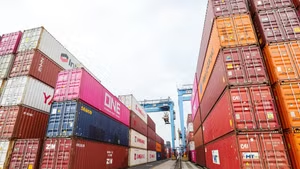
Despite the positive outlook, VASEP warned that rising logistics costs remain a major challenge. Higher international container freight rates, limited refrigerated container availability and port congestion continue to put pressure on exporters, especially on routes to the US and the EU.
The association said the sector's strong first-half performance provides a solid foundation for achieving double-digit export growth in 2026. However, maintaining the momentum will require businesses to strengthen their presence in fast-growing markets such as China, ASEAN and the RoK, while continuing to meet increasingly stringent standards in the US, EU and Japan, alongside tighter cost control and greater investment in value-added products.