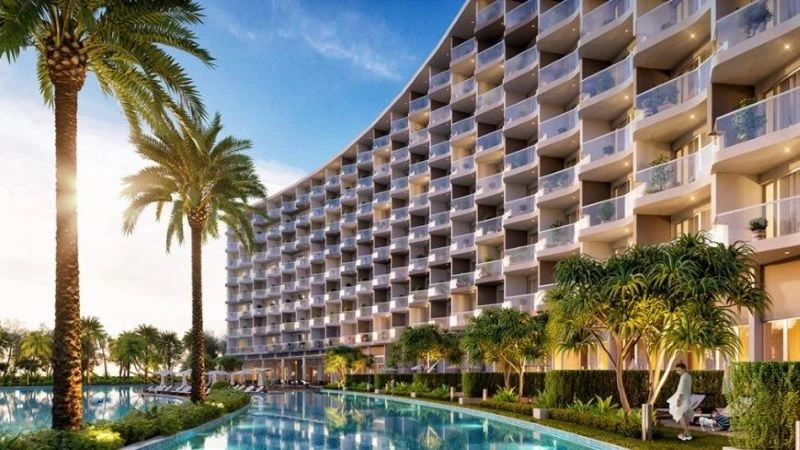
The Vietnam Hotel Investment Guide 2025 released by Savills Hotels shows that repositioning and operational standardisation are becoming core strategies enabling investors to maintain competitiveness and capitalise on the growth momentum of the tourism market.
Viet Nam’s resort market is entering an important phase of transformation as tourism growth reaches impressive levels, while the supply of new hotels has slowed markedly compared with previous periods. According to assessments in the Vietnam Hotel Investment Guide 2025, this context is creating a key focal point: existing projects with good locations but underutilised value are likely to become the centre of investment attention in 2026.
According to experts, the most prominent trend at present no longer lies in expanding room numbers, but in upgrading assets to enhance competitiveness. Viet Nam has many projects in prime locations whose operational efficiency has not yet been optimised. As new supply slows — especially in Ho Chi Minh City and Ha Noi — and customer demand increasingly requires higher quality, upgrading and repositioning will become the strategy delivering the greatest value for investors in the 2026–2030 period.
Data from Savills Hotels show that more than 68% of current supply is self-operated by owners, some of whom have not invested adequately in guest experience. Accordingly, if renovated, operationally standardised, or better leverage through distribution networks through partnerships with international brands, the performance of many projects could improve significantly.
In destinations such as Ha Long, Nha Trang, and Mui Ne, room supply is concentrated mainly in the midscale segment, which is facing intense price competition. Meanwhile, demand from international visitors from Europe, India, and Northeast Asia, as well as Viet Nam’s growing middle class, is shifting towards higher requirements for experience, service, and amenities. This mismatch between supply and demand makes projects with renovation and upgrading potential the most attractive asset group.
At the same time, due to legal barriers and limited land availability, many existing projects in Ho Chi Minh City and Ha Noi are assessed as assets with strong value-added potential if upgraded and repositioned in line with their true potential. This trend is becoming more pronounced as future supply in the two major cities is nearing its ceiling.
In Ha Noi, only about 4,000 new rooms are expected to be launched between now and 2028, mainly in the upscale–luxury segment. Ho Chi Minh City is even more constrained, with fewer than 1,500 rooms currently under development. Meanwhile, emerging markets such as Quy Nhon, Phu Yen, Ho Tram, and several northern satellite areas are rising thanks to accelerated infrastructure development, especially as Long Thanh Airport and key expressways come into operation. However, to fully seize these opportunities, resort products at new destinations need higher standardisation, more diverse experiences, and greater alignment with international visitor preferences — goals that upgrading and repositioning can achieve much faster than developing new projects.
It can be seen that Viet Nam has a rare opportunity to elevate the overall quality of its resort market. Investors who proactively reinvest in existing assets — from design and landscaping to operations — will be the leaders in the new growth cycle. With the combination of strong demand, limited new supply, and the rapid maturation of domestic investors, 2026 is expected to usher in a phase where optimising asset quality becomes the dominant trend.
Savills Hotels believes this is the most opportune time for owners to reassess their operating strategies, evaluate brand repositioning potential, and swiftly capture the shifting dynamics of the market.










![[In Pictures] Nui Chua Rock Park: A million-year-old outdoor museum of landforms on the Khanh Hoa coast](https://en-cdn.nhandan.vn/images/nyM650OGFWrOVWc-xajqNz57td8idIAL_VG9puyG2UZEKOnmq1DVlT1--ZclbO3z2WBaWZhbt6O3e8kjPZqJMWkfEz7RO9qhcwg8o8LQFK8/ndo-br-cao-nguyen-da-moi.jpg.avif)