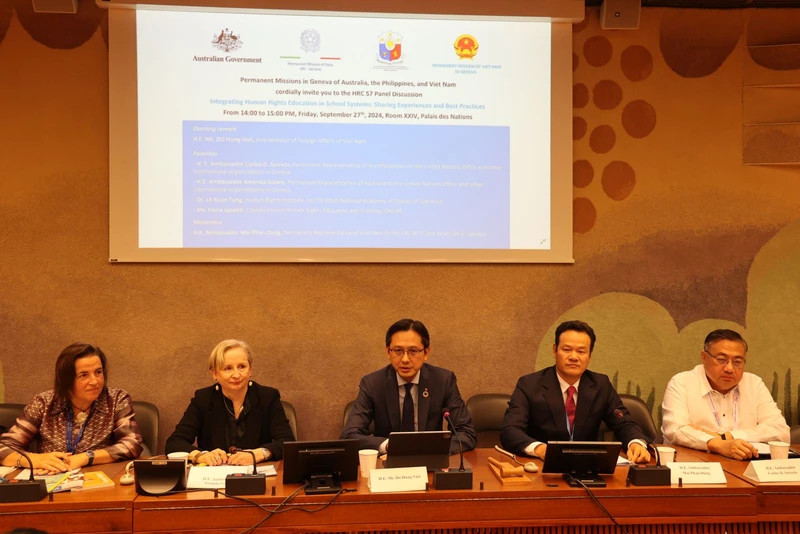
Raising awareness of human rights in Vietnam
Human rights education in Vietnam is not only an international responsibility but also an inherent task arising from the requirements of the cause of national liberation revolution, socialist revolution, and the cause of national renewal and development.
Since becoming a member of the United Nations Convention Against Torture (CAT), Vietnam has taken many specific actions to implement the recommendations, including recommendations on human rights education. These recommendations are implemented within the overall human rights education policy in Vietnam.
Ministries, departments and sectors have actively implemented programs and plans to propagate human rights, especially to disseminate and train on the Universal Declaration of Human Rights and other international documents on human rights; Vietnam’s efforts and policies in ensuring human rights. Many activities to widely disseminate legal provisions on human rights have been organised in many forms, such as organising conferences, seminars, and legal discussions or integrating them into “Law Day”.
The main activities of training institutions in the process of implementing the recommendations of the CAT Committee are to carry out training activities, legal education on human rights, and at the same time develop programmes and plans to disseminate human rights values and laws on human rights to all classes of people, thereby raising awareness and understanding of human rights, contributing to the implementation of recommendations on enhancing education and raising awareness of human rights in Vietnam.
Paying attention to human rights education
Based on consulting with ministries, branches and research and training institutions, on September 5, 2017, the Government approved a project on incorporating human rights content into the education program in the national education system. This project sets the goal that by 2025, 100% of educational institutions in the national education system will organise human rights education for learners. At the same time, based on the comments of agencies, organisations, and agencies, the project has been adjusted to integrate human rights education content to suit each level of education.
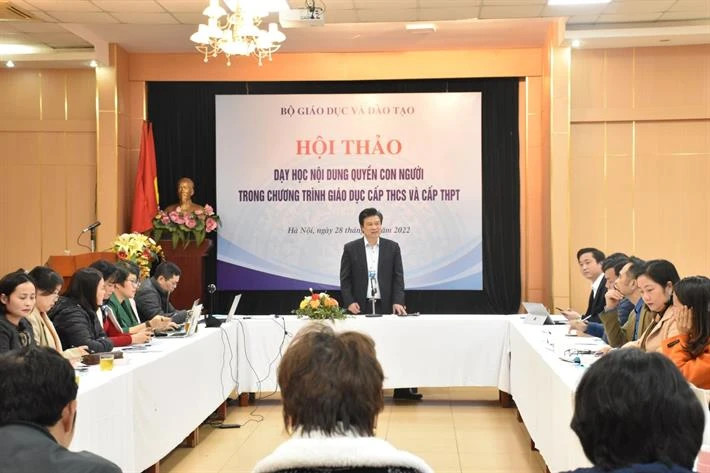 |
| A workshop on teaching human rights content in the secondary and high school education programme. |
In addition, Vietnam has also established a system of specialised research institutions on human rights such as: Institute for Human Rights Studies - VIHR under the Ho Chi Minh National Academy of Politics; the Centre for Human Rights and Citizenship Studies under the Faculty of Law, Vietnam National University, Hanoi; and the Centre for Legal Research on Human Rights and Citizenship under the University of Law, Ho Chi Minh City.
In addition, a number of specialised research institutes under the Vietnam Academy of Social Sciences, such as the Institute for Family and Gender Studies, Institute of State and Law, and Institute for Human Studies, have established a Human Rights Research Department. Among them, there are centres that directly participate in training, teaching and research activities, but there are also centres that were established mainly to serve the process of theoretical and practical research on human rights. The teaching and training content is also focused on harmoniously combining theory and practice to guide learners to general perceptions of human rights.
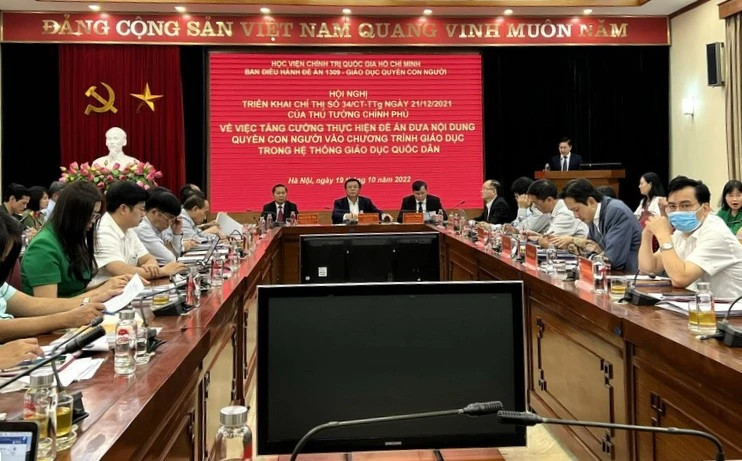 |
| At the national conference to implement Directive No.34/TTg of the prime minister (dated December 21, 2021) on strengthening the implementation of the project on incorporating human rights content into the education program in the national education system. |
Tasks in the coming time
Through the implementation process, up to now, research/training institutions have participated quite proactively and effectively in performing the function of educating, propagating and disseminating the contents of human rights and human rights laws, contributing to raising awareness and responsibility of each individual towards the issue of respecting human rights and fundamental freedoms; helping the implementation of CAT Committee recommendations, especially recommendations directly related to educational activities to raise awareness of human rights, become more favourable, and achieve goals more quickly.
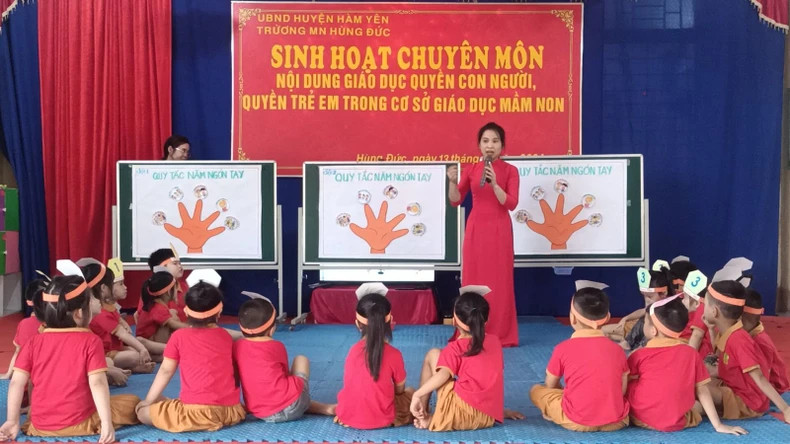 |
| Human rights education in preschools. |
To enhance the effectiveness of human rights education in the coming time, it is necessary to focus on implementing a number of solutions, as follows:
Firstly, it is necessary to effectively combine human rights education with the implementation of Party resolutions, State programs, and projects on socio-economic development, job creation, hunger eradication and poverty reduction, etc.
Second, it is also necessary to further promote human rights teaching programs in the national education system, especially at the undergraduate and postgraduate levels. Human rights education programs need to ensure modernity, stability, and consistency, with continuity between levels of education. Consider introducing human rights subjects with appropriate content into the training programs of universities in Vietnam as a compulsory subject for universities specialising in law, and an elective subject for universities specialising in non-law. In addition, it is necessary to continue to research, gradually develop and compile teaching materials, and have a roadmap to open human rights training courses suitable for each target group.
Third, it is necessary to be creative and skilful in synthesizing different forms and methods of education, propaganda and dissemination of human rights. In addition, it is necessary to focus on specific forms of education through policy-making activities, guidelines, and legislative, executive and judicial activities.
For the activities of disseminating and popularising human rights content, it is necessary to use, exploit, and flexibly apply forms and methods of disseminating and educating human rights to ensure suitability and effectiveness; ensure that the content of the propaganda is suitable for the target audience and goals; combine the dissemination and education of human rights with life skills, legal advice, legal aid, grassroots mediation, dispute resolution, handling of law violations, etc.
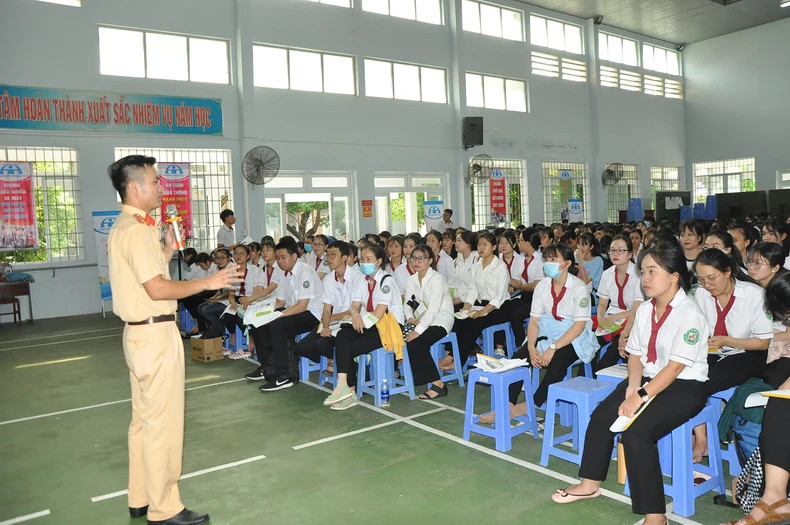 |
| Raising awareness on human rights for students. |
Fourth, more attention should be paid to training and fostering a team of lecturers with specialised knowledge to serve human rights education in the university system. The team of lecturers serving human rights education in universities includes both lecturers specialising in human rights and lecturers in other specialties related to human rights content.
In addition, it is necessary to focus on training a team of professional lecturers and researchers in the field of human rights law, especially training to improve foreign language proficiency, and sending lecturers for training and coaching abroad. This is a premise for including human rights education content in official teaching in the national education system; at the same time, there is a plan to attract good lecturers and scientists at home and abroad in this field to participate in teaching human rights law at universities, especially law-specialised educational institutions.
In addition, there is a need for a training and fostering plan to raise awareness of organisations and forces responsible for human rights education. State management agencies and educators need to properly recognise the importance and necessity of including human rights education in training programs at all levels and grades, in accordance with economic, cultural and social conditions, meeting the requirements of international integration. It is necessary to focus on strengthening training and fostering knowledge about human rights for responsible subjects, firstly managers and educators.
It is necessary to build a set of standard learning materials on human rights for university and postgraduate training systems; invest in facilities, equipment and appropriate financial resources for training institutions to carry out research, teaching and propaganda activities, and disseminate knowledge about human rights.
Education not only brings practical understanding of the content of human rights but also contributes to raising awareness and responsibility of each individual in promoting, implementing and protecting human rights. In addition, in order to combat violations, it is necessary to equip learners with knowledge and understanding of human rights protection mechanisms so that the implementation of human rights in practice is most effective.