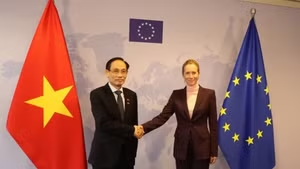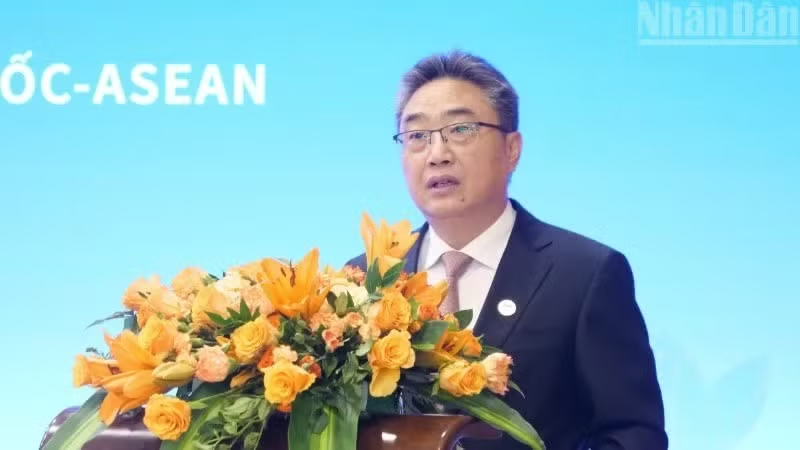
In an interview with a correspondent of Nhan Dan Newspaper in China, Shi Zhongjun stated that China and Viet Nam are neighbouring socialist countries sharing common ideals and a traditional friendship described as “comrades and brothers”. The selection of China as the first foreign destination by Party General Secretary and State President To Lam highlights the importance placed on bilateral ties and underscores the strategic depth of the Viet Nam–China comprehensive strategic cooperative partnership.
This will generate new momentum for both countries’ efforts to accelerate the building of a Viet Nam–China community with a shared future of strategic significance, while also contributing positively to the development of ASEAN–China relations, as well as to peace, stability, development and prosperity in the region and the world.
The visit will create fresh impetus for both sides to advance the building of a strategically significant shared future community, while positively contributing to ASEAN–China relations and to regional and global peace, stability and prosperity.
Secretary-General of the ASEAN–China Centre Shi Zhongjun
Shi Zhongjun noted that Viet Nam and China share common ideals, beliefs and broad strategic interests. Shared ideals and a shared future are the most distinctive features of bilateral relations. The year 2025 marks the 75th anniversary of diplomatic relations and the Year of Viet Nam–China Humanistic Exchanges. At present, relations between the two countries are entering an unprecedented period of historic opportunity.
Under the strategic guidance of the top leaders of the two Parties and countries, political exchanges have become increasingly close. Senior leaders maintain regular and intensive contact, enabling timely and in-depth discussions on overarching, strategic and directional issues concerning bilateral relations, agreeing to elevate comprehensive strategic cooperation to a new and deeper level, in line with the overarching goal of the “six more”, thereby accelerating the building of a Viet Nam–China community with a shared future of strategic significance and jointly advancing the socialist cause amid profound global changes.
Recently, following the annual sessions of China’s National People’s Congress and the Chinese People’s Political Consultative Conference, as well as the successful conclusion of the 14th National Congress of the Communist Party of Viet Nam, the two sides held the first ministerial-level meeting of the “3+3” strategic dialogue mechanism on diplomacy, defence and security. This fully reflects the stature and strategic nature of relations between the two Parties and countries, sending a clear message to the world that both nations are working together to safeguard their political systems and promote national development and rejuvenation, bringing valuable stability and positive energy to an increasingly volatile world.
He added that practical cooperation between the two countries is expanding in breadth and height, highlighting its role in supporting each side’s modernisation efforts. Both sides remain committed to mutually beneficial, win-win cooperation and to deepening development connectivity. Bilateral trade cooperation continues to improve in quality and scale, while high-quality Belt and Road cooperation and the development of Viet Nam–China railway links contribute to expanding the new western land–sea corridor, providing stronger momentum for ASEAN–China cooperation. At the same time, encouraging results in clean energy, the digital economy and green development are continuously strengthening the material foundation of the shared future community.
People-to-people exchanges between the two countries are also increasingly close, with activities such as the People’s Forum, youth friendship meetings and border festivals being held dynamically and successfully. The surge in interest in learning Chinese in Viet Nam and the boom in tourism in China are helping to consolidate public support for the shared future community.
Both countries are currently at a crucial stage in building socialism, building on past achievements and looking towards the future. At a new historical starting point, both sides should move forward together along the path charted by the top leaders of the two Parties and countries, making new contributions to the global socialist cause and human progress.
Secretary-General of the ASEAN–China Centre Shi Zhongjun
Shi Zhongjun stressed that both countries are at a critical juncture in their socialist development, building on achievements and looking ahead. At this new historical starting point, both sides should advance together along the direction set by their top leaders, contributing further to the socialist cause globally and to human progress.
Both sides should further strengthen strategic mutual trust, maintain close high-level exchanges, enhance exchanges of governance experience, continuously improve governing capacity, and jointly explore pathways for Party governance and national rejuvenation. They should expand practical cooperation, deepen collaboration in trade and investment, infrastructure, cross-border economic zones, smart border gates and other areas, and promote cooperation in emerging fields such as technological innovation, the digital economy and artificial intelligence.
They should also strengthen people-to-people exchanges, successfully organise programmes such as the “Red Study Tour” for Vietnamese youth in China, and enhance cooperation in cultural tourism, education and training, and healthcare, bringing these experiences closer to the peoples of both countries.
From the perspective of the ASEAN–China Centre, Shi suggested that Viet Nam and China could make full use of various multilateral cooperation mechanisms within the ASEAN–China framework, effectively coordinate with regional development programmes such as the Master Plan on ASEAN Connectivity, implement the Regional Comprehensive Economic Partnership (RCEP) to a high standard, accelerate the development of the ASEAN–China Free Trade Area Version 3.0.
They should deepen cooperation in key areas such as the digital economy, green economy, connectivity and the stability of industrial and supply chains, strengthen coordination on regional issues, firmly uphold ASEAN centrality, and promote synergy and shared development between Viet Nam–China and ASEAN–China cooperation, contributing to the building of a more closely connected ASEAN community with a shared future.