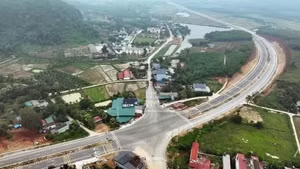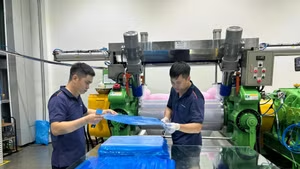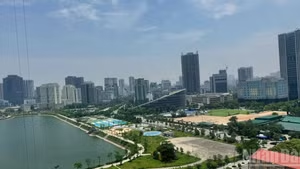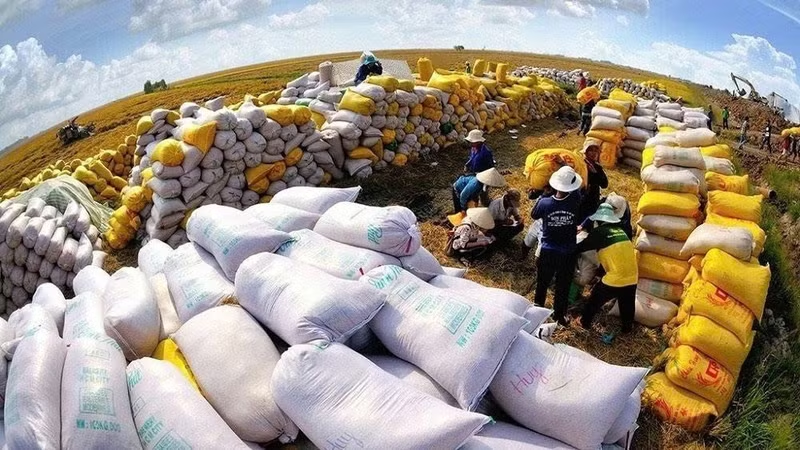
From the excitement of the Viet Nam-Singapore Industrial Parks (VSIPs) network to areas such as digital transformation, green energy, semiconductor industry, and smart logistics, Viet Nam-Singapore relations are witnessing new cooperation potentials.
Many favourable conditions to strengthen cooperation
Singapore is a country with a lot of experience and strengths in developing science, technology, and innovation, especially its long-term investment strategy for research and development (R&D); an open innovation ecosystem connecting institutes, universities, and businesses; and a transparent legal environment that promotes technology commercialisation. This is also a leading country in developing smart cities, digital infrastructure, green technology, and attracting international talent; and is a standard model of national governance in the digital age, with its core strength lying in the ecosystem creation mechanism.
Viet Nam's strength in this field lies in its golden population structure with young human resources with sharp mathematical and technological thinking (STEM) — an essential foundation for innovation. In addition, a stable geopolitical position and the world's leading rare earth reserves help Viet Nam become a reliable destination in the supply chain diversification strategy of technology powers.
Viet Nam and Singapore have many favourable conditions to strengthen cooperation, especially in the fields of science, technology, and innovation. Singapore is one of the Asian countries with early experience in developing strategic technology industries. This country has been implementing a semiconductor industry development strategy since the 1970s and has recently continued to build a new generation semiconductor strategy to adapt to the strong development of artificial intelligence (AI) and advanced technologies.
According to Dr Ha Son Tung, Deputy Head of the Department of Advanced Optical Technology at the Singapore Agency for Science, Technology and Research (A*STAR), Singapore has many practical lessons worth referencing for Viet Nam, especially in technology governance, building a research ecosystem, and training high-quality human resources. With the advantage of a close geographical position, many cultural similarities and the increasingly close connection between the two economies, Viet Nam and Singapore will be able to fully promote research cooperation programmes on a deeper and broader scale in the near future.
In addition to inheriting the successes of the VSIP model, the two countries can expand cooperation into high-tech fields through direct research projects between science and technology agencies of the two sides. In particular, training high-quality human resources for the AI and semiconductor industries is considered a particularly important priority.
Enhance the competitiveness and adaptability of the two countries
Viet Nam is currently facing many great opportunities to make breakthroughs in the field of science and technology if it effectively takes advantage of brain resources from the overseas Vietnamese community.
A notable advantage of Viet Nam today is the growing community of overseas Vietnamese intellectuals working in Singapore. As the region's leading technology and innovation centre, Singapore is gathering a large number of Vietnamese experts working in key fields such as AI, big data, semiconductors, biotechnology, and public policy administration. Many Vietnamese experts currently hold important positions at Singapore's leading multinational technology corporations, universities, and research institutes. Experts say that overseas Vietnamese intellectuals can act as a strategic bridge, contributing to promoting cooperative programmes in research, technology transfer, and resource connection between the two countries.
In the context of increasingly fierce global technology competition, strengthening cooperation between Viet Nam and Singapore in the fields of AI, semiconductors, and innovation not only makes economic sense but also contributes to improving the competitiveness and adaptability of both countries in the face of technological fluctuations in the future.
Assoc. Prof. Dr. Luu Anh Tuan, from the Department of Computer Science and Data of Nanyang Technological University (NTU), assessed that there is currently great potential for cooperation between Viet Nam and Singapore in AI, digital transformation, and technical management. Singapore has accumulated a lot of practical experience in building a digital transformation and AI application ecosystem at the national level, while Viet Nam has the advantage of young, dynamic human resources and the ability to quickly access new technology.
Luu Anh Tuan commented that if the two sides increase sharing of experiences and jointly develop practical AI products, this will be an important driving force in promoting technology, not only for the two countries but also for the entire region.
With increasingly strong bilateral relations and the shared determination of both sides to promote innovation, Viet Nam-Singapore cooperation in AI and high technology is expected to become one of the prominent pillars of relations between the two countries in the coming period.