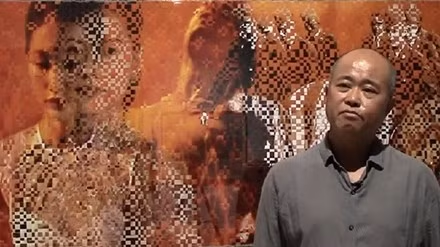
Born in the town of Ha Tien in the southern province of Kien Giang, Dinh left Vietnam for the US when he was 10. Now holding US nationality, he still spends most of his time on activities that connect and support creativity in Vietnam.
He is the co-founder of San (Platform) Art in Ho Chi Minh City - an art space which is highly appreciated by individuals and arts organisations as a bridge linking them with contemporary Vietnamese artists.
In his interview below with Nhan Dan Weekly reporter Dao Mai Trang, from the viewpoint of an artist and the co-founder of San Art, Dinh talks about advantages and difficulties facing Vietnamese artists in integrating into the world art scene.
Question: It has been 20 years since you returned to Vietnam and prepared for the establishment of San Art while working as an internationally recognised artist. In your observations, has contemporary Vietnamese art established itself on the map of the world’s arts or is it still a faraway land waiting to be discovered?
Artist Le Quang Dinh: During the 1995-2005 period, only a few contemporary artists living in Vietnam caught the attention of the world’s arts. It was maybe the consequence of the fact that there were not many contemporary arts events in Vietnam, and the artists did not work hard enough to be heard.
However, over the past five years, I have seen positive changes. Vietnam’s contemporary arts today, despite the small scale, have robustly developed and drawn much attention from the world. A few months ago, a meeting was held in Ho Chi Minh City between the Tate Museum in London, UK - one of the biggest museums in the world - and Vietnamese artists.
The outcomes, in my opinion, are contributed to significantly by small, independent and non-profit arts spaces which have been active in working out programmes and operational guidelines aiming to catch the world’s attention.
Instead of paying attention to the fine arts of a country, museums, galleries and curators of the world’s major art events have taken greater notice to the artists themselves. In your opinion, who are the Vietnamese artists that have caught the most attention?
From my point of view, artists that have caught a lot of attention include The Propeller Group trio (all three members working on the management board of San Art). Tiffany Chung from Ho Chi Minh City, Nguyen Thai Tuan from Da Lat, and Nguyen Trinh Thi from Hanoi, have also drawn much interest from many international curators. There is also a group of young talented artists including Nguyen Huy An, Phuong Linh, uu Dam, Nguyen Thi Thanh Mai, Nguyen Van Du and members of the Art Labor Collective group.
What do you think about Vietnamese artists’ activeness, particularly young artists, in expanding their operations and artistic influence beyond their home country?
Over the past two decades, arts universities and colleges in the US have included classes on professionalism in their curriculums for students. After graduation, arts students know how to introduce themselves and their artworks to galleries and curators. These classes are valuable for young artists.
Unfortunately, arts universities in Vietnam have not yet opened such training courses. There are a few exceptions, but generally, Vietnamese artists do not know what they need to do.
Is it difficult for San Art to have Vietnamese artists participate in international arts events?
Yes, it is. There are not many Vietnamese artists who are ready to present at an international events under our criteria. It is partly because of shortcomings in the education of the arts in Vietnam, which has not seen significant change in comparison with the curricular of the French at the Indochina College of Fine Arts in the past. Vietnamese arts students focus their study on techniques of drawing, painting and sculpture.
But in fact, as you may know, artists need to know how to research the theme they are following as well as how to conceptualise their ideas.
At San Art, we try to show the artists that shortcoming. We hold programmes helping artists how to talk about themselves and their artworks. We also introduce them to our working contact network which includes many international artists, curators, art historians, residence programmes, and arts spaces outside Vietnam. A number of the artists have grasped the chance to stay and host exhibitions abroad.
However, I also noticed that the Hue University of Fine Arts has recently hosted a number of exchanges with arts universities in the region. A number of its graduates returned to the university to work as lecturers after getting a master from overseas universities. The lecturers proposed a progressive curricular for students while establishing them as promising artists at the same time.
In its operations, San Art also helps introduce and sell artworks of Vietnamese contemporary artists. Why do you consider the trading of artwork important to San Art’s operation?
At San Art, we hold that the trading of the artworks is important to improve the artists’ income. However, we have to limit the number of staff members and not many of us specialise in trading and retaining contact with collectors.
In addition, there are not many domestic collectors showing interest in contemporary art works as most of the purchasers are foreigners. We need time and greater efforts to establish a community of local collectors.
How can cultural management agencies create effective art spaces like San Art?
I think the first thing they can do is change their perspective on independent art spaces, increase their trust and remove their hesitancy about us. We just want to provide support for artists and help create a vital art environment. Secondly, it is necessary to amend out-dated regulations on granting licenses for the organisation of art events, which is costing us a lot of time.
Thank you so much for speaking with us!