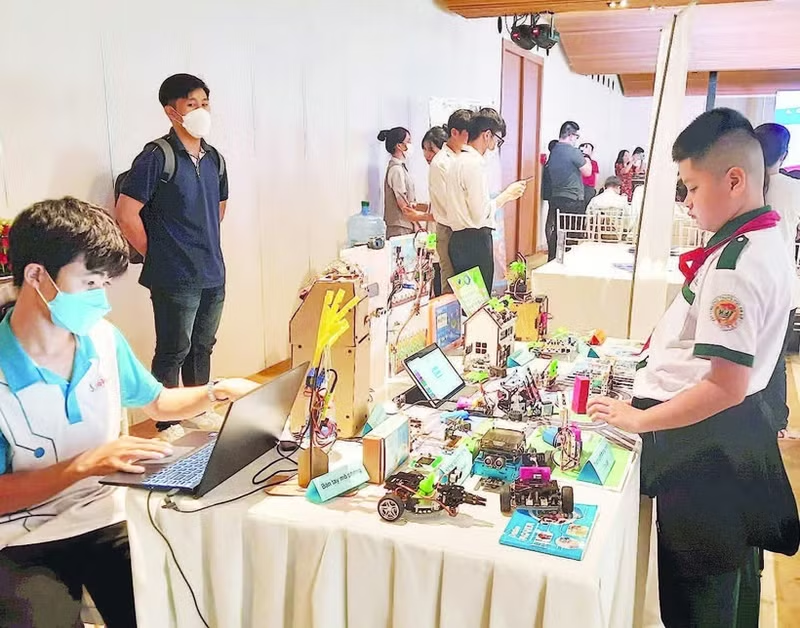
Ho Chi Minh City has been working to turn this strategy into reality, with the goal that by 2030 every citizen will have equal opportunities to learn within an open, diverse and modern education system.
Building a learning society
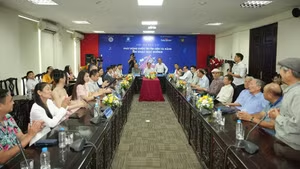
During 2021–2025, through a range of proactive measures and efforts to overcome difficulties, the Ho Chi Minh City Association for Promoting Education led the country in results for the “Learning Citizen” model, reaching more than 2.1 million people as of early 2025. This has had a positive impact on the city’s development of other learning models.
Vice Chairwoman of the Ho Chi Minh City Association for Promoting Education Nguyen Thi Dieu Anh said the association and its branches at all levels have continued striving to promote and improve the quality of the movement “The whole country competes to build a learning society and promote lifelong learning” among all social groups by effectively implementing and scaling up the models of “Learning Family”, “Learning Clan”, “Learning Community”, “Learning Unit” and “Learning Citizen”. These efforts meet the requirements of the national digital transformation programme and contribute to building a learning society and UNESCO’s Global Learning City in Ho Chi Minh City.
During 2021–2025, through a range of proactive measures and efforts to overcome difficulties, the Ho Chi Minh City Association for Promoting Education led the country in results for the “Learning Citizen” model, reaching more than 2.1 million people as of early 2025.
However, Nguyen Thi Dieu Anh noted that alongside the achievements, these learning models have not been implemented evenly across localities and units. Financial and human resources remain limited; investment in lifelong learning programmes has not been given sufficient priority; and there is a shortage of dedicated staff for community education and lifelong learning. A segment of the population — especially unskilled workers — has yet to clearly see the benefits of lifelong learning. While the association is a core force and grassroots education-promotion staff are unstable, and in many places, they are assigned additional duties.
Some localities still face funding difficulties. Most commune-level associations lack computers and the equipment needed to carry out their work, particularly to implement and assess the “Learning Citizen” model via software. For lifelong learning efforts to be effective, localities need solutions to implement learning models that fit practical conditions.
At the same time, conditions should be created for people to participate by improving the effectiveness of community education, culture and sports institutions; encouraging lifelong learning through communications and by recognising exemplary role models at the grassroots level.
In addition, information technology should be applied more strongly in education to enable online and distance learning. In the immediate term, it is necessary to participate actively in and successfully implement the “Digital Literacy for All” movement, especially in rural, remote and disadvantaged areas across Ho Chi Minh City.
A global learning city
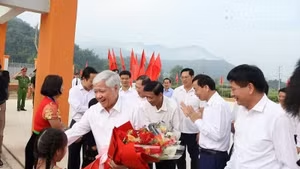
To date, in Ho Chi Minh City the lifelong learning movement has developed strongly within families, clans, communities and organisations, contributing to political stability, higher labour productivity, sustainable poverty reduction, and ever stronger community bonds.
As of May 2025, the level-2 literacy rate among people aged 15–60 reached 99.71%; 100% of educational institutions met the standard for universal pre-school education for five-year-olds; and the city achieved level-3 standards for universal primary education and universal secondary education, as well as level-2 standards for eradicating illiteracy.
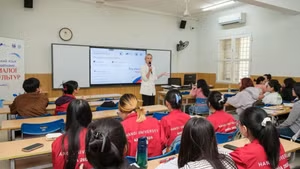
The city has introduced many learning models aligned with digital transformation requirements, such as the “Ho Chi Minh City Digital Citizen” programme, which helps residents access and become familiar with digital applications, online public services and electronic transactions.
Many wards and communes have piloted “Community Learning Spaces”, “Digital Libraries” and “Connected Classrooms”, initially achieving positive results and laying the groundwork for wider expansion of learning environments in the time ahead. Notably, in February 2024 UNESCO recognised Ho Chi Minh City as a member of the Global Learning Cities Network, contributing to enhancing the city’s image as well as that of the country on the international stage.
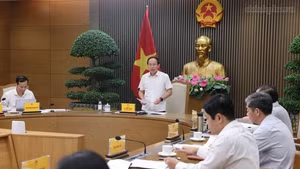
According to Vice Chairwoman of the Ho Chi Minh City People’s Committee Tran Thi Dieu Thuy, UNESCO’s recognition as a member of the Global Learning Cities Network is an honour. However, there remain limitations that need to be addressed, particularly disparities in organisational capacity across localities, insufficiently tight inter-sectoral coordination mechanisms, and a lack of synchronisation in infrastructure supporting digital transformation for community learning.
Accordingly, the task of building a learning society requires a decisive shift – from awareness to action, from a campaign to sustainability, from fragmented implementation to unified coordination – while ensuring that content is closely aligned with people’s real learning needs and Ho Chi Minh City’s new development trajectory.
To achieve the targets for building a learning society in the 2026–2030 period, Tran Thi Dieu Thuy called agencies, units and localities to pay attention to training and improving the capacity of officials responsible for building a learning society, especially at the grassroots level, in line with the requirements of the new management model.
She also urged stronger decentralisation and delegation of authority to grassroots units in organising community learning activities; innovation in communications; the application of digital platforms; and close coordination with the Viet Nam Fatherland Front and mass organisations to build consensus and spread the spirit of lifelong learning.